
The UK broadcasting rules are strict. When presenters on a telly show inadvertently mention a prominent commercial product on air, it is considered to be free advertising. The culprit is required to qualify the gaff with the prompt disclaimer ‘other brands are available, of course’. Usually, with a hint of a smirk curling around the corners of the mouth.
Watch Rugby's Greatest Rivalry LIVE
Two rugby giants collide. Stream live, replays and highlights free on RugbyPass TV.
Rugby Australia could do with introducing a similar practice now. When Joseph-Aukuso Sua’ali’i was trumpeted as RA’s next big thing by ex-chairman Hamish McLennan at the end of 2023, the free advertising fanfare was as loud as the ‘musack’ filling the empty spaces in a South African rugby stadium:
“Before he pulls on a jumper he has generated over AUD $50 million worth of publicity for rugby. The first time he plays for the Waratahs in front of a full house, he pays for himself. It’s a no-brainer.
“That guy will fill stadiums. He will be a breath of fresh air for rugby union. The fact that he wants to switch from league to union is amazing, and he’s an incredible talent.
“What you’ve seen at the [2023] World Cup is we don’t have the depth that we used to, so you need ‘A’ grade players like that who can come in and make a difference.”
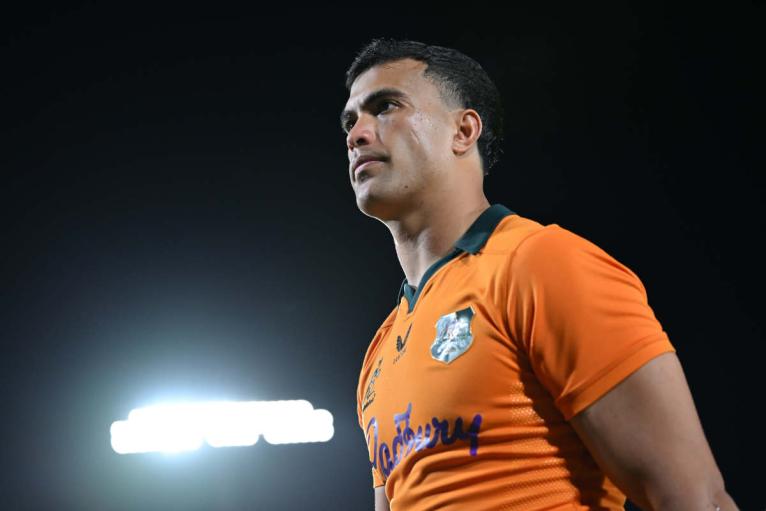
James Graham, a top-flight English leaguer playing in Aussie at the time, added to the marketing overkill when he claimed: “He is going to be the poster boy, the pin-up boy, the billboard boy, he’s going to be driving every commercial. The attitude of the players that are currently there, maybe [they] accept [that] ‘yes, we’ve not been good enough and we need a superstar’.”
Maybe, just maybe, we can dial the volume down, forget the free advertising and judge a man by his deeds, rather than by the noise around him. After events in Townsville on Saturday, nobody can be in any doubt that brands other than the ex-Sydney Rooster are available at centre.
The performance of Queenslander Isaac Henry in the number 13 jersey once graced by the likes of Jason Little, Stirling Mortlock and Dan Herbert was the most promising since Sua’ali’i’s own debut against England in November 2024 at Twickenham. Eighty sunlit minutes at the Queensland Country Bank stadium showed that the legacy is still alive, that Henry can be a new centre of attention, and that Sua’ali’i may be safely moved to the back three, where his unique skill-set truly belongs.
You don’t need superstars who can parachute in from another sport and show rugby players how to do it, you need people who can play the position for which they have been chosen without learning the sport on the hoof.
Two games under Les Kiss have laid bare what Joe Schmidt should have known all along. You don’t need superstars who can parachute in from another sport and show rugby players how to do it, you need people who can play the position for which they have been chosen without learning the sport on the hoof.
In Townsville there were powerful, heavy men who could scrum and carry in the front row, and a dominant enforcer behind them. Australia fielded the pairing at hooker they should have had all along in the shape of ex-Junior Wallabies prop Josh Nasser and Top 14 comeback king Brandon Paenga-Amosa; they backed up their best scrummager on the tight-head [Taniela Tupou] with the young man who will eventually succeed him in the same role [Massimo De Lutiis] on the bench, and De Luttis, Wallaby number 1,000, duly honoured the jersey with a try in the 57th minute. Above all else, they finally picked Lukhan Salakaia-Loto to start in the second row behind both, a spot he should have occupied ever since the Lions tour this time last year.
In the back row the possibility of twin number sevens, Carlo Tizzano and Fraser McReight, playing together in the same back row was aired for the final 12 minutes of the match, with Harry Wilson shifting into the second row. ‘McZano’ chimed Kiss hopefully after the game. It sounded like something really special and exotic from the menu of a famous fast-food chain, which for legal reasons cannot be named. Other brands are of course available.
All eight Wallaby tries were scored by forwards and six of them came from the front row. As Tupou observed succinctly after proceedings had finished, there was “less running without the ball, more running with the ball and I think that it’s working really well for us.” The Wallaby tight forwards carried on 53 occasions and they were especially potent close to the opposition goal-line.
It was eighth versus 10th in the World Rugby rankings and at times it showed, but at least Kiss’ Wallabies now have a tight forward foundation upon which they can look to build success. The mini-series versus seventh-ranked Argentina will be another big step up in quality, but the two Tests – at La Tacita de Plata [the stadium nicknamed ‘Little Silver Cup’] in San Salvador de Jujuy on 29 August, and the Estadio Malvinas Argentinas in Mendoza on the following weekend – provide the right test at the right time.
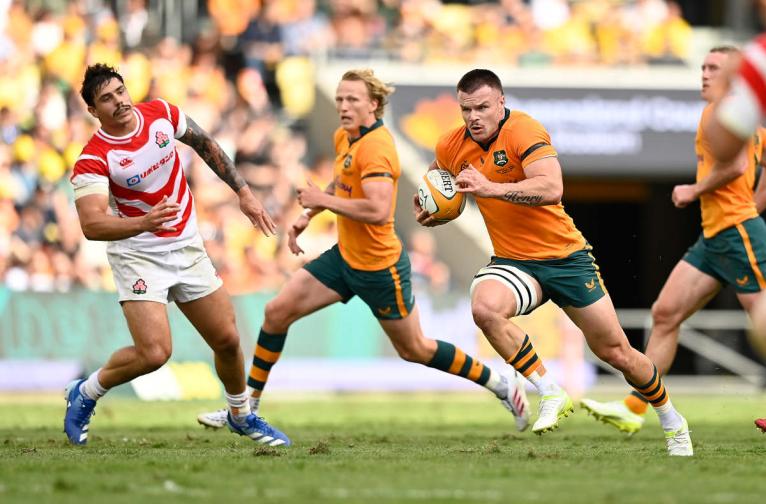
The real centre of attention after the game in North Queensland was Isaac Henry. At Brisbane Boys College Henry once played through a fractured rib, and his professional lifetime of Wallaby No.999 has likewise been beset by injury. A broken foot, a hamstring tear and two separate knee ligament and tendon ruptures have punctuated a six-year career featuring only 20 Super Rugby appearances, two Test matches for the Wallabies and one game for Australia ‘A’ in the Pacific Nations Cup.
Henry’s six games for the Reds this season are the most he has managed in any single year since his debut in 2021. Fully fit and firing, he is exactly the sort Kiss needs alongside one or other of his two tough hombres – Len Ikitau (probably) or Henry’s fellow Reds centre Hunter Paisami (possibly). He can kick, he can kick for goal, he can pass smoothly off both hands and he picks great lines on the carry.
The stream of injuries must have been positively Sisyphean in their repetitiveness, but they have only fortified Henry’s s desire to succeed at the highest level, as he told Rugby Pass:
“My grandfathers and my Dad, I’ve never been raised to complain, particularly when it comes to the physical side of things. I feel like I’ve probably been blessed in how I was raised and also some genetics as well.
“I don’t think it was an external factor to be honest. My whole life I wanted to play rugby the best I could, and I was so close so many times to putting my best foot forward. If I hung them up in those situations on injury terms rather than on my own terms, I would’ve never been able to live with myself.”
In Townsville, Henry completed all eight of his tackle attempts on defence, while topping all carriers in the inside backs with 11 runs for 102 total metres, with two clean breaks and six other tackle busts to boot. He dove-tailed perfectly with his club-mates Carter Gordon at No.10 and Paisami at 12 and he has opened the door to the positional switch most informed judges of Australian rugby want to see made as soon as possible. Henry’s performance nudged Kiss further down the track he probably wants to travel anyway, when he shifted Sua’ali’i to wing during the first Test against the Brave Blossoms in Osaka.
— William Bishop (@RPvids1994) August 16, 2026
— William Bishop (@RPvids1994) August 16, 2026
— William Bishop (@RPvids1994) August 16, 2026
In the first clip, the Wallabies are working the classic Scotland attacking set-up from a lineout perfectly, with Gordon doing his best Finn Russell impersonation and ghosting in behind his two centres Paisami [Sione Tuipulotu] and Henry [Huw Jones]. Like Tuipulotu, Hunter uses Carter as a decoy to widen the defence before springing his club-mate Henry through the short hole. In the second clip, Henry picks up Max Jorgenson on a support line instinctively, with the kind of easy facility JAS was trying to learn from scratch. At the end of the play, it is he swinging the ball away off his left hand with the final break assist to the same player.
Another bust by Henry primed the powder for the first of two power-carrying sequences by the Wallaby tight five forwards in the Japanese red zone:
— William Bishop (@RPvids1994) August 16, 2026
— William Bishop (@RPvids1994) August 16, 2026
The pattern of ball-carriers is broadly the same in both sequences: No.8 Harry Wilson, then No.5 Salakaia-Loto, then No.1 Angus Bell take play all the way up to the goal-line in the first example; and No.5 to No.1 to No.8 in the second, with No.3 ‘Nella’ Tupou employed as the battering ram to break down the last bits of the Brave Blossom defence in both sequences. That is what you call an organized red zone offence.
Within two matches of the Les Kiss era, Australian rugby has discovered that it is not tied to its own advertising, nor does the new head coach need to follow the same selection process as his predecessor Joe Schmidt. The tight five forwards featured some genuinely big, powerful men, four of whom tip the scales at more than 130 kilos.
The front five scrummed and carried with a will they lacked previously, and a change-up was trialled behind them with the shift to ‘McZano’ in the twilight minutes of the match. Above all else, Australian rugby discovered it is quite possible to select a better alternative to Sua’ali’i in the No.13 jersey. Henry’s performance showed that other brands are not only available, they offer better bang for your buck.
 Register your interest to receive priority updates on RWC27 ticket releases. Don't miss out, stay in the loop!


I didn't see that game so I'm pleased Henry looked the part by the report. Something like clarity in his running lines that I spotted a few years ago.
If only it was true that the BBC banned free advertising!