
The Springboks have come through the white-hot intensity of four Rugby’s Greatest Rivalry Tests with a 3-1 series victory as well as some important answers regarding their personnel.
NEW: Follow Your favourites in the App 📱
You can now follow their favourite teams, tournaments and players in the RugbyPass App!
Younger players such as Sacha Feinberg-Mngomezulu, Morné van den Berg, Ethan Hooker and Cameron Hanekom passed the ultimate test against a resurgent All Blacks outfit, and as a result, all four should be in the mix when the squad departs for the World Cup in Australia next year.
Meanwhile, a clutch of veterans responded to the challenge of four consecutive Tests against a New Zealand side obsessed with tempo, and emerged with their reputations well and truly enhanced.
Rassie Erasmus’ charges have added this trophy to their lengthy list of accolades – which includes back-to-back World Cups, a British and Irish Lions series and three Rugby Championship titles. And yet, it’s no secret the global tournament in 2027 and the possibility of a third consecutive title remains their priority.
While many of the older players who featured at the past two World Cups are unlikely to make the cut, Siya Kolisi, Eben Etzebeth, Pieter-Steph du Toit, Damian de Allende and several others clearly have what it takes to contribute to what could be a record-breaking campaign.
A question of balance
While there are many examples of players in their mid-to-late 30s performing at a World Cup and even lifting the trophy – Richie McCaw, Schalk Brits and Duane Vermeulen, to name a few – a squad stacked with 35-year-olds isn’t going to survive the pace and intensity of a seven-week tournament. On the other hand, a group short on experience will struggle to win the big clashes and finish as also-rans – as a largely green Australia side did in 2023.
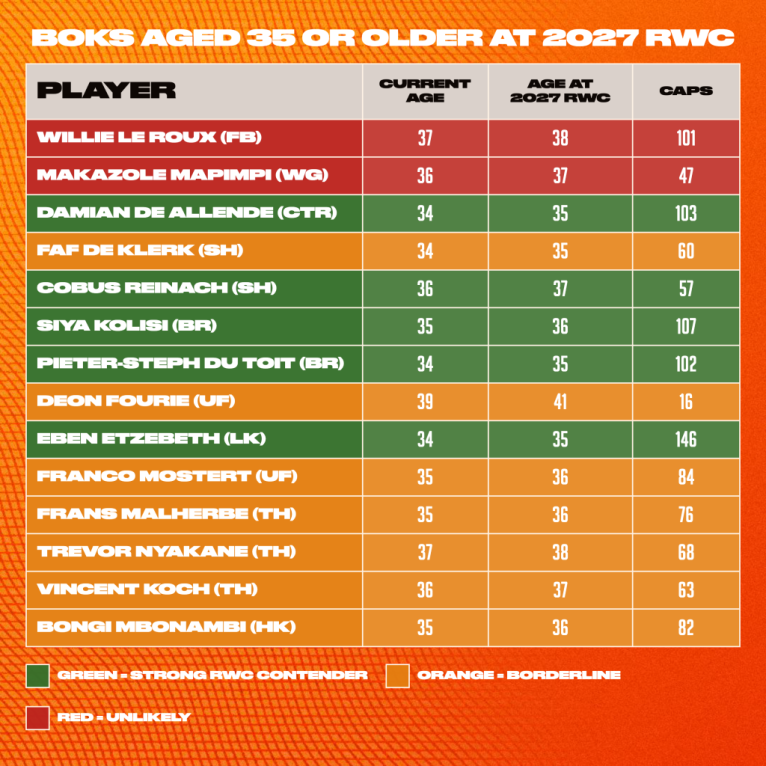
In 2024, Erasmus recognised the need to address the balance between youth and experience before it became an issue – although at the time, some projections highlighted the extent of the Bok coach’s challenge. As many as 27 of the 35 players who featured at the 2023 World Cup will be 32 or older in 2027, and within that group, a whopping 15 – effectively half the squad – will be older than 35.
Older players on the back burner
Fast forward to the present, and the age profile of the South African squad has changed.
Erasmus has pushed forward with his plans to blood youngsters, and as a result, there should be a fair representation of stars aged 30 or younger at the next World Cup.
The pool of older players has shrunk. Some have moved on. Vermeulen retired after the 2023 World Cup, while another decorated player in Steven Kitshoff hung up his boots in 2025 after sustaining a serious neck injury. Frans Malherbe (back and neck) and Trevor Nyakane (Achilles) have been sidelined for lengthy periods due to chronic ailments, although Erasmus has suggested Malherbe may yet feature for the Boks, and the big man is expected to return for the Stormers in early 2027.
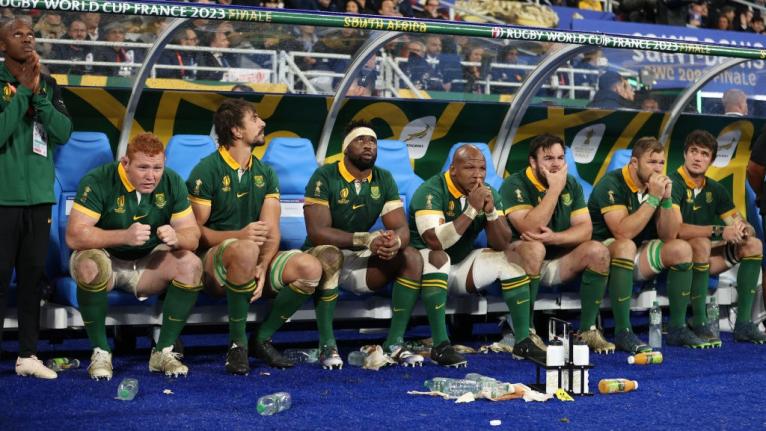
Erasmus continues to invite senior players to national alignment camps, even if they are not necessarily part of his immediate plans. The goal is to keep these players informed about the overall strategy and to ensure they are ready to join the group at short notice.
That said, if all of Erasmus’ frontline players are fit and available in the lead-up to the World Cup, it’s unlikely Willie le Roux, Makazole Mapimpi, Vincent Koch and Bongi Mbonambi will travel to Australia. These players are yet to play a Test in 2026, and were used sparingly in 2025. Utility forward Franco Mostert continues to train and travel with the squad, but is has not featured this season. Scrum-half Faf de Klerk is another ageing player who is performing at club level but currently surplus to Test requirements.
Age is just a number
Erasmus will continue to wrestle with big questions over the next 12 months.
How many veterans should he include in his World Cup squad, and at what point does that number compromise the Boks’ quest to play an all-court game that harnesses their set-piece and attacking strengths?
The Greatest Rivalry series would have been instructive, as many of the old hands proved they can go the distance in the most demanding of situations.
There was a noticeable improvement in the team’s discipline and accuracy after Siya Kolisi returned from a hamstring injury ahead of the second Test in Cape Town. Kolisi broke John Smit’s record of 55 Test wins as skipper a week later in Johannesburg, and played a key role in the series decider in Baltimore.
While Kolisi is widely recognised as one of the game’s greatest leaders, his on-field contributions are often overlooked. The Boks addressed their issues at the attacking breakdown after Kolisi’s return, and while he only played 43 minutes in Baltimore, he finished the game as one of the leading defenders with a tackle count of 10.
Like Kolisi, Du Toit, Etzebeth and De Allende have featured across most of big Tests and tournaments in this golden era for South African rugby. All three will be older than 35 in Australia, but going by their titanic contributions against the All Blacks, they will remain crucial to the cause.
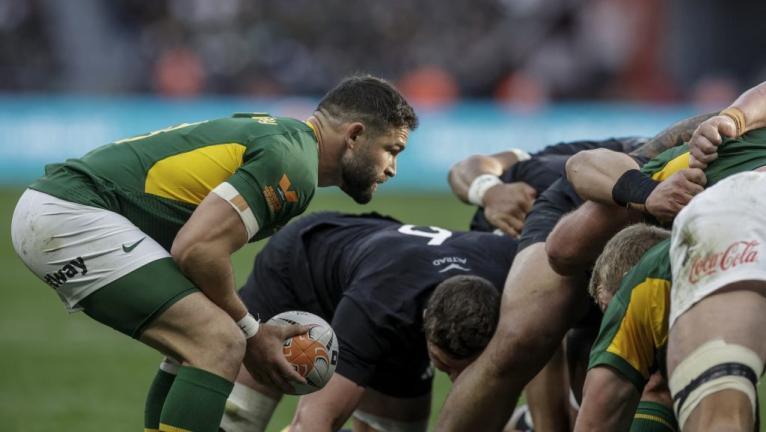
The Bok coaches relied on De Klerk to steer South Africa home in the past two World Cup finals, and took the decision to drop Cobus Reinach from the matchday squad altogether after the 2023 semi-final against England. Few would have predicted the ageing star would take his game to the next level in this World Cup cycle, or that he’d emerge as the first-choice scrum-half in a more attacking approach driven by former All Blacks fly-half Tony Brown.
While a lot of athletes lose some speed after 30, Reinach – who will be 37 next year – has gathered momentum at the back end of his career. The Stormer will be an asset in a match 23 that favours a six-two or seven-one bench split – given his ability to cover wing – while his sharp service from the ruck as well as his acceleration in broken play will amplify South Africa’s attacking approach.
Deon Fourie was a surprise pick for the Greatest Rivalry series, and certainly made an impression at hooker and flank – and as additional captaincy option. Utility players are essential at a World Cup tournament, and if Fourie is still performing next season for the Stormers and Boks, he could make the cut, even at the age of 41.
At the peak of their powers
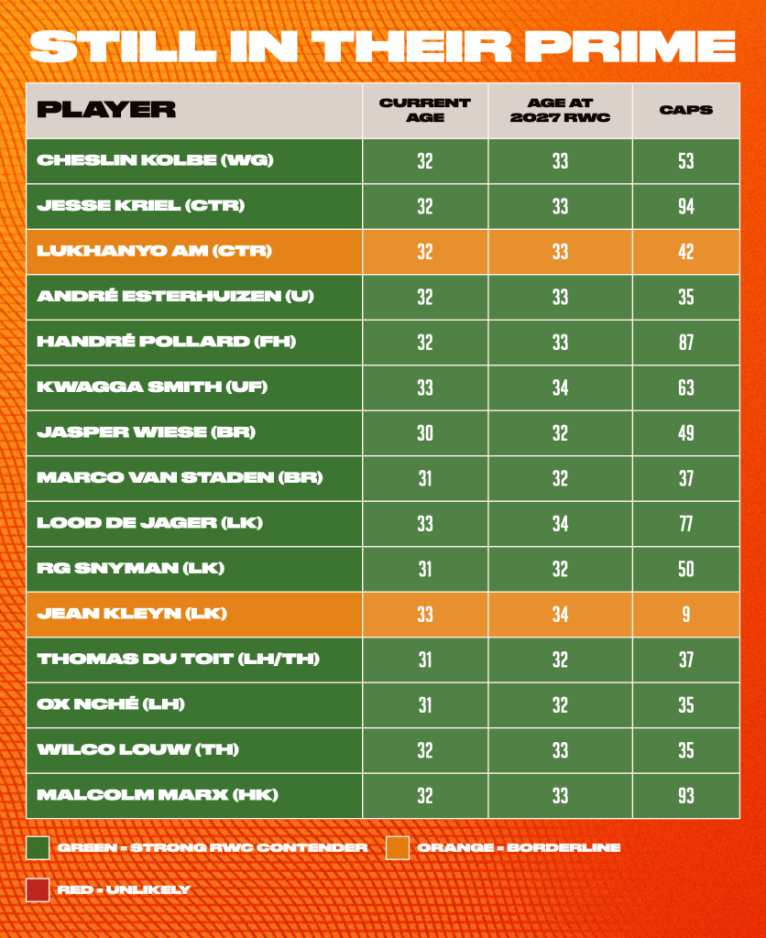
Erasmus will also need to account for another group aged between 32 and 34.
Like Reinach, Cheslin Kolbe doesn’t appear to be slowing down in his advanced rugby age, and his late development as a goalkicker – and the Boks’ most accurate kicker against the All Blacks – could offset the limitations of Manie Libbok and Feinberg-Mngomezulu, who add value in other areas.
De Allende was one of the Boks’ most consistent performers across the four-Test series, and while he deserves credit for his individual contributions, his midfield partnership with Jesse Kriel is one of the bedrocks upon which this prolific era is built.
Kriel – who is exposed to a less demanding club environment in Japan and remains one of the fittest players in the squad – will be 33 next year, and has already signalled his intent to play on to the subsequent World Cup in 2031. It remains to be seen if Lukhanyo Am’s own stint in the Far East will culminate in another World Cup campaign.
Malcolm Marx produced several result-shaping plays against New Zealand, and like Etzebeth, doesn’t appear to have a clear like-for-like alternative in the present squad. If Marx broke down between now and the World Cup, Erasmus may need to recall Mbonambi.
The same could be said of Jasper Wiese, who played some of his best rugby in recent weeks. The Boks are playing a more ambitious attacking game, yet so much hinges on the gainline performances of Wiese and De Allende, who drag two to three players into their orbit and generate momentum and space for the rest of the team to exploit.
The rise of Ox Nché, Wilco Louw and Thomas du Toit has offset the losses of Kitshoff, Malherbe and Nyakane, and the Boks are well placed to attack the World Cup with a group of front-rowers in their prime.
The Bok scrum and lineout made a statement against their biggest rivals, and images of the rampaging maul which culminated in a try at the FNB Stadium will live rent-free in the New Zealanders’ heads before of a possible World Cup quarter-final showdown.
The return of Lood de Jager has improved the Boks’ lineout and maul, and after a long spell on the sideline, the 33-year-old is ready for an extended run that may well culminate in another title. RG Snyman will be back next season to bolster the Boks in these departments, while Kwagga Smith will return to lend his considerable experience to the Bomb Squad.
While Erasmus favoured a six-two bench throughout the series, the use of André Esterhuizen – as hybrid player who can slot in at flank or centre – added a new dimension to their attack. De Allende has avoided serious injury in recent seasons, and has as a result monopolised the number 12 duties. There will come a time, however, when Esterhuizen or Damian Willemse will need to plug that gap, especially over the course of a World Cup. While he remains South Africa’s best full-back, Willemse (29) appears destined to make the shift to the midfield in the long term.
South Africa set the record straight over the past month. The quality of those performances will encourage the Erasmus as he looks ahead to a World Cup where the All Blacks, France, Ireland and even England will be desperate to end the Springboks’ reign.
Many veterans have shown they still have the appetite for the fight, and are prepared to go the distance in what could be the most gruelling battle yet.

Your home for rugby. Download the RugbyPass app on the App Store (iOS) and Google Play (Android) now!
Follow your favourite teams, tournaments and players, and get personalised news and Match Centre notifications direct to your device.
From live rugby streams and upcoming fixtures to breaking news, in-depth analysis and live scores, RugbyPass has everything you need to stay connected to the game.


We’ve seen certain players play on at an age that was very uncommon previously.
If you look after your body well and have a bit of luck you can be competitive at 40, like Brad Thorn and Ma’a Nonu have shown. Given the level of professionalism compared to a couple of decades ago, the average ages of former WC winning teams may not always be relevant.
Various players are unlikely to feature next year at WC - Willie le Roux, Makazole Mapimpi, Vincent Koch, Frans Malherbe, Trevor Nyakane, Faf de Klerk - with others possible - Franco Mostert, Deon Fourie, Bongi Mbonambi - but depending on who comes through and who of the probables is injured.
Others in their 30’s like the ones in green in the bottom table are playing that well that there is no reason not to take them.
What was clear is that the Boks were undercooked in test 1, which may be the biggest learning for the coaching staff.