
A traditional proverb: “better to be lucky than good”. Even at the elite level of sporting performance, where every ‘i’ is dotted and every ‘t’ is crossed, sometimes you need to catch a lucky break for all the preparation to count. Life can be that simple.
NEW: Follow Your favourites in the App 📱
You can now follow their favourite teams, tournaments and players in the RugbyPass App!
As the American crooner Frank Sinatra once observed, “people often remark I’m pretty lucky. Luck is only important insofar as getting the chance to sell yourself at the right moment. After that, you’ve got to have talent and know how to use it.”
Halfway through the greatest rivalry series the Springboks had already proved they possessed a loaded gun: the brute power at set-piece to provide a foundation for success in the final two Tests. They had control of the scrum, the lineout and the maul derived from it, and therefore they had control of the penalty count.

What they needed was an opportunity to fire the bullets, and it duly arrived in the 11th minute after an injury to Cheslin Kolbe. While Kolbe has been one South Africa’s very best for as long as anyone can remember, he was not what Rassie Erasmus needed to manufacture the essential ammunition on this day of days.
The outline of the lesson was already hiding in plain sight, as clots of supporters in black began to fill the vast FNB Stadium four or five hours earlier. The Springbok Women trotted out on to the field against the Black Ferns with exactly the same aim in mind as their male counterparts. They wanted to dominate the scrums and the mauls and win the lion’s share of penalties from them.
They succeeded spectacularly well within the limited terms of their remit, winning eight penalties at either scrum or maul, the overall penalty count by a massive 17-8 and drawing no fewer than four yellow cards from their illustrious opponents in the process. Surely, if your set-piece is stronger and you spend half the game with one extra player on the field, your dominance will pay dividends?
The answer to that question was a resounding ‘no’. The Black Ferns made four times as many line-breaks as their hosts, racking up seven tries and 52 points. When it came to ball-using as opposed ball-winning, there was only one team on the field. In the modern game, you can win without dominating possession.
It was Lady Luck which offered Erasmus the opportunity to fix an error in his original selection for the third Test. The man he most needed on the field was Manie Libbok, and he turned what initially appeared an outrageous slice of bad fortune into the greatest of blessings. The sinuous playmaker juiced enough substance out of the drying husk of Tony Brown’s attacking blueprint to become a decisive influence on the fate of the game.
To understand the extent of Libbok’s contribution over the 70 minutes in which he was on the field, let’s go back to the statistical beginning, and rehearse the plusses and minuses of the Springbok approach over the first two Tests.

In the first half of the series, the Boks had scored fewer tries than New Zealand [four to the All Blacks’ nine], they had converted no tries from launches outside the opposition 22 where the Kiwis had scored four, and they had lost the final quarter of the game by a colossal total of 33 points to three, and five tries to nil.
In a series of such claustrophobic intensity, when you are playing the same opponent on four consecutive weekends, the team which repairs its weaknesses the quickest without diluting any of its strengths, wins. In Soweto, the Springboks drew level on try-count, they converted their first two tries of the series from positions outside the New Zealand 22, and they shaded the final quarter by 10 points to seven. At the same time, they still won the scrum penalty battle five to one and scored from a pushover from five metres, while rolling a lineout drive all the way over from 20m in the 66th minute.
On the other side of the ledger, while the New Zealand lineout functioned a lot better at the Calabash, the scrum and maul defence failed at some critical moments. New Zealand still need to find some props who can sustain their technique over long scrums, against sides which regard the set-piece as an end in itself. As luck would have it, Dave Rennie and his coaching panel still have the time they need to find them, before the World Cup kicks off in just over 12 months.
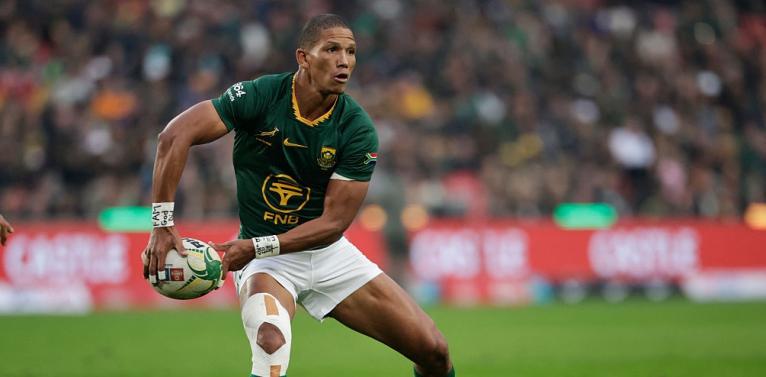
It was Libbok’s appearance off the pine which changed the character of the game to South Africa’s great advantage. Libbok is no novice at this level, having played 34 games for his country since his debut in 2022-23. He epitomises the depth-and-continuity build Erasmus described as follows: “The one advantage we do have, Dave [Rennie] has only coached them eight or nine games?
“Please don’t see this as boasting, but we’ve been together since 2018.
“They don’t have the luxury yet because he’s building a team, and I know what that feels like in 2018 when I got the team 18 months before the World Cup.
“I know these players inside out. They know me.”
Libbok’s ex-club colleague Sacha Feinberg-Mngomezulu shifted out of the firing line to full-back, and at long last he began to cut a less introspective, error-prone figure and relaxed into his work. Springbok backline moves started to function with far more fluency, with Libbok’s outstanding passing from left to right allowing his two centres space to move for the first time in the series.
— William Bishop (@RPvids1994) September 6, 2026
— William Bishop (@RPvids1994) September 6, 2026
The first pass from the Humansdorp magician is a thing of beauty, travelling fully 15m through the thin air in a perfect spiral, inviting Jesse Kriel to take play into the far 15m channel and prove he can be as effective on attack as he is in defence. It is the kind of pass which sets a tone for the game, and it was no accident the try was scored in the same zone where the move started. Just give Kriel and Damian de Allende a one-on-one with some room to move, et voilà.
Another perfect delivery by Libbok off the left hand created more space down the right 12 minutes later.
— William Bishop (@RPvids1994) September 6, 2026
The positive domino effect was felt in the increasing confidence of Feinberg-Mngomezulu’s performance, freed from the demands of operating at first receiver play in, play out.
Instead of tamely kicking back every time the All Blacks gave them the pill as they had in Cape Town and at Ellis Park, the arrival of Libbok woke the Boks up, and had them running for their lives from the backfield.
— William Bishop (@RPvids1994) September 6, 2026
— William Bishop (@RPvids1994) September 6, 2026
The straw which broke the camel’s back arrived in 58th minute, via another left to right move with two long passes from Feinberg-Mngomezulu and Libbok freeing up a Springbok centre to beat Leroy Carter for the second time.
— William Bishop (@RPvids1994) September 6, 2026
It was Libbok’s fortuitous arrival which enabled the South Africa men to do what the women could not, and back up ball-winning with more incisive ball-using. South Africa have proved they remain a nose ahead of New Zealand. No more than that – the All Blacks still lead on points, 83-78, and the try count by 13 to eight over the three Tests. They can still draw the series at a neutral venue in Baltimore.
There is still something real to play for. If they can tie the series at 2-2, Dave Rennie will return home rugby’s equivalent of a ‘made man’; if it finishes with another Springbok victory, Erasmus will be humming along to Ol’ Blue Eyes in the background:
“Yes there were times, I’m sure you knew,
When I bit off more than I could chew,
But through it all, when there was doubt,
I ate it up, and spit it out…
The record shows, I took the blows…
And did it my way.”

Your home for rugby. Download the RugbyPass app on the App Store (iOS) and Google Play (Android) now!
Follow your favourite teams, tournaments and players, and get personalised news and Match Centre notifications direct to your device.
From live rugby streams and upcoming fixtures to breaking news, in-depth analysis and live scores, RugbyPass has everything you need to stay connected to the game.


With Manie we could start playing rugby that is exciting. Think it is fair of world to call us boring sometimes when we have such dangerous and fast backline players and Manie seems like the one who can bring the best out of our backs. We can still keep our power game but just bring some eye catching backline moves. Hope to see Springboks showing a great running game in Baltimore.
Looking back at the Wellington massacre a year ago it was an unfortunate injury to SFM which lead to the early introduction of Manie, who went on to boss the game as the main playmaker. Now I’ve always rated Manie as the better of the two flyhalf options that the Boks have and, Manie once again showed why he is the man - the Tonyball man. I just wish now that Rassie has seen the light and will pick Manie as his no.1 flyhalf from now until after the next RWC.
SFM can be the bench cover for flyhalf, centre and fullback, all positions he has played in which will allow the rebirth of the 6/2 bomb squad allowing a complete tight five waiting on the bench.