
It would seem, based on the nature of the reporting over the last week, that the world’s media have taken Scott Robertson’s exit from his All Blacks head coaching role as confirmation that New Zealand’s rugby empire has collapsed.
New Zealand Rugby’s decision to cut Robertson two years into his four-year contract is being seen as the removal of the last brick in a once impregnable wall.
And it’s easy to understand why and nor is such a view without justification. In the last decade, New Zealand has suffered a decline on the world stage at all levels and all forms of the game.
In the decade between 2005 and 2015, the All Blacks won two World Cups, and the Black Ferns three, and it wasn’t uncommon for even high-profile Kiwi commentators to periodically complain that international rugby was boring because New Zealand were just too good.
The achievements of that period were staggering. New Zealand’s Under-20 team won five world titles, the men’s sevens team collected the world series seven times and the women three.
The All Blacks won 87% of their tests in that decade and they led the way in skill-development, game innovation, culture building…everything.
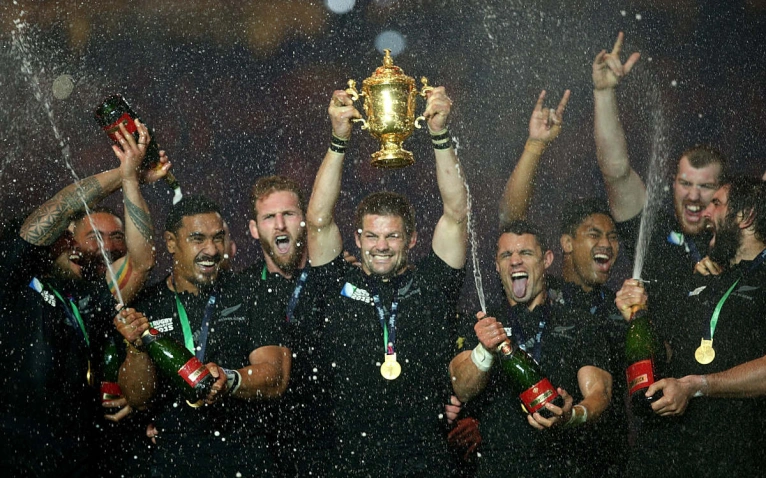
But since winning back-to-back World Cups, New Zealand has been on a slow but undeniable descent – one that has seen them lose the sense of awe their teams used to induce for the way they could pass and catch so perfectly under pressure, strategise their way through problems and innovate their skill-sets when they sensed the rest of the world was catching up.
How much New Zealand has lost its way can be ascertained by the statistics, which show that since 2016 the respective win ratios of both the All Blacks and Black Ferns have dropped by 10 per cent.
The Under-20 team managed just one world title, the men’s sevens have only twice taken the World Series, and while the Black Ferns won the World Cup in 2017 and 2022, their semi-final exit in 2025 was not a shock defeat.
The numbers posted since 2016 illustrate the litany of problems that have beset New Zealand, some of which are beyond the game’s control.
In the last five years, four assistant coaches have either been fired or resigned mid-contract, while Robertson became the first head coach to be ousted in such a manner.
New Zealand has experienced changing migration patterns that have seen larger numbers of people arrive from Asia and India with little-to-no rugby knowledge or interest.
That, and the easier/cheaper access to broadcast content of American sports, has diluted the game’s social licence, and impacted participation rates.
But New Zealand’s rugby demise in the last decade is also due to self-inflicted problems that relate to flawed appointment processes, questionable decision-making and an increasingly pervasive need to top up the coffers.
The impact has been felt across the ecosystem, with the Black Ferns forced to parachute Wayne Smith into the camp eight months before the (Covid-delayed) 2021 World Cup when the previous head coach was left in an untenable position after a review into the team’s culture.
Last year the Under-20 team saw head coach Milton Haig walk out a week before the Junior World Championship started, and then there has been the unprecedented upheaval within the All Blacks.
In the last five years, four assistant coaches have either been let go or resigned mid-contract, while Robertson became the first head coach to be ousted in such a manner.
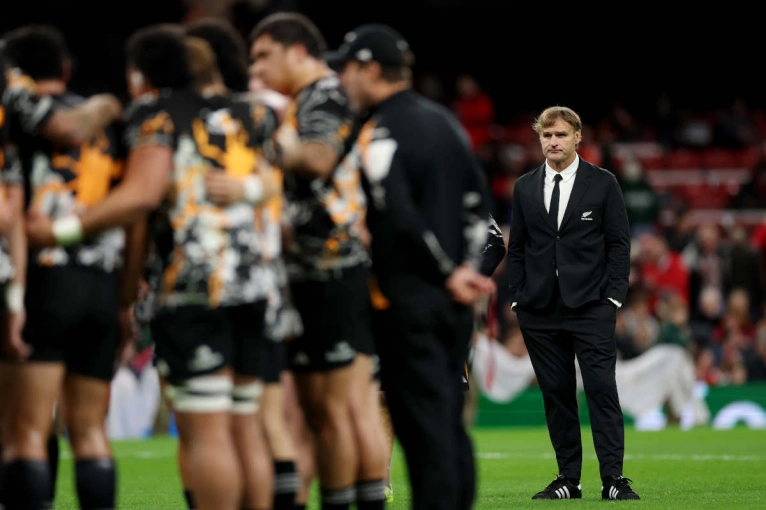
The uncertainty has been just as prevalent in the boardroom, where there have been four different chairs in the last five years and the appointed chief executive of the commercial arm of NZR left barely a year into the role.
No wonder then that everyone is looking at New Zealand with significantly less fear than they were 10 years ago, and no wonder there is a profound sense of the All Blacks being in on the ropes.
But there is an alternative view to consider, which is that the dismissal of Robertson is not evidence of an empire in decline, but in fact is the last act in an overhaul that is paving the way for a major rebuild.
What’s maybe not realised outside of New Zealand – or that much within – is that there has been a monumental cleanout of personnel in the last 18 months.
In late 2024, the entire NZR board (minus one director), was replaced as part of a change to the constitution that endorsed appointing nine independent members rather than a mixed model of provincial representatives being elected alongside others picked by a committee.
In 2019, NZR took too long to run the process to replace the retiring Steve Hansen, and also made a mistake insisting that candidates present with their respective wider teams in place.
In mid-June last year, NZR chief executive Mark Robinson departed, and in early January this year, high-performance manager Mike Anthony announced he was leaving to take up a role with Brighton in the English Premiership (football).
Robertson, it could be said, was the last remnant of that regime.
Patently, at the heart of the All Blacks problems since late 2019 has been the flawed coaching appointment process.
In 2019, NZR took too long to run the process to replace the retiring Steve Hansen, and also made a mistake insisting that candidates present with their respective wider teams in place.
The latter meant some of the best assistants were overlooked because they aligned with the unsuccessful head coach candidate and the former resulted in good people being signed up elsewhere.
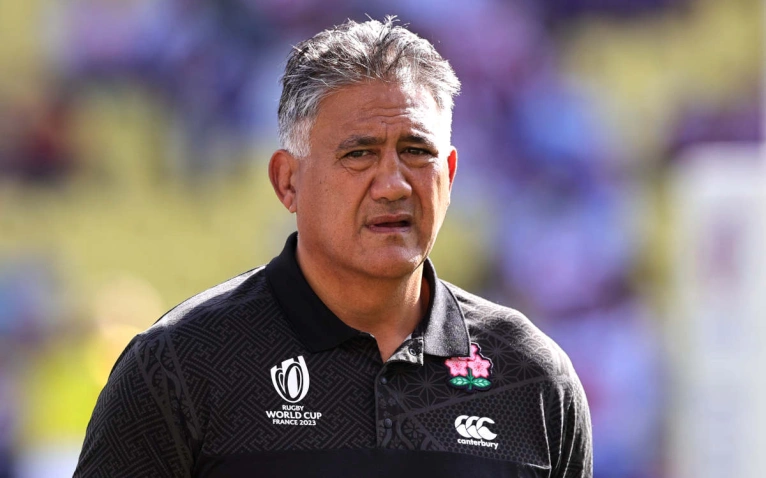
As Ian Foster revealed in his autobiography Leading Under Pressure, he had Jamie Joseph and Tony Brown lined up to be in his team, but they were both re-signed by Japan a week before the All Blacks interview process began.
“Not being able to secure him [Joseph] did change the dynamic of my team,” Foster wrote.
“It meant there was no chance of getting Brownie either, and so, relatively late in the piece, two high-quality coaches with international experience were taken off the table.
“It inconvenienced me, but I felt the real loss was to the All Blacks. Those two men had a lot to offer as coaches, and my love of the All Blacks is such that I wanted the best people to be on the team.”
Not being able to secure Joseph and Brown left Foster scrambling for alternatives in a relatively shallow pool of talent and he opted for John Plumtree and Brad Mooar – two coaches who were not necessarily All Blacks calibre but who he considered the best available at the time.
After two years of Robertson, in which the All Blacks won 20 of their 27 Tests, the new board, led by the 1987 World Cup-winning David Kirk felt they had to make a change.
Plumtree and Mooar were dismissed in July 2022, but despite the fact Jason Ryan and Joe Schmidt came in as replacements and the All Blacks improved considerably, the NZR board decided at the end of the year that it needed to bring Robertson in as head coach after the World Cup.
The truth is that the decision reflected a strained relationship between Foster and CEO Robinson and a fear within the board that Robertson, who had guided the Crusaders to seven successive Super Rugby titles, was going to head offshore if he didn’t get the All Blacks job.
After two years of Robertson, in which the All Blacks won 20 of their 27 Tests, the new board, led by the 1987 World Cup-winning David Kirk felt they had to make a change.
“The All Blacks are not on track,” was Kirk’s key message. “We mutually agreed that he would step down from his post. I really have a great deal of respect for Scott Robertson…(but) we believe this is in the best interests of New Zealand rugby and of the team.
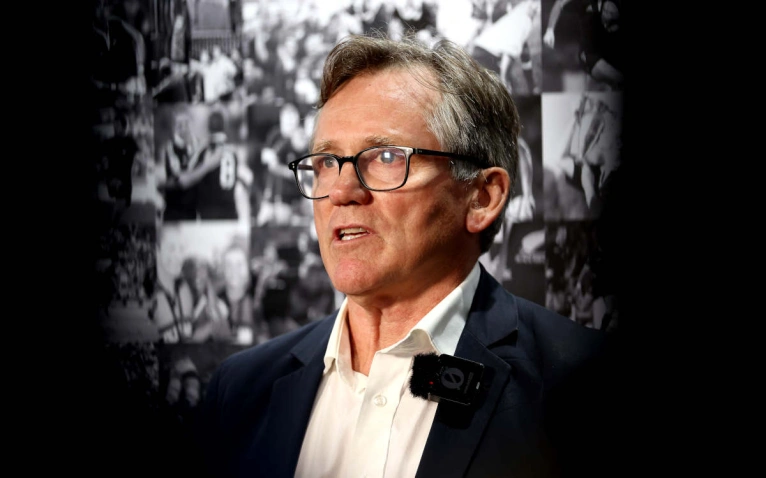
“I think fans will probably share that view that there were ways that we were playing, ways we were falling short of the excellence that we’re looking for that never really got addressed over the year.”
Far from being a panic move, the decision to remove Robertson from his post was a considered, evidential decision that has paved the way for a new, better-equipped board to evaluate the right way to appoint the next All Blacks coach and ensure the team ends up with the best leadership team.
It may seem that with Super Rugby kicking off in a month, that time is against NZR, but it is clear that Kirk is determined to get the decision right rather than make it quickly.
All sorts of speculation is swirling about who is supposedly being lined up, but Kirk was genuine when he told media that there is no pre-conceived plan and that the goal is to ensure that the list of New Zealanders with extensive international experience – Joseph, Schmidt, Dave Rennie, Tony Brown, Foster, Vern Cotter, Pat Lam – are all spoken to and encouraged to apply.
After a long period of steady decline, New Zealand now has a chance to use its new board of directors to appoint a world class All Blacks coaching team and potentially have the new man report to a highly credible and globally respected head of high-performance.
And, it would seem, that the plan is to first find the head coach and then work with him to find the right assistants, while there is also going to be a re-think about the vacant head of high-performance role and what the job description should be.
The point is, however, that after a long period of steady decline, New Zealand now has a chance to use its new board of directors to appoint a world class All Blacks coaching team and potentially have the new man report to a highly credible and globally respected head of high-performance.
The potential coaching pool is deep, and other than a concern the All Blacks may not have the answer at centre, the playing pool is equally impressive.
Most teams would love the front-row depth the All Blacks have, as well as their strength at lock and with Ardie Savea, Cam Roigard, Jordie Barrett and Will Jordan committed to 2027, so if shrewd decisions are made, this is still a potential World Cup winner.


Be honest. Sacking Razor was a rabid witch hunt by an incompetent executive driven by media frenzy and petty parochialism.
This is spot on and it’s so nice to read a piece that isn’t written by a journalist who seems to have an issue with NZRFU and rugby in general and so only wants to write negative stuff to try and embarrass the game and get themselves some click bait responses. It was obvious that the play was in disarray and the ABs were going backwards. The two assistants quitting was also a telling point pointing to issues within the coaching group that was manifesting on the field. While I am not 100% comfortable with the board - who ever is? This is a good chance to reset the process and ensure that it is followed rather than ignored.
A change of coach may be the answer. But the answer to what ? At 74% win ratio Razors record is excellent..Had 3 big games 2025 ..Lost one to England , beat Ireland and the biggest of all , beat Boks at Eden Park….I think the biggest issue in NZ Rugby right now is the unrealistic expectations of the public still believing in their inherent right to dominate Worldrugby not taking into account the huge strides made by the opposition jn closing the gap..New coachwill have the same challenges..
We may argue about many things and bias in Nothern Island approach, where Dirk belons too, with some other Sirs, who are very vocal, but the article has get the number of comments means it is a great read to discuss and it is a point which hurts.
It also does not answer the reason why decline happends outside of changing migration patterns, yet migration takes ages to make effect and it is also known that major US sports are mainly linked with migration rise…
I would not argue on the NZR mess, I do not know anything why it happends and also not sure that firing the head coach of the main team makes much sense with no plan in hads as TB mentioned in his interview, just a akind of “ i do not like his hair” attitute, but in sport there is clear cicles and on my eyes it is the cicle AB right now down - they won nothing in under U 20 for a long time, there is SR detirioration to second tear competition with no deffence, but great runing, and may be it was too long for “greats” of 2005 to 2015 to keep their places - so no new greats were able to take the stage?
It is time to rebuild and get to other direction in circle of team development - saddly without Razor. it would be interesting what is his next “trajectory” move… Wales is also in the same point of circle by the way - so would be fun if Razor take it and beat AB after what … hundreads of years of waiting, or Scotland, which probably will beat AB with or withour Razor soon…
Still - great read and if you look on the article of about 4 monther before from the same author - it was a sort of prediction there - so for me good rugby mind, whatever the situation. Thank you Greg!
I dont care so much if we win or lose, just want to see that Swagger back from all involved. The haka is all well and good when we are on top of our game, but is added anxiety and pressure when we aren’t firing. It should be something we do at home only, not elsewhere.
lets hope so and it might take a while to beat the boks in a series and win another world cup unless we get the right coaches and players
How about some good news for canes footy and fans, big signing for hurricanes and a lot of speculation it's Richie Mounga
As you stated, after the 2015 WC the ABs started aslow slide. Hansen and Foster presided over this. The main issue they had was the dual playmaker, which really ment we will play BB somewhere and he can run the show.
Thence after 2019 Foster on disown and the slide continued, yes could have won 2023 but still sliding.
Razor came in, maye be there was a small upward trajectory.
Always wondered why BB was still there, now we know this was to appease senior players. Razor should have taken a
Small axe to some players.
Hhopefully next coach has the ba___ to do his own thing
Is this “small upward trajectory” in the room with you now?
I think they were clearly a worse team in 2024 than 2023. Yes a lot of experienced forwards left, but I don’t think the pack dropped off at all, and actually got better in some areas like defensive line out, and the scrum was a weapon when Lomax was fit and firing. But they lost the ability to score tries.
Then they were clearly worse in 2025. The attack is so bad now I think only Wales and Japan out of the teams that will play in the Nations Championship look worse.
Razor was his won worst enemy. He got caught in between trying to replicate the Crusaders game and trying to play All Blacks rugby. The result was a mess. He didn’t have the confidence in his ability, maybe due to lack of experience implementing this with other teams, to make the full transition to Crusaderball. Look at someone like Cotter coming back to the Blues, knew exactly what to do and how to get it done. They played the exact opposite type of rugby they had played for the past 30 years and dominated.
Barrett was there because the Crusaders game plan is built around set piece and kicking, and as unpopular as it is, Barrett is by some distance the best kicking 10 in NZ.
I really hope so🙏 as far as l'm concerned the selections and that axe you mentioned will be the make or break for this team in 2026! It’s gonna take balls but l will always feel it was where Robertson and his assistants went wrong they kept selecting safe and consistantly underperforming players should have been benched than let go back in 24.Don’t stop with the coaches cleanout the old guard, loane, Reece,ALB, Barrett's (apart from Jordie, though l’d consider a change of position)
To all the Capt Kirk (read desperate AB fans), Razor has all but effectively acknowledged that he is being gagged!
Now if Capt. Kirk’s review and subsequent actions were, above reproach, why would he need to gag the ex coach?
He maintains the players were not the primary drivers, yet that unequivocally seems to be the case.
He talks of trajectories, but nobody actually knows what that means.
I am still quite sure this was a hatchet 🪓 job, the fact that only Kirk’s “Yes” men comprised the review panel, and that the keenest coaching brain in NZ has been blindsided behind this decision, all points to a pretty autocratic action by Kirk.
NZ will soon turn in him for this blunder and i see the AB’s falling even further behind the pack.
No coach worth his salt wants to be at the mercy of prima donna players.
If you don’t know what trajectory means then look it up in a dictionary.
You have only guessed about “yes” men so please cease espousing your drivel and stop pretending it’s all fact!