
Whenever a ship changes direction in rough oceans it runs the risk of being caught in a beam sea. This occurs when waves strike the vessel at a 90-degree angle on its side. If the situation is not resolved quickly the vessel can capsize.
The Springboks face a similar predicament. Much has been made of the influence of attack coach Tony Brown and how the former All Blacks fly-half has tried to reshape the way South Africa move the ball. But this has been overplayed, portraying Brown as some sort of Rasputin figure, whispering into the ear of Tsar Rassie Erasmus, redirecting the Boks away from what has brought them so much success.
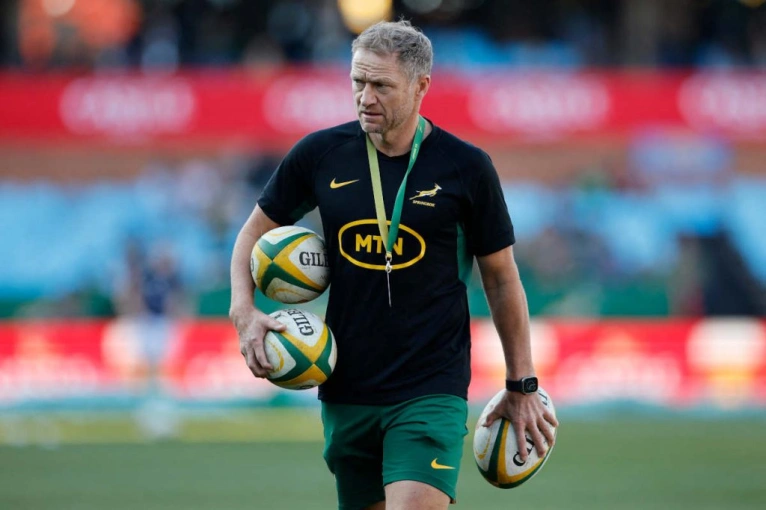
Erasmus is no fool, nor is he as easily swayed as Nicholas II. Erasmus is clearly eager to alter his double World Cup winning outfit. He has more attacking options in the wide channels than before as well as an arsenal of creative half-backs. Adaptation under these circumstances is natural.
It’s important to recognise the tweaks have yielded positive results. Some of the best work from Pieter-Steph du Toit and Siya Kolisi of late has come in the trams. Along with other big ball carriers they have created mismatches against opposition wingers. From there zippy scrum-halves have flung the ball infield for onrushing support runners.
When it works it looks unstoppable. Andre Esterhuizen scored his first Test try on Saturday against Australia after a break on the right and several offloads – the final one from Du Toit. This play pushes defenders to the margins, creating space through the guts of the defence. Quick hands and dynamic running combine for easy scores.
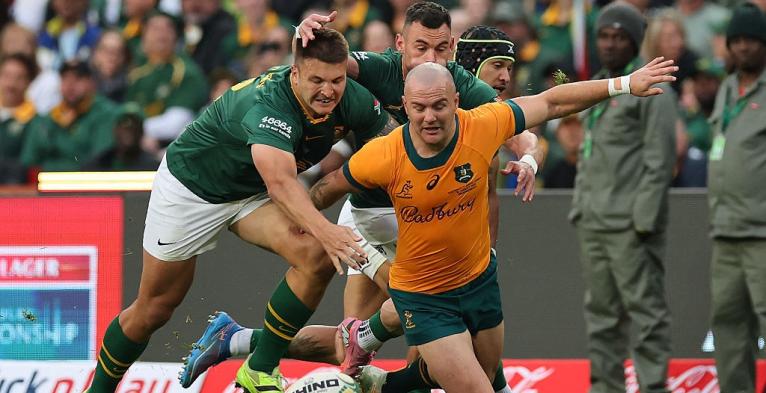
But we also saw the danger with this approach. More than once a ball carrier through the middle or in Australia’s 22 was isolated. This was either off the back of the Springboks’ phase play breaking down or because a player picked up off the base of a ruck and went himself. Either way, time and again the Aussies were able to pick the Boks off as if they were ducks during hunting season.
There is such a thing as having a game that moves too quickly. You’re constantly trying to create chaos with ball in hand, that’s what opens up holes in the defence. But there’s a tipping point.
“Isolation kills,” says Richie Gray, a man who understands the breakdown as well as anyone in the world. “It doesn’t matter how or why it happens, if you regularly send runners who find themselves without any help, any half decent team is going to boss the breakdown. You have to make sure that you avoid isolation at all costs.”
Gray’s expertise has earned him work with a range of elite teams, including the Springboks from 2013 to 2016 as a breakdown skills coach. Thereafter he coached his countrymen in Scotland before hopping around France, first with Montpellier, then with Lyon and now Toulon, where he’s been since 2022. He has also shared his insight on the point of contact with the Miami Dolphins and the Philadelphia Eagles in the NFL where he helped develop the revolutionary ‘tush push’ play which is effectively a maul.
“A coach will always have to weigh up certain options when structuring their attack,” Gray explains. “There’s a fine line between every philosophy. Do you want to play fast? Well that might leave players isolated. Do you want to be very tight and methodical? Well that might mean that you don’t take advantage of those line breaks.
“It comes down to tempo. Because there is such a thing as having a game that moves too quickly. You’re constantly trying to create chaos with ball in hand, that’s what opens up holes in the defence. But there’s a tipping point. When you start creating chaos in your own attack that can play into the hands of some teams who target turnovers on the floor. The Wallabies are exactly that sort of team.”
Does this mean that Erasmus and Brown will always have a binary decision to make? Must they choose between playing fast and loose or keeping things close? Is there a way to have their cake and eat it?
“It’s actually an easy fix,” Gray says. “A lot of turnovers we’re seeing are from players going off script or making mistakes. We’ve seen a lot of players picking and going alone. We know when players fatigue they can lose their discipline and make poor decisions. There’s a malfunction in communication which can disrupt the rhythm and flow of the game.
“The other area you can fix is found in that old cliche which says you have to earn the right to go wide. ‘Wide’ doesn’t always mean the wide channels. It can also refer to a team waiting for the right moment to start running away from their clear-out support, maybe through the midfield or even with a pick and go. If it’s all helter-skelter, inevitably there is going to be someone isolated.”
Personnel is also an obvious factor. The Springboks have missed the presence of Duane Vermeulen – “unmovable over the ball,” according to Gray – whose heft at the base of the ruck often meant that an extra man in support was surplus to requirements. Jasper Wiese’s suspension hasn’t helped in this regard and the bomb squad’s failure to detonate this year has also exposed a design flaw.
If you don’t hold the point of contact it can feel like you’re standing in the face of these massive waves that keep coming. When it’s big men doing the carrying it’s incredibly hard to stop.
The Springboks team for the second Test suggests they will revert more to type. With Handre Pollard steering the wheel at fly-half there is less chance of the team overplaying without structure. And with two locks on the bench in Eben Etzebeth and Lood de Jager, as well as Franco Mostert starting in the back row, the implication is they will look to “keep the ball in the darkness”, as Gray describes the tight channels.
“It’s okay to set yourself up to avoid your opposition’s strength,” he continues. “The Wallabies want it loose. They want as many rucks as possible because that gives them more opportunity to nick the ball. Stay away from that threat and your chance of winning increases.
“I’m fascinated to see how South Africa goes about it on Saturday. It feels like they’re going back to that Springboks way of doing things. They’ll likely keep players around the ball and punch holes through the middle. Australia will have to try and break those pods up. [Will] Skelton and the other big Aussies will need to be at their best. They’ll need to have that stopping power because if you don’t hold the point of contact it can feel like you’re standing in the face of these massive waves that keep coming. When it’s big men doing the carrying it’s incredibly hard to stop.”
On Saturday we’ll see whether Erasmus has steadied the vessel or if the Boks are still being rocked broadside. Either way, with Brown offering new currents to follow and Gray reminding them of the dangers below the surface, South Africa’s voyage through this Rugby Championship and beyond could prove as much about navigation as raw power.


Comments
Join free and tell us what you really think!
Sign up for free