
As chairman of the enormous Heinz corporation, the great Irish wing Tony O’Reilly cultivated an insatiable appetite for baked beans and tomato ketchup among consumers. The Pied Piper of the Irish business world also had a ready way with words. He once memorably distilled the difference between Irish and English rugby thus: “in England, rugby is sometimes serious but never desperate. The state of Irish rugby is often desperate, but never serious”.
In Wales, rugby always means melodrama and it is mostly taken far too seriously for its own good. When the bombshell finally dropped with the WRU’s proposal to cut from four to two regions last week, the reaction among Welsh rugby’s good and great was suitably operatic in tenor. A Jones [Sunday Times columnist Stephen] and a Davies [ex-Wales fly-half Jonathan] both waded in with verbal fists flying and provoked the social media equivalent of a Saturday night back-street brawl.
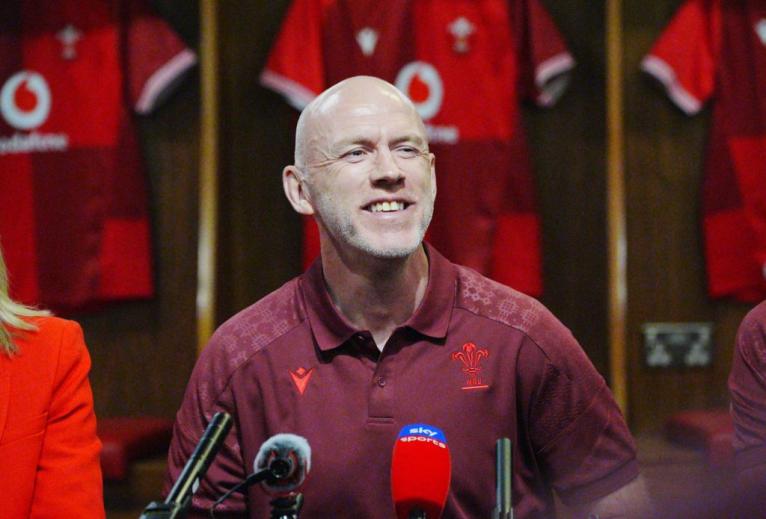
Jones claimed “Welsh rugby [is] facing oblivion. Nonsensical idea to cut pro game to two amorphous lumps of Wales with no feeling of belonging, is the end. Total idiocy. Suicide.”
Playmaker turned pundit Davies added, “All decision-makers will be gone in two years and their decisions will affect rugby in Wales forever. I’ve no confidence they have the rugby knowledge or the feel for the game and what it means for people in Wales.”
If Welsh rugby had as many bold decision-makers as it has those queuing up to attend its funeral service, the current crisis would already be a thing of the past. It is far easier to damn than to plan. The underlying question remains: how can Wales build a more effective link between international and club rugby; a higher level of competition which brings skills and conditioning closer to the Test benchmark?
Over 12 years ago I wrote a book with the now sadly deceased Alun Carter which included a chapter asking exactly the same question. When Wales’ nine Celtic League clubs were swapped out for first five, then four hastily assembled regions in 2003, it was because they could not climb the foothills domestically, much less breathe deeply in the more rarefied air of the Heineken [Champions] Cup in Europe.
Despite all the political wrangling which preceded their formation, in the short term the concentration of talent in four teams helped Wales win four Six Nations titles over the next 10 years.
Despite all the political wrangling which preceded their formation, in the short term the concentration of talent in four teams helped Wales win four Six Nations titles over the next 10 years under the guidance of Mike Ruddock [2005], and then Warren Gatland [2008, 2012 and 2013]. But the men of the moment at their inception, WRU director of rugby Terry Cobner and Kiwi head coach Graham Henry, knew in their heart of hearts Wales only had the money and talent base to sustain two, or at most three professional entities.
They could see the essential features of the Welsh rugby landscape 23 years ago. For Cobner, there were three interconnected problems: How much money have we got? How much talent do we have? What fixture list do we need? The ex-Pontypool and Wales flanker thought three teams might be sustainable, but he received a rude awakening when submitting that theory to practical trial. When Cobner tested the waters with [then] Gloucester chairman Tom Walkinshaw about the prospects of joining the English Premiership, he was told in no uncertain terms there was only interest in two clubs, Cardiff and Swansea. Not three, two. In Cobner’s terse words, “of course, no-one no Wales would have agreed to that!”
A recce mission to the Prem would yield the same answer in the present day. Local West Country derbies with Bristol, Gloucester and Bath would pique interest in a new Anglo-Welsh format, but the Premier Rugby Limited and the Rugby Football Union would only agree to add two Welsh clubs to their existing 10-club competition, not three. Back in 2002, ‘Ted’ Henry knew “there were only about 60 to 70 good players who might have been able to play professional footy in the country”, and that meant two squads of 35.
“The game in Wales was too political,” he said. “I knew I’d never be able to get the idea of only two regional sides through, even though that was all we could manage in terms of playing resources. All the big clubs along the M4 [motorway] would want their share of the pie. They would never admit they had such a limited pool of elite players, even though I’d seen it from the first Probables vs Possibles trial we’d arranged a few months after I was appointed by Wales.”
The truth hurt back then, and it still hurts now. The four Welsh regions have only two league titles in the past 14 years to show for their efforts. Ironically, those titles were won by the two franchises now in open rebellion, the Scarlets and the Ospreys. It has been even worse in Europe, with no Welsh appearances at all in Champions Cup finals since 2003 and a paltry two wins [by Cardiff] in the second-tier Challenge Cup over the same period. It is a very modest return for a country with any true feeling for the game, let alone one in love with it.
The union is under pressure, looking to refinance its existing NatWest and Welsh government debt facility, and since negotiations began with the regions on the form of the new PRA last year the amount of investment demanded from the ‘Regional Principal Investors’ has risen from an estimated £22m to around £41m over the proposed five-year term.
While the financial demands are multiplying, there is no evidence four regions can provide an answer to either of Cobner’s first two questions and create genuine winning pyramids from the bricks available. The outcome is they attracted less gate revenue than teams from all the other URC nations bar Italy.
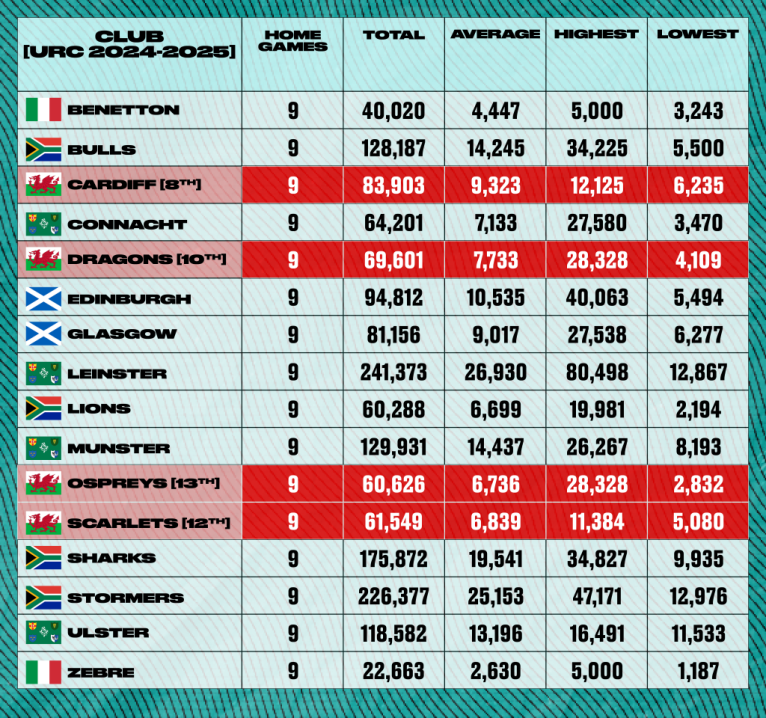
Attendances mimic results, and the four Welsh outfits finished eighth, ninth, 12th and 16th last season. Even the bumper ‘Judgement Day’ double-header at the Principality Stadium did not break the top 10 for attendance, and the play-off qualifier with the lowest regular season gate average [Glasgow] still put as many bums on seats as the top Welsh region, Cardiff. Rugby lovers in Wales have been voting with their feet, and the seasonal GPS suggests they are taking them further away than ever from rugby stadia.
While Wales will probably remain in the URC despite the WRU’s pre-existing legal obligation to field four sides, two teams in the Premiership is an outside bet, which cycles Cobner’s original question all the way back to Walkinshaw’s original answer. The voice of reason in the middle of the mayhem belongs to ex-Wales and British and Irish Lions skipper Sam Warburton, writing in The Times.
“The option that should be considered is merging the regions into East and West. I played for East Wales as a youngster against the West and was very proud to do so. If two teams are not considered enough, then let’s create another development region up in North Wales.
“Ideally, then, those three regions would play in an Anglo-Welsh competition, but first we have to prove that we are good enough to do so. If we stay in the URC, so be it.
It would work like the system in New Zealand, where if a player is not playing Super Rugby Pacific, he will then turn out in the National Provincial Championship instead.
“With three super regions, you would probably then have a group of 35 contracted players of national interest. Anybody who’s not a player of national interest would then be dual-contracted or seconded to a club side in the Super Rygbi Cymru [second tier] league.
“There, we could go as tribal as we want, with all the traditional clubs in a ten-team league, and hopefully some of them could participate in the Premiership Cup in England.
“It would work like the system in New Zealand, where if a player is not playing Super Rugby Pacific, he will then turn out in the National Provincial Championship instead.”
As Warburton suggests, there is some provenance attached to the East Wales/West Wales division. The two teams have a limited but promising history, with both having played the 1967 All Blacks and the 1973 Wallabies. The East Wales outfit came out of the game against New Zealand with a highly creditable draw, the only time on tour those ‘Invincibles’ failed to register a victory. East Wales went on to beat the Australian tourists 19-11 six years later.
“Amorphous” club combinations such as Neath/Aberavon and Pontypool/Cross Keys had been appearing against touring teams throughout the 1960s and 1970s, so the idea is not quite as nonsensical as Jones indicates. If you didn’t feel you belonged, you would get smashed to smithereens by those 1967 All Blacks, but the scratch East Wales team did rather more than hold its own.

As the legendary Gareth Edwards commented afterwards, “Had we won it, against one of the greatest teams I ever played against, people would still be talking about it with great reverence. It was a wonderful performance by a side that had been put together literally, in a week.” Some 40,000 people turned up on the Wednesday afternoon before Christmas to watch them do it, too.
There has been love for the two-team concept in the past and there can be again in the future. But as I observed over 12 years ago in The Good, the Bad and the Ugly, “regional identities have to be far enough removed from their club roots to embrace support from the wider catchment areas they are supposed to represent.’ When I mentioned that to ex-Pooler and Wales prop Graham Price all those many years ago, a wry smile crossed his face.
“The four regions never started from a clean slate,” he said. “The Blues were Cardiff and Scarlets were Llanelli, and everyone knew the Dragons were Newport. They will say they have attempted to embrace the catchment area outside the city and up the Eastern Valley, but they haven’t.
“East and West Wales, or even the old county system would have helped disentangle the regions from the clubs. Instead, they continued to play as both, so what you had was duplication.”
Control player contracts, and you control the market and the wage structure. That is why the Ireland model has been so successful.
Offer the players central or dual contracts, move them when needed to create playing opportunities, prioritise Wales-qualified players and eliminate low-quality foreign imports from the two remaining 50-man squads.
Central contracts are more efficient because you pay the players once rather than twice: the union pays whether they are on regional or Test duty, the region has to pay whether the player turns out for them or not. Control player contracts, and you control the market and the wage structure. That is why the Ireland model has been so successful.
A two-team structure represents solid realism for the game in Wales, two-plus-one is the dream of the ambitious. Let the renewed success of the national team fund a shortfall in gate receipts from fewer fixtures fulfilled at regional level, then invest in Super Rygbi Cymru on the tier below with the savings you make. Or stick with “a feeling for the game”, and the ongoing melodrama of desperation.


Comments
Join free and tell us what you really think!
Sign up for free