
I’m jumping at shadows right now – and it feels both very daft and really quite sensible.
I’m skittish – uncomfortable – and am caveating predictions so profusely that, even by my standards, the clauses feel excessive.
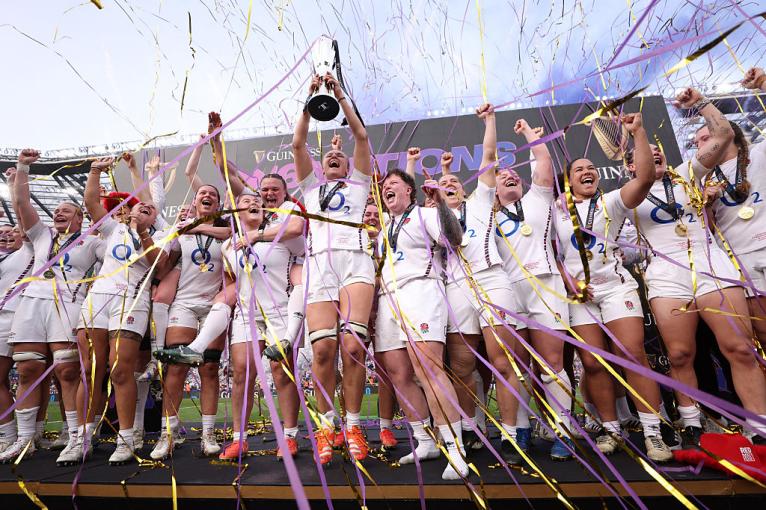
Because, although England’s campaign boasts a peerless points difference of 223, their bill of health is pretty much immaculate, and they’ve beaten the remaining nations a combined 12 times since the last tournament – I’m not as convinced as I was two months ago that they’ll win the World Cup, and I know I’m not alone.
And, as counter-intuitive as this might seem, a big reason for that is that it’s all been too easy.

With all due respect to their opponents so far, the Red Roses haven’t been properly tested, so John Mitchell has been able to rotate in flurries, and – when they’ve haemorrhaged opportunities and struggled to problem solve – we’ve been able to describe them as ‘wasteful’, rather than ‘out.’ It’s all going to plan – they’ve strolled through the draw – but wouldn’t it have been reassuring to have seen them, on a World Cup stage, forced to really fumble around in that hat before unearthing a rabbit?
31 straight wins is majestic, but might they be better-equipped to win this thing if they’d faced a smidge more adversity en route?
This isn’t England’s fault: they are consistent, brilliant, and hungry – and, as my athletics coach once told a knobbly-kneed, despondent teenager (me) who’d won a bronze medal in a field of three – ‘you can only compete against those who show up’ – but it perhaps explains the jitters.
As Kat Merchant, Rachael Burford, and many other astute rugby minds have pondered – it might just have benefited Zoe Aldcroft and co to have tasted defeat since that fateful night at Eden Park.
31 straight wins is majestic, but might they be better-equipped to win this thing if they’d faced a smidge more adversity en route? The Black Ferns lose a handful of matches each and every cycle before sashaying their way to the top of that podium, and just look at how much better Ireland were on Sunday for that torrid afternoon in Brighton. 2014’s golden crop of Red Roses all swear they were leaner, meaner, and smarter for losing five out of seven the previous summer.
It feels absurd to be questioning the sport’s dominant force because of their dominance, but – as Canada continue to prove ingeniously versatile, and as the Black Ferns tighten things up with each Braxton Sorensen-McGee dot down and Stacey Waaka conjuring act – that’s what I’m doing, and that’s before you throw in the pressures of a home World Cup, and the prevailing narrative that anything other than a trophy lift would be a failure.
It was time to seek reassurance: to speak to someone who has won and lost – but mostly won – in white, and has an uncanny ability to perform best in the most rarefied air. Player of the match against France at the last World Cup, again in Bordeaux in the 2024 Grand Slam decider, against New Zealand that Autumn, and on both occasions she’s captained the Red Roses.
And it’s Alex Matthews’ giggle-enclosed response when I say that the purpose of our catch-up is to drill into England’s relationship with pressure which encapsulates why she’s so impervious to it.
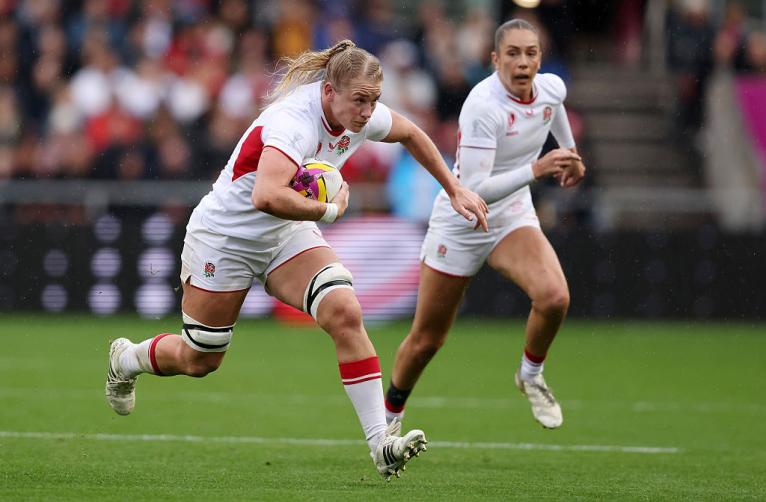
“I’m happy to chat – but you’ve picked the wrong person to get a whole article’s worth out of!”
How wrong she’d prove.
The 32-year-old grew up ‘a perfectionist – with the biggest fear of failure’, to the extent that she’d repeatedly sneak round to the back of the line during 2 v 1 drills at Hartpury College – to avoid messing up before coaches and contemporaries. Post-match, she’d click through analysis frame-by-frame, tearing strips off herself, before realising: “this isn’t good for me.”
Sevens would prove her saving grace – “you’re so exposed out there” – as she learned “to make mistakes, and love the game even when it’s not perfect. Flipping my perspective changed everything, and now – when I’m nervous – I remind myself that I’m just playing rugby. I’ve done it all my life – and I’m pretty good at it. This is elite sport – of course you want to be driven and professional – but striving to be perfect holds you back.”
The Red Roses all handle things differently. Some share Matthews’ philosophical approach. Others are jokers – like Hannah Botterman or Meg Jones – who “you never see feeling pressure, but always bring the energy we need, and are often the final voices before we take to the pitch.”
Between us – there’s always enough talent and hard work to handle the pressure – and that’s a proper safety net.
The newcomers ask a lot of questions, seeking the comfort which comes with clarity – and then there are those who prefer to remain quietly laser-focussed. There are some who lead with rhetoric, some – like the back-rower – “who only speak when their gut rumbles”, and some whose intensity screams “follow me.”
Mitchell has often said that the latter are his favourite figureheads, and so it’s no wonder he settled on Aldcroft for this most weighty of campaigns. “As soon as Zo crosses that line, training or not, she gives absolutely everything. We all laugh at her – she’s just crazy. Incredible, but crazy.”
One thing they have in common, which Matthews admits is incredibly reassuring, is their competitiveness. “Say I have an off day,” she muses, “there are 14 other girls who’ll be on it, and do everything they can for the entire time they’re out on pitch. Between us – there’s always enough talent and hard work to handle the pressure – and that’s a proper safety net.
“Plus the depth of this group has transformed. Back when I first got involved, you had a set 15, and – so long as everyone stayed fit – they’d play right through to a World Cup final. That’d be impossible with the demands of the game these days, and Mitch has met that head-on.
“He’s had rotations planned from day one, and we wholeheartedly trust that process. I could vanish tomorrow, and Maddie Feaunati would be in and performing, which is no coincidence.”
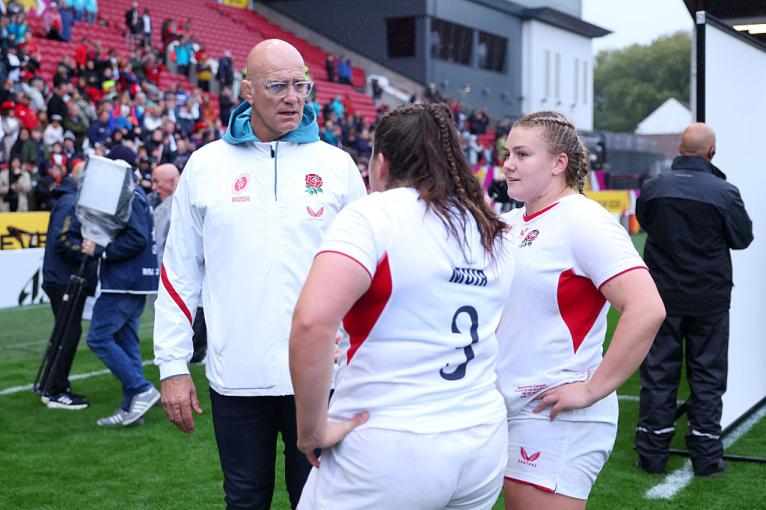
It’s helped that they’ve trained harder than ever. ‘There’ve been sessions this cycle which have been tougher than anything we’ve experienced on game day – when coaches have taken us to ridiculous intensity and fatigue, and then thrown scenarios at us with basically no time to think. We’ve never been so well prepared for adversity or the far-from-ideal.”
Mitchell’s biggest impact, she continues, is in their connection. Their goal-setting is intentional and player-driven, they’ve total understanding of their processes, and are closer-knit than ever before.
We’re going into a home World Cup ranked number one: it would be crazy not to see this as a time to be excited, to give it our all, and to create memories on and off the field.
He’s also run towards the difficult conversations: that the nation expects a Red Roses win, and that they’ve a colossal target on their backs.
They’ve had Olympians in camp, and worked closely with sports psychologists – but most of it’s been internal. Particularly impactful, Matthews recalls, was a player-led meeting in August – when “people really opened up, and were willing to make themselves vulnerable about exactly those expectations, right on the eve of the campaign. It was this amazing, honest space – and it was important that we were the ones speaking, as we’ll be the ones out on that pitch. When we feel pressure – if we run into a problem – we’re the ones solving it.”
Words matter – and they’ve reframed “pressure” as “opportunity.”
“We’re going into a home World Cup ranked number one: it would be crazy not to see this as a time to be excited, to give it our all, and to create memories on and off the field.”
Opportunity is just along the scale from fear of failure- only without the inhibitions – and, the way we want to play the game, we can’t be held back by anything.
Leading the team out before her father, Dave – whose terminal cancer wouldn’t prevent him making it to Brighton a fortnight ago – immediately stands out as a moment which “meant everything.”
“We have our ranking off the back of a huge amount of hard work, and years of consistency. Everything in life is perception, so we don’t mind if people want to tell us we’re under pressure – because we see that as a privilege.
“Opportunity is just along the scale from fear of failure- only without the inhibitions – and, the way we want to play the game, we can’t be held back by anything.”
Surely things felt hairy back in April, in the Women’s Six Nations Grand Slam decider as a 24-point buffer against Les Bleues evaporated – and they found themselves in a one-point ball game with 15 seemingly-possessed French women? Or when Canada led 12-7 in Vancouver, with a quarter remaining – and England were unable to keep 15 on the field?
She frowns. “No… I’m trying to put myself back in those games, but – genuinely – no. Even when France were coming back at us, none of me panicked – because it’d be okay if we lost. We’d learn more from that anyway, and just bounce back.”
Ah-hah! So it *would* have been better to have tasted defeat at some stage? She pivots beautifully.
Most of us remember how losing the final felt in 2022. We learned so much from that, as much as we’ve processed the emotion and moved on.
“In a way – we have. We’re always assessing performances as chunks. Against France, for example, we lost that second half badly – and rarely perform for anything like 80 minutes. We’ve had our backs against the wall: we know what that feels like, and we’ve talked about those occasions plenty. You’ve just gotta keep calm! Chill!
“Plus – “, she’s serious for a moment – “most of us remember how losing the final felt in 2022. We learned so much from that, as much as we’ve processed the emotion and moved on. It’s not like this group hasn’t lost something significant – under a lot of pressure – in recent memory.”
I’ve one final jitter to soothe. What about the fact that a Red Roses triumph would prove that stable and considered investment is an absolute requisite, if you want to win a World Cup? Do they feel pressure to demand change on behalf of the whole women’s game?
I needn’t have worried.
New Zealand might win World Cups, but then they don’t perform for the three years outside of those – and you wonder if they’re getting the support they need, or how effectively they’re growing the game as they go.
“Growth has happened already this tournament – just look at the numbers across the board – and we’ve the chance to drive that with every day of it remaining: not just the final. That’s something which really matters to me personally, and being a part of what England Rugby has done for the game is a huge privilege.
“Since the very beginning, we’ve been the driving force of all of this growth – leading the way in so many areas – and we’re inspiring people around the world, whether we win or not.
“New Zealand might win World Cups, but then they don’t perform for the three years outside of those – and you wonder if they’re getting the support they need, or how effectively they’re growing the game as they go. The Red Roses do that at all times.”
It’s as forcefully as she’s spoken all conversation, and she continues.
“Honestly – we’re just excited. It’s already been the biggest and best World Cup yet, so – in that department – it’s job done. As for the pressure – it’s a privilege that everyone thinks there’s so much on us!
“It’s an honour – a testament to what we’ve done. We’ve earned it, so come at us.”


Comments
Join free and tell us what you really think!
Sign up for free