Sacha Feinberg-Mngomezulu wants to be understood. The 23-year-old with the rugby world at his feet appears to have it all. Freakish natural abilities, unbridled self-belief, effortless good looks. He has drawn comparisons with Dan Carter and has already scored more Test tries than any South African fly-half. His fellow Springboks voted him as the team’s player of the year and he now tops the RugbyPass list of the game’s most outstanding performers in 2025.
And yet he remains curiously misread. His confidence is often mistaken for arrogance. It is not uncommon to see him talk back to referees or square up to opponents. He has been accused of forgetting himself, of failing to conform to a template established by past Springbok greats. And because he does not fit the mould – because he is redefining expectations and, for some, because of his multicultural background, with a Zulu mother and a Jewish father – he has become something of an enigma.
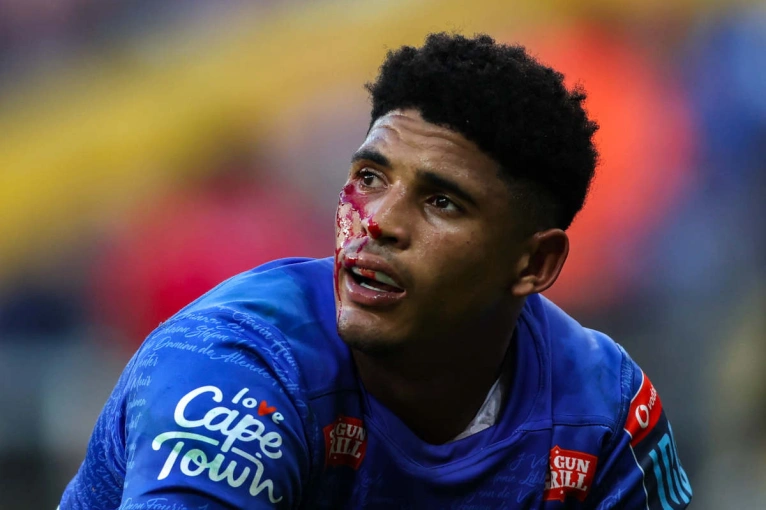
“There are three realities,” Feinberg-Mngomezulu exclusively tells RugbyPass. “There’s the opposition reality, there’s our team’s reality, and there’s the outside reality.” It is the last of those, he suggests, that is the most volatile. “You’re one hiccup away from a completely different conversation. I’m someone who sometimes plays a bit on the edge, so I know that opinions of me from the public can change very quickly.
“I still need to prove myself for people to understand who I am and I know that will take time. I’m fine with that. I think everyone wants to be understood, but it’s not something that can be rushed.”
Born and raised in Cape Town, his athleticism was honed in the elite talent factory of Bishops Diocesan College in the city’s leafy southern suburbs. Even as a teenager, it was apparent that he was different. Coaches and team-mates noticed not only his gifts on the field, but his comfort in leading others and speaking with authority. In a clip from 2015, at an end-of-season function for his under-13 side, a baby-faced Feinberg-Mngomezulu delivers a speech beyond his years, drawing laughter and admiring applause from the adults listening on. It is not difficult, watching it now, to trace a straight line from that moment to the player he has become.
From a young age I’ve been interested in the law of attraction. I realised you can kind of do anything you put your mind to
Feinberg-Mngomezulu speaks openly about the importance of belief, about visualising outcomes before they arrive. As a teenager, he became fascinated by the idea that intent could shape reality, that if one could speak things into existence, the universe would respond in kind to those brave enough to manifest their own destiny. He concedes that this is an unconventional world view, one that may chafe against more conservative sensibilities in a sport where players are typically shaped by their environments rather than encouraged to self-author their futures.
“If you can see it and you have the courage to speak it, then it will happen,” he says. “From a young age I’ve been interested in the law of attraction. I realised you can kind of do anything you put your mind to, as cliché as that may sound. So from about age 14, I didn’t really have any doubt in my mind that things would eventually carry out nicely for me.”
In rugby terms, they largely have. From the age of 13 onwards, Feinberg-Mngomezulu was selected for representative sides at every level. He played for Western Province at under-16 Grant Khomo Week and the prestigious under-18 Craven Week, before earning selection for SA Schools in 2019. The Covid pandemic briefly interrupted his ascent, but it was only ever a pause. He made his senior Western Province debut in 2021 and immediately announced himself, making 22 tackles against the Cheetahs from fly-half.
“There’s no defensive system in the world that requires your 10 to make 22 tackles,” Stormers coach John Dobson told RugbyPass last month, pointing to the almost zealous edge Feinberg-Mngomezulu brought to his early senior career. “Sacha can be reckless in the best possible way,” Dobson added, an observation that speaks as much to his fearlessness as it does to the fine line he has always walked.
Much of this strength comes from his familial bonds. The melding of his parents’ cultures both challenges conventions in South Africa while also embodying a new vision for a democracy still finding its feet three decades after the fall of apartheid. His paternal grandfather, Barry Feinberg, was an anti-apartheid activist who was exiled to London but remained a tireless campaigner for a non-racialized society. “I’m a product of what he fought for,” Feinberg-Mngomezulu says.
Feinberg-Mngomezulu understands that visibility is now part of the job description, but he is wary of being flattened into a caricature.
Despite this recognition, he does not want to speak about his family. His father, Nick Feinberg, is a radio broadcaster and highly active on social media. His mother, Makhosazana Mngomezulu, is an advocate of the High Court and a member of the Cape Bar. His brother, Nathan Mngomezulu, is a reality TV star. All of this is in the public domain. When asked to reveal more, the young man whose fame eclipses his relatives side-steps the question with the same ease he shows from first receiver.
That instinct to withhold, to keep parts of himself private, is deliberate. Feinberg-Mngomezulu understands that visibility is now part of the job description, but he is wary of being flattened into a caricature. In a sport that cries out for so-called personalities and then pillories anyone who dares to be different, opacity becomes a form of control.
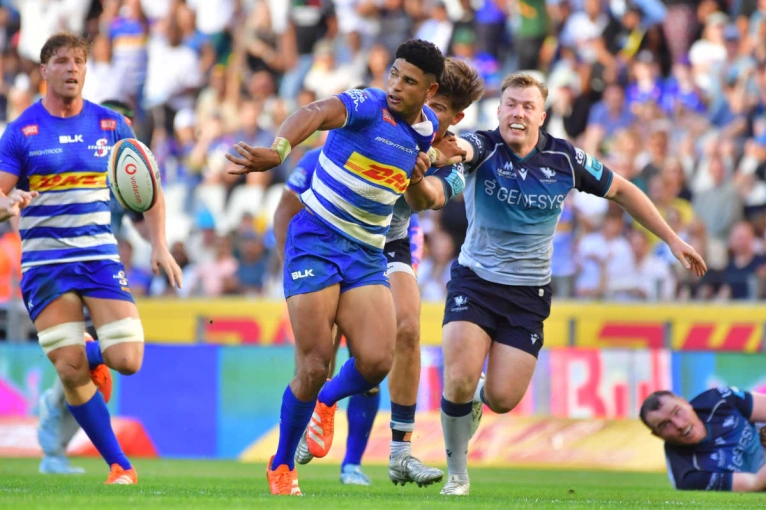
Those closest to him are acutely aware of the tension that surrounds him. At the Stormers, where he has been carefully managed through injuries, positional shifts and accelerating expectation, there is admiration for his confidence but also a protective instinct around his development.
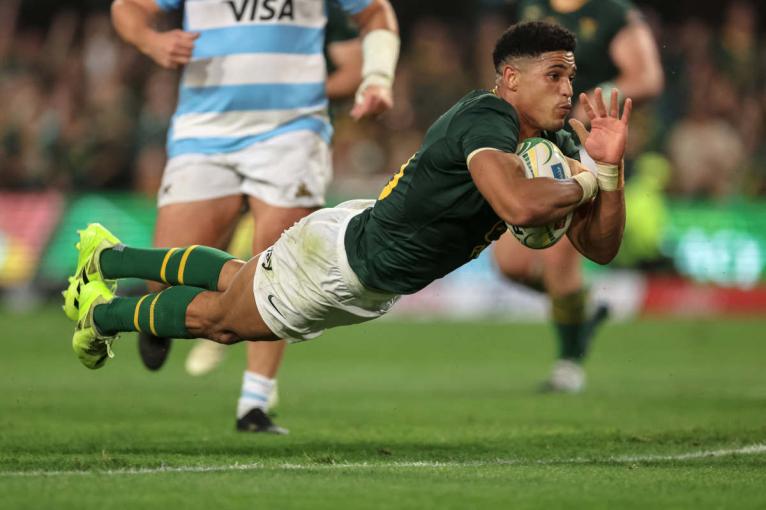
Dobson has spoken about the importance of channelling that competitive edge rather than blunting it. You do not want to sand down the very qualities that make a player rare. The challenge, as with all exceptional talents, is ensuring that the instinct to impose himself does not become a burden he carries alone. As Springboks coach Rassie Erasmus pointed out after Feinberg-Mngomezulu scored a hat-trick of tries against Argentina in September, “there’s been a hell of a lot of people helping him.”
There is something to be said about owning who you are. I think that’s cool, especially when you’re working in tandem with your team-mates and they start accepting you for you.
Not that he denies this. He is adamant that we spend time talking about Ox Nche’s scrummaging, about the work done by Damian Willemse in the back-field, about Malcolm Marx’s World Rugby Player of the Year award. He praises Handre Pollard’s calming influence and Manie Libbok’s work ethic. He emphasises the collective spirit within the Springboks camp, gives his coaches their dues and touches on the well-worn narrative that these rugby players matter beyond the confines of their sport.
And yet there is no doubt that he burns with ambition. He also references the drive of Cristiano Ronaldo and, as a devoted Chelsea fan, the star quality of Didier Drogba. “There is something to be said about owning who you are,” he explains. “I think that’s cool, especially when you’re working in tandem with your team-mates and they start accepting you for you.
“At the end of the day, we play the sport to keep the country happy, most especially in South Africa. So when they’re happy, I’m happy. But if that ever changed, I’d like to think I can handle it well and not be too flustered by it.”
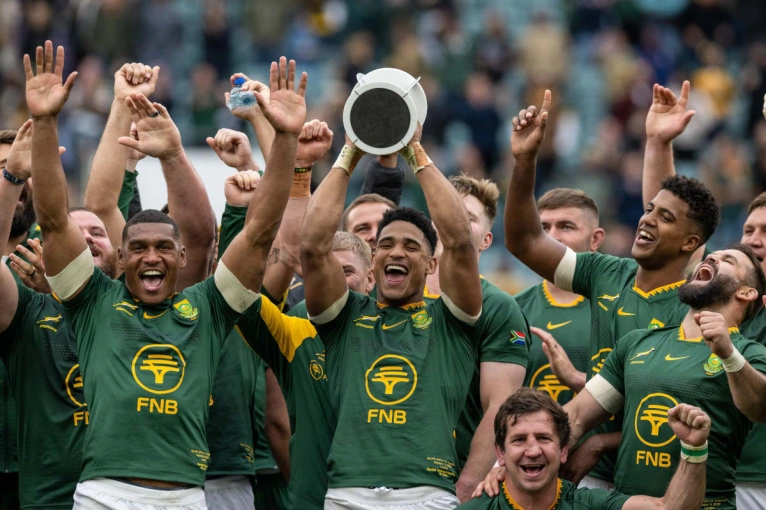
That, ultimately, is where his desire to be understood circles back on itself. Feinberg-Mngomezulu is not asking to be indulged or excused, nor is he seeking permission to be different. On the field he has already blazed a trail. His personal highlights reel includes a try against the Lions in the URC where he juggled the ball on his knees and another following a 360-degree pirouette against Argentina. He can slot kicks from distance, carry to the line, clear rucks and hold his own in contact. It’s no wonder Dobson argues, “he’ll go down as the best Springbok of all time”.
Feinberg-Mngomezulu welcomes the praise but doesn’t give it more fuel. His goals remain unchanged from when he was a schoolboy. He does not flinch when speaking about striving for honours and records, about his desire to redefine what a South African fly-half can be. He does not see those goals as vanity projects but as markers of intent.
I’m just trying to follow my path as best as possible. I’ve worked hard for what I’ve achieved.
What he bristles at is the distortion of his story. The idea that confidence must imply arrogance, that belief must suggest disrespect. “I’m not above the law,” he says. “I’m just trying to follow my path as best as possible. I’ve worked hard for what I’ve achieved.
“Sometimes my clarity on that and my confidence may be misinterpreted. But I’m just doing life the way I want my life to go. It may be unique to some people, but the one thing we all share is that we want to be successful in one way or another. That’s why I go for it. Sometimes I may be misunderstood for that.”


Sacha was their worlds best player? lol!
If not Sacha, then who?
SFM nowhere near the finished article yet - which is quite a scary thought.
What’s going on here hahhaha
Let’s be serious. Top 4 should be world rugby short list.
Antoine Dupont was 2nd on the list and has only played 4 tests this year!
Its reasonable to still rate him as the 2nd best (or even the best) player in the world, but he hasn’t done enough to deserve being considered for the award of international player of 2025.
Dan who?
CREATE YOUR OWN REALITY.