
In the 1986 cult movie Highlander, a Spanish nobleman, unaccountably played by Scottish James Bond, Sean Connery. tells his protegé Connor MacLeod: “In the end, there can be only one”. The battle of the immortals finishes with a sole survivor, and the victor takes all the spoils.
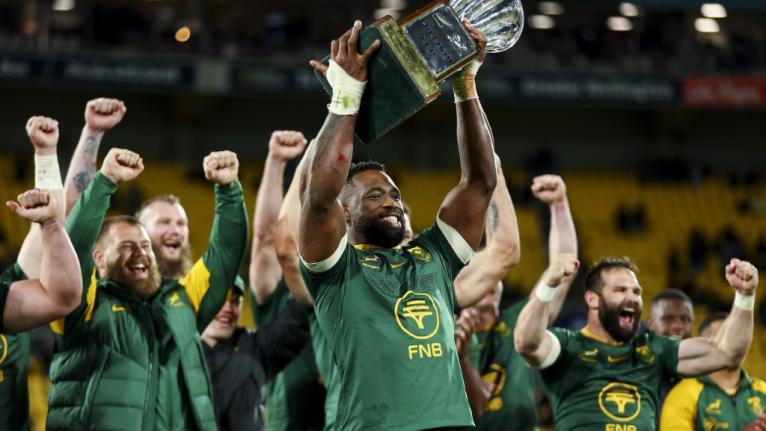
After the Springboks’ remarkable 43-10 rout of the All Blacks at the Cake Tin, there can be no lingering doubt about the identity of the world’s number one team. If there was any uncertainty, the unfolding of events in Wellington let it be known the world champions are still sitting on the summit of rugby’s Mount Olympus. In the end, there can be only one.
South Africa won the final 50 minutes 36-0, and the last quarter 26-0, putting to bed any residual notions the speed of Super Rugby Pacific produces better conditioned athletes for Test rugby.
The only period of performance in recent times which has come close to rivalling the Springbok purple patch in Wellington was France’s 34-0 half hour against Ireland in Dublin, which effectively won them this year’s Six Nations title. The great rump of those players in mid-blue and myrtle green ply their trade in European leagues. Go figure.
It would have been an historic defeat for New Zealand anywhere in the world, but the unkindest cut of all is the story unfolded on home turf. The Springboks have won five of the past six games against their age-old rivals, and the 33-point victory erases the 35-7 pre-World Cup shellacking at Twickenham from the record books.
The sheer scale of the loss was an accident waiting to happen. Had more first-teamers toured with France in July, it probably would already have occurred, sometime during the three-Test series against the Six Nations champions. As it is, there will be deep ripples of discontent in the Land of the Long White Cloud for a long time to come. All Blacks teams do not ship 40 points at home at a pivotal moment in a major championship.
Sky Sport’s New Zealand pundits were shellshocked after the event. Ex-All Blacks full-back Mils Muliaina had an alarming view of those decisive minutes.
“It blew out in the end, and what concerns me is that it almost seems like they [New Zealand] gave up,” he said.
“It’s not really the sight that you like seeing from the All Blacks, but you have to give it to South Africa.
“I mean, they came out of the second half, they put on some pressure, they demanded everything in the second half, and basically blew the All Blacks away.”
Muliaina was not alone in sensing something is rotten in the state of Denmark. Former New Zealand skipper and two-time World Cup winner Kieran Read smelled an internal weakness under pressure.
“You’ve got to look at the All Blacks side and go, ‘Okay, there’s something not right there.’ There’s something within that group, when you’re able just to leak and leak [more points]. Where is that spine that we want to see? 43-10, that is an absolute hiding.”
The inquisition in the dark, winding chambers of New Zealand rugby will be long and torturous. There will be searching queries about the quality of the coaching group and there will be more questions about selection. What are the best combinations in the front row at scrum time? Who is the best centre? Which combination provides the best synergy in the back three?
None of which will bother Rassie Erasmus and his charges. Chicago Bulls basketball legend Michael Jordan once remarked “the harder I work, the luckier I get” and Erasmus has become a totem of good fortune for South Africa. Rassie probably did not pick his best backline to start the game, but a few minutes before half-time it was on the field nonetheless because of injury.
Not for the first time, Rassie’s boldness in selection attracted the very best of good luck. The key shift was the introduction of Andre ‘the Giant’ Esterhuizen, all 6ft 5ins and 120kg of him, in midfield with the starting number 12 Damian Willemse moving into injury-stricken Aphelele Fassi’s spot at full-back.
That gave the Springboks the ideal balance between raw power [Esterhuizen, rookie Ethan Hooker and resurgent number eight Jasper Wiese] and dual playmaking from first Sacha Feinberg-Mngomezulu, then Manie Libbok at 10 and Willemse at the back. Suddenly, the Bokke hit the Tony Brown-ball sweet spot with those players working in combination.

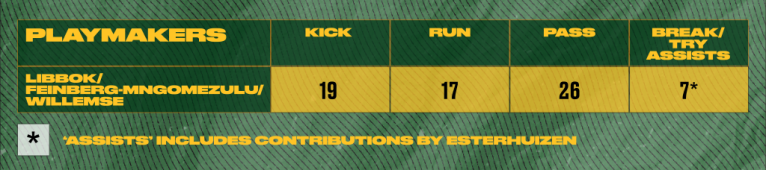
With all three of Esterhuizen, Hooker and Wiese ranging between 6ft 2ins and 6ft 5ins in height and tipping the scales at an average of nearly 120kg, there was power to burn among the core carriers, and it was coupled to proper triple threat from the key playmaking positions. The All Blacks had unwittingly walked into a perfect Springbok storm in the swirling wind of the Cake Tin. The spectacular outcomes probably surprised Rassie himself, even if they represented the sunny side of hard work and smart thinking.
Spiky ex-All Blacks scrum-half Justin Marshall noted in commentary, “No-one can argue about [South Africa’s] game-plan. They are not just a team that plays territory, they have some strike power in their backline and they can play with pace and tempo that can put a score on like that against the All Blacks at home. Quite incredible.”
Incredible indeed. The first hint of a smooth click and a powerful whir in the Springbok backline engine arrived just before oranges.

The three arrows provide the power – Esterhuizen at the front, Wiese and Hooker behind, while the twin circles [Libbok and Willemse] supply the passing ability out to the sideline. That ability to play short or wide right from the off gives the New Zealand midfield defence plenty to think about.
André the Giant’s imposing physique masks a more nuanced and underrated set of skills. When he was voted the RPA’s players’ player of the year after the 2021-2022 English Premiership it was not simply because of his sheer size and power. The Sharks spearhead is naturally left-sided, with a booming left-foot punt and more sympathetic hands than he is often given credit for. His value as an extra seven on the deck was the equal of any specialist open-side in the league.
In tandem with Libbok, who passes outstandingly off his left hand, that gave South Africa enormous potential on left-to-right attacks.
Esterhuizen is in shot at the start of another dominant attacking scrum by the Bokke and he is the key man at the end of the play, delivering a long pass straight from the base to Cheslin Kolbe on the right sideline. Power centres are not supposed to have the vision or passing ability to make that play.
When Hooker moved over from the left to the right edge to accommodate emergency wing Grant Williams, he became a winged Hermes in the air, winning four consecutive reclaims on that side of the field.
Hooker beats Jordie Barrett to the high ball, Esterhuizen shows he is far more than a mere banger by outmanoeuvring Billy Proctor on the offload, the footballing ability of Willemse and Williams does the rest down the left sideline. A couple of minutes later, Ruan Nortjé pilfered a lineout throw and Libbok and Willemse connected directly for the try.
The Stormers centre/full-back takes the ball out of stride and above his head, but still generates enough speed and power in a straight line to drive through three All Blacks near the goal-line.
The the eye of a perfect storm of Springbok power and playmaking settled directly above the Cake Tin in the 68th minute. It began with an outstanding run out of defence by Hooker, consolidated by Esterhuizen cleaning out not just one, but two All Blacks at the ensuing ruck.
More power from Wiese and Esterhuizen confirms the initial break, before the cross-kicking skills of Libbok apply the finishing touches to a move of Olympian scale.
There was still time for one more ambrosial dish from the Gods, with Willemse and Williams combining sinuously down the left and André the Giant smashing the remains of the defence out of the way.
South Africa and New Zealand have always approached the game of rugby from opposite corners, and it has made the contest utterly compelling for more than a century. But the time when the Springboks used to be the more conservative of the two nations, and New Zealand the more innovative and progressive, is just a distant memory.
Now it is South Africa which has built a cosmopolitan coaching group truly global in nature, drawing on knowledge and experience from all over the world. New Zealand is plain vanilla local. One head coach freely embraces risk in selection, where it has to be wrung out of the other like the last drop of water from a damp cloth. Pressure draws a frank and open attitude out of Rassie, where Scott ‘Razor’ Robertson tends to disappear behind a hedge of media-speak:
“I can try butter it up and bottle it up to sound cool and respectful, but we were really dogs**t today.” [Rassie after the first-round loss at Ellis Park]
“We own it as a group. It’s pretty clear we got to a point where we played some great rugby and we let them get away.” [Razor after Wellington]
“My language is not quite as eloquent as his,” said Robertson when reminded of Erasmus’ observation, but it’s not about eloquence. It’s about staying in front of the evidence until it hurts.
Erasmus risked looking like a clown if his radical changes had not come off, but now he’s found a backline which can take South Africa all the way to the 2027 World Cup. Razor Robertson could yet die wondering about his best combinations. In the end there can be only one, and right now Rassie is the man.


Comments
Join free and tell us what you really think!
Sign up for free