
Second-half Saltire implosions, drop goal efficiency and the battle for the skies above Dublin feature heavily in this week’s rundown of the stats that may shape your thinking are revealed…
Stat of the Week – In the last two weeks, Scotland have won the halves they have been dominant in (first vs Argentina and second vs New Zealand) 31-7. But have lost the opposite halves 50-10.
According to Opta stats, their match against Argentina was just the third time in Tier One v Tier One history that a team had been nilled in the first half and then scored 30 or more points in the second. It was a rare collapse for a team who just last week had hauled themselves out of a first half deficit and were just ten minutes away from sporting ecstasy. But what has misfired for Scotland over these past two weeks and are there easy(ish) fixes they can employ to stop these periods where momentum suddenly turns against them?
Both of the last two matches followed a similar pattern. With Scotland trailing to New Zealand they ended up carrying more (142 vs 120) and with Argentina trailing Scotland, Los Pumas also carried more (165 vs 134). That is a fairly common response to trailing by a significant margin as the value of territory diminishes and the value of possession increases. Obviously, it’s not a flawless plan as you run the risk of giving up turnovers – both Argentina and Scotland (vs New Zealand) had 16 turnovers lost, more than their opponents. Watching Scotland fritter away their lead on Sunday, you may have been convinced that the most dangerous spot to be in is a team with a healthy lead as your opponent has nothing to lose. There is some truth to that but the danger is that the team throwing caution to the wind will cough up possession which will lead to tries or to nerve settling penalties. Afterall, few thought Argentina’s comeback would restart after Finn Russell restored a 12pt lead on Sunday.
In the last two matches, Scotland have struggled to hit the right notes with their 22-entries. Against New Zealand they had 11 of them but were horribly inefficient scoring just 1.2pts per entry. Against Argentina they were much more efficient, 3.5pts but had just six of them and they dried up in that second half. Argentina had 12 and while they were less efficient they pressured Scotland and forced them to give up penalties – they conceded 10 to just five for Argentina. Los Pumas didn’t kick any of these chances for three points, but it did give them an opportunity to flip field position. They ended up with 71% of their possession in the Scottish half versus 62% for the home side.
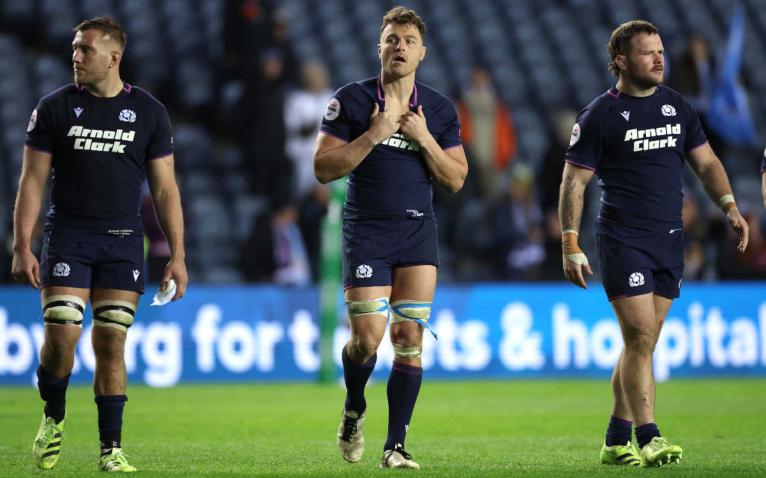
In both matches, Scotland showed periods of brilliance which were more than balanced out by periods of collapse. When the momentum started to shift, they found it very difficult to fight against the tide and all those stats we’ve talked about for the last fortnight came to the fore.
Drop Goal Fever
In the four matches this weekend where a Tier One side played another Tier One side, only South Africa, Ireland, and Scotland scored more than three points per 22-entry – England scored exactly 3pts. Italy averaged just 1.5pts, New Zealand 2.7pts, Australia 2.1pts, and Argentina 2.7pts. Why then, you might be wondering, didn’t more teams take George Ford’s approach and kick drop goals? In fact, why are drop goals so out of fashion?
On the face of it, there is a simple mathematical equation that states if your points per 22 entry are less than three then you should kick at goal – either through a penalty or a drop goal. Of course you won’t be successful every time, so perhaps better to state if your points per entry is less than 2.4pts (80% accuracy for a kick) then you should kick for goal. That would still suggest that both Italy and Australia would’ve been better going for points more often than they did.
The issue with going for goal at a significantly higher rate is you lose the pressure which leads to immeasurable benefits. For example, you are far more likely to get a yellow card awarded against you if you are defending in your own 22. You are also more likely to get an easier shot at goal by entering the 22 and trying to win a penalty. Not only that, but if you lose a lineout close to the opposition line in most cases they will be forced to kick and give you possession just outside the 22 or maybe even still in it. That gives you two bites at the 22-entry whereas a missed penalty or drop goal results in a 22 dropout. These facts mean that we have seen a huge shift towards teams going to the corner from kickable positions. That has also changed the scoring profile of matches as teams used to kick at goal early in matches then go for tries later in matches meaning more points were scored later on. That is no longer the case.
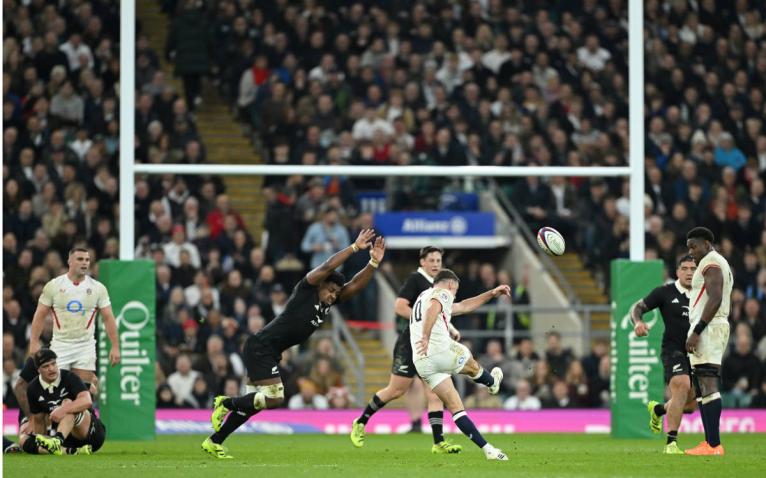
What is missing in all of this is the context of the match. When Ford hit his first drop goal on 37 minutes, England were 7pts down and had been outplayed in the half. At that point in the game, a late score of any kind to the All Blacks took them into two score territory and gave them a huge psychological boost. Instead, Ford calmly notched two kicks without pressure and brought England to within a point at half-time. From the first drop goal England would add 20pts without reply, more than enough to hold-off a yellow card supported late charge by the All Blacks.
So, in general, it doesn’t make sense to sacrifice 22-entries of penalty kicks or drop goals. But what is often missed in the stats alone is the negative momentum slide of successive failed entries or the positive boost from points scored when you don’t feel you’ve created any pressure for your opponent. That is what Ford and England found on Saturday.
Bok Battle
Ireland v South Africa will be the game of the third round of the Quilter Nations Series. One area to look out for is the aerial battle between the two sides. Ireland were completely dominant in the air against Australia and South Africa almost lost in the World Cup semi-final against England after they lost the aerial battle. Though they won’t say it publicly, Ireland may well fear that they can’t live with the physicality of South Africa – France couldn’t after all. They may also feel that stretching the field as wide as possible will force South Africa to move their forwards around more than they would like. Regardless, you know that Rassie Erasmus will have a plan up his sleeve to mitigate this risk and ensure his perfect Autumn record is kept intact.


Having been delighted with the ENG victory, I headed to the stats on Sunday and got a bit of a surprise.
ENG vs NZ
Possession 45 55
Territory 47 53
Carries 103 130
Passes 113 170
Defs Beaten 17 24
Rucks 76 111
Then the big number, which changed everything;
Tackles 191 120
So ultimately, ENG were another level in defence with the 5x7’s, whereas NZ did a lot more in attack but ultimately ENG were more efficient at scoring points, hence the red zone and the help of the drop kicks.
It would be really nice to see how these happened by Quarter, which will also tell its own tale of how the game played out with ENG’s bench finishing much stronger.
Arguably that makes England’s win look even more impressive. 2nd best in the all big metrics outside of tackling, and they still put up 33 PTS.
It shows they are being much more efficient with their scoring at a similar rate to the ABs regressing.
I think those stats would be broadly similar across much of their 10 game win streak. Their scoring efficiency has certainly been a trend lately.
killed my formatting after pressing send but you can see the like for like stats.
Sam, to aid the analysis of these games, would it be possible to post the headline stats from each of the games;
Attack (carries)
Attack (passes)
Attack (no of rucks)
Attack (metres gained)
Attack (points scored)
Defence (tackles)
Defence (turnovers)
Defence (points conceeded)
Could we then have this split by Quarters, so you can see how the game evolves through the KPI’s and data.
I think that would give us a much better insight into the ebb and flow of games and where they are won and lost through the Quarter.
This would give a really nice stat based foundation for the discussions that followed.
I would love to see that data for ENG vs NZ - it would paint a very clear picture of how the game unfolded.
Get on it Sam!
I think one of the most interesting stats is why lock forwards keep being given red cards that are mostly rescinded this Autumn.
Is this showing an intrinsic bias of the current laws against taller players, or are the disciplinary panels applying more common sense judgement when it comes to appeals?
Either way WR need to look further into this. Red cards are having a bit too much influence in games at the moment and are just becoming too common at International level.
I think they have gone a bit overboard with yellow and red cards and need to look at the frequency of how much they are being issued. You hardly get a game without them any more.
I think the red to rescinded rate is 50:50 last time I checked PMcD. So a coin toss?
Indeed, the more interesting stat is how one position (5 lock) got more reds than any other position.
Oh and my favourite stat - that 100% of the reds were bollocks.
IRL v SA
France played into SA hands. Ireland won’t.
It should also be noted that SA are at the end of a long International window, with the two most recent matches played with 14 players. I know the teams were somewhat rotated but Ireland will be very very fresh and very motivated.
I think Australia showed with their forward oriented tries a way for SA to solve things. But Farrell will have a plan as much as Rassie has.
Dublin has not been a happy hunting ground for SA and Erasmus has never won there as coach. SA should have the tools to win but can they get up to the same emotional intensity again to use those tools decisively?
Scot v Arg
There were two matches here:
1. the rugby match and more importantly
2. the match for a Top 6 world ranking where Argentina came in with a 15-0 lead.
When it was 21-0 in the former match, Scotland were leading 6-0 in the latter.
You could see the activity and fervour with Contemponi and his crew at that point. This had little to do with the 21-0 score line.
Argentina massively attacked Scotland to defend their Rankings position. The actual match then became winable once the rankings match was put to bed.
That’s a fair assessment Eric but ultimately it comes back to the wrong bench strategy of going 5|3 vs 6|2 and the decision to put Josh Bayliss at lock (which he isn’t).
All in all, it was a really bad day fro Gregor Townsend, hence the fans response at the end.
For me, our wins against the Boks in 2022, 2023 & 2024 were our best performances of those years. That’s the level we would need.
I think the difference this time is that our best may not quite be enough. They are on a different level at the moment.
The big positives from the Australia match - starter plays working from a functioning lineout, excellent ruck speed and Big Sam getting creased carrying to the line while making 2 scoring passes - should make it an 80 min game.
Still, the Boks really should be winning this.
Bang on about the Scotland v Argentina match. Every chance that Trevor Brownend wasn’t even aware of the connotations around the in-game score margins.
Rassie is the BEST coach to get them up emotionally for this one.
Interested to see his team sheet is week!