
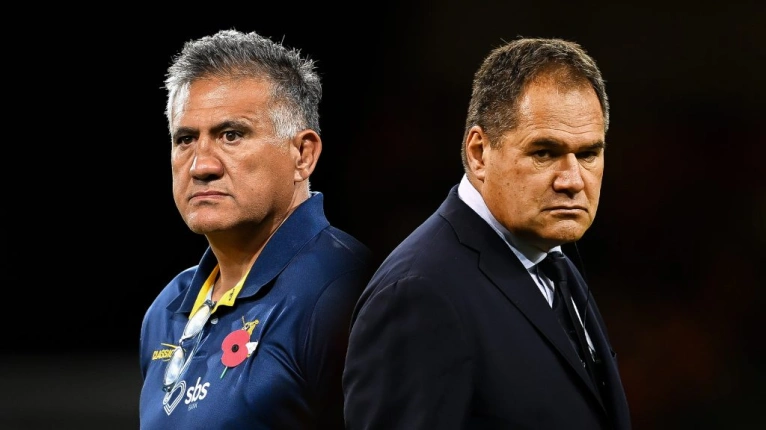
The ‘worldwide trawl’ for coaching talent has dwindled, and the contest for the top job in New Zealand rugby has become what it probably always was: a two-horse race between ex-Japan head coach Jamie Joseph and ex-Chiefs and Wallabies supremo Dave Rennie.
Joseph must be the front-runner given his recent success coaching the New Zealand A side which toured Europe concurrently with ‘Razor’ Robertson’s All Blacks. Where Robertson’s men faltered, Joseph’s cruised through a three-match tour with three resounding wins against a Barbarians side first up, followed by England A and finishing with a victory over Uruguay in the southwest of France.
One week before Robertson’s charges lost the full international against England at Twickenham, Joseph’s team were beating England A at the Rec in Bath 31-14. That as much as anything did for Razor and made up NZR chair David Kirk’s mind about the need for radical change.
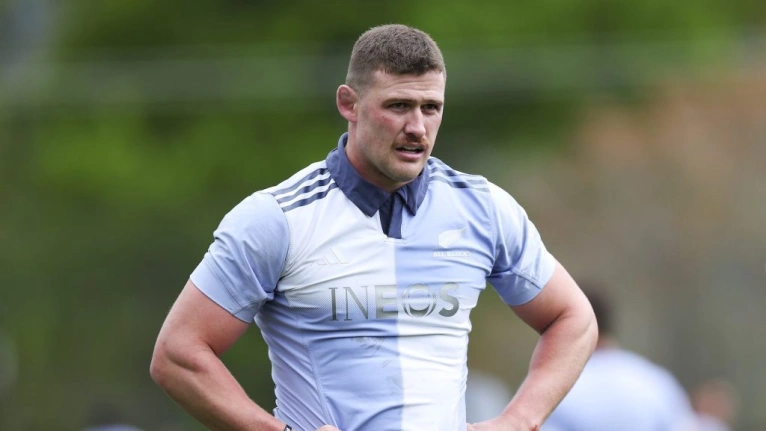
Some players in New Zealand will be happy with the change, and Blues skipper Dalton Papali’i will probably count among their number. The hybrid back-rower has earned 37 caps in total and formed a deadly partnership with Ardie Savea under Ian Foster. But the flood of national recognition turned to a trickle before completely drying up under Robertson. With the ex-Crusaders head coach in charge, the 28-year-old only played 15 minutes off the bench in 2025, at a time when he should have been approaching the zenith of his playing career.
Papali’i’s recent comments to 1News implied a less-than-ringing endorsement in the well-publicised player review which finally torpedoed the good ship Robertson.
“I was there when ‘Shag’ [Steve Hansen] and ‘Fozzy’ [Ian Foster] were there holding the helm,” he said. “Seeing it change to Razor’s agenda, you could see there was a big difference.
“People spoke up and they had to have a review… I don’t really want to speak too much on that. What happened, happened.”
If popular opinion crowns men, Joseph would already be a king. It was he who rescued the Blues castaway and brought him back into fold, not only as his preferred number seven, but as a captain to boot.
“I really had a good relationship with Jamie Jo and I felt like I was back to my old self,” Papali’i continued. “I feel like I play better with the weight of being a leader. Going into the ABs XV, I got that role back again, the captaincy, and I took it with both hands.
“I enjoyed it and felt like I played well again. Everyone bought into the culture and it was a credit to Jamie Jo and the coaches. They set up the environment for everyone to be at their best and I loved it.”
The preference for ‘old school’ methodology on Joseph’s coaching menu is well-documented. The ex-Highlanders number 10 Lima Sopoaga recalls a time when after one unexpected pre-season loss, some of the backs were required to defend driving mauls from lineout run by a full-blown pack of South Island forwards. Even the gilt-edged ‘Nugget’, scrum-half Aaron Smith had to get his hands, and his shorts, dirty in the process. There were to be no draft dodgers.
“It went on for 15 minutes,” Sopaga told Nine Sport. “Imagine how well that went. It was honestly one of the worst days of my life. After he blew the whistle, I walked away and I just kept on walking. The field was massive. I walked for a kilometre down the road and I had tears in my eyes.”
Sopoaga went on to observe Joseph’s ability to “max out” the talent of the underdog players at his disposal, with Japan and the Highlanders alike. Innovation was the preserve of his long-time confederate Tony Brown, who has stated publicly he will honour his contract with the Springboks up until the 2027 World Cup.
“Those two men are like Shaq and Kobe, Batman and Robin,” Sopoaga enthused. “If he is to get the job, I’m sure Jamie being Jamie, he’s got a couple of tricks up his sleeve. If he can’t get Tony, he’ll have someone else. He’ll have A, B, C, D, E, and F all in the back of his mind.”
If Joseph gets the All Blacks gig, the real question mark will not be so much about his ability unify players, but whether he can find a partner in crime to supply the IP which keeps the Al Blacks ahead of the global game. O’Neal never functioned quite so fluently without Bryant, nor the Caped Crusader without his sidekick.
The first round of Super Rugby Pacific suggested, left to his own devices, he may be more of a good listener than a keynote speaker, following an existing trail west rather than pioneering it.
Why? The first two rounds of the Six Nations averaged 39 minutes of ball-in-play time, and the Highlanders-Crusaders game mirrored it exactly. There has been an average of 188 rucks in Europe’s premier international competition, and there were 184 in Dunedin. One round of play up north produced an average of 79 kicks per game, while the first match of SRP down south finished with 82. Joseph’s Highlanders launched a massive 44 of those at home, under a glass dome impervious to the fluctuations of the weather outside it.
If Joseph becomes coach of the national side, will he still be following trends set by the likes of France and England? After two rounds of the current Six Nations, both have kicked an average of 35 times per game for a total of over 1000 metres. Those are big kicking figures indeed, but the early evidence suggests the Highlanders are looking not only to match them, but surpass them.
On Sky Sport’s The Breakdown, ex-All Blacks Stephen Donald and Jeff Wilson were left shaking their heads ruefully.
“It’s just not New Zealand rugby,” Wilson remarked.
“We finished a whole season last year, at the end of the year, talking about kicking the ball away and turning possession over.
“And then, in the very first game we saw 80 kicks. That’s not New Zealand rugby. I’m sorry, keeping the ball in hand – you know, you can’t play with fear.
“Because for me, the number of times, the moment it broke down, [both] teams were going to a box kick in the attacking half, not even in the defensive half, the exit.
“That’s an attacking strategy. I just I don’t accept that’s in the best interest of our game, and given the skill-sets of our players.”
If Joseph is going to translate his methodology from provincial level to the Test match arena as head coach of New Zealand, there could be a bumpy media road ahead.
The good news is there are a few individuals who could easily supply his needs. On the Crusaders side, scrum-half Noah Hotham may already be the best box-kicking half-back in New Zealand. With Hotham launching the mortar ‘bombs’, the visitors had won back four of their contestable kicks, on both sides of the field, before play hit the half-hour mark. And their scrum-half knew exactly what to do with the turnover ball won.
— William Bishop (@RPvids1994) February 16, 2026
— William Bishop (@RPvids1994) February 16, 2026
In both instances Hotham plays the short side for all it is worth after the box kick reclaim is made. He catches the Highlanders backfield in the middle of a regroup in the first clip and if his kick ahead stays infield, there will be an almost certain score in the second.
On the other side of the field, Timoci Tavatavanawai has exactly the kind of skill-set which will thrive in the brave new box-kicking world.
— William Bishop (@RPvids1994) February 16, 2026
— William Bishop (@RPvids1994) February 16, 2026
‘Big Jim’, as he is known to his friends, is chasing from one spot inside the edge chaser in both clips. He started life as a power wing before moving in to first five-eighth. The big body gives him rock-like immovability over the tackle ball and the winger’s aerial instincts allow him to catch it on the reclaim. It is rare and valuable combination.
Add those abilities to the following break and offload and you have a Joseph gem on your hands.
— William Bishop (@RPvids1994) February 16, 2026
It looks increasingly likely Joseph will be the man to succeed Robertson in NZR’s brave new rugby world south of the equator. If he is appointed to the toughest gig on planet rugby, he will need a man to fill the boots of Brown alongside him. Could that man be Scott Hansen, who coached Japan as his main assistant between 2019 and 2022? Can he really roleplay Robin to Joseph’s Batman? As the anti-hero Harvey Dent once put it in The Dark Knight, “You either die a hero, or live long enough to see yourself become the villain.”

Watch Super Rugby Pacific live and free on RugbyPassTV in the USA!


We can’t wait to find out the name… I hope the announcement won’t be much longer.
If it’s JJ, we’ll probably see a few Landers in the mix in July.
Curious to know what his choice will be for the starting inside centre spot. Curious to see the back three as well. And where to put Jordie Barrett — at 13?
Lowe’s switch to that position might give us a clue.
Papalii’s departure is a setback, as he would have had his say, but Withy could come in.
We’ll have to wait and see — the appointment, the staff, the captain, and the first selections.
Jim + Jordie could be a sight to behold, gives you extra leaping power to both of the field…
I assume that this was written before Papali’i announced that he is abandoning the sinking ship and taking up a position in the Top14?
I was awrae he might be shipping out but I felt his comments about the Razor regime were tight-lipped enough to be worth quoting!
Bring it. Let’s see who the back room staff will be, that is the real surprise in waiting.
Well he has woked with Scott Hansen before - three years in Japan. Hold on to your hats!