
The All Blacks have gambled that they will ultimately be better off for head coach Scott Robertson and his assistant Leon MacDonald reaching a mutual decision to part company just five tests into their working relationship.
From what Robertson has said publicly, he and MacDonald were philosophically misaligned about how they wanted the All Blacks to play and held such fundamental differences of opinion about the best way forward that neither man could see how they could resolve their differences and work effectively together.
On the basis that their professional relationship was beyond salvation, they agreed that the best course of action was to move quickly and suck up the short-term pain of alarmist headlines, for what they hope will be the longer-term gain of greater harmony and cohesion within the coaching group.
And so, in what was a genuine revelation, a press release popped into media inboxes mid-morning on August 22 to say that MacDonald was leaving his post as assistant coach of the All Blacks just days before the team headed to South Africa for a two-test series.
Equally surprising was the candour and honesty of the announcement. There was no sugar coating – no euphemisms or hiding behind the ubiquitous “to spend more time with his family”.
The release made it clear the two men had their differences in opinion, with Robertson then fronting media later that same day, to further explain: “Just a little bit of philosophy on rugby, how it’s played,” he said.
“We just didn’t quite click in different aspects.There was no intent to get to this point where we are now. But we just believed for the both of us, the best thing for the All Black group is we make the call now.
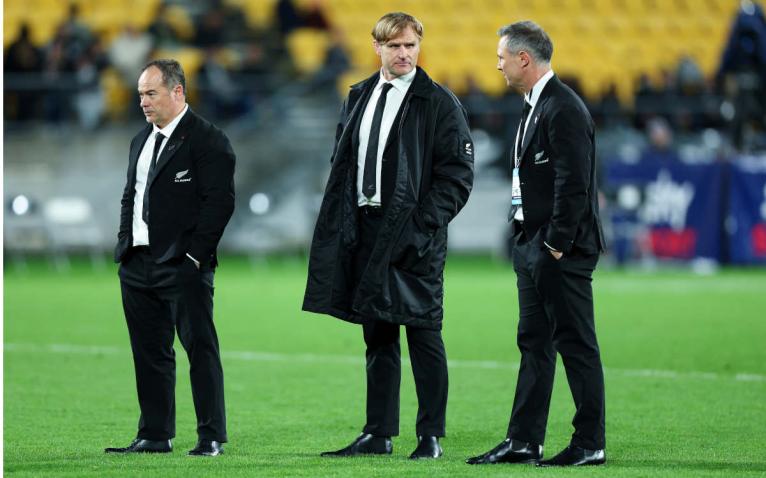
“We went through a process, and we got to here.”
Robertson clearly didn’t want to get to South Africa and have his strained dynamic with MacDonald become more noticeable and impact on the players at a time when they need to be at their absolute best if they are to have any chance of winning against the world champions.
By acting as swiftly and as decisively as he did, Robertson has likely prevented MacDonald’s departure from the coaching group blowing up into a bigger and ongoing saga.
But the whole business of why MacDonald only lasted five tests in the role is a question that requires further examination, most pertinently whether it is indicative of deeper and potential ongoing issues within the coaching set-up.
What’s particularly hard to fathom is how Robertson and MacDonald didn’t comprehend that they were not strategically aligned in their respective vision for how to set-up the All Blacks’ attack.
It’s hard to fathom because they have known each other for 27 years, starting as team-mates with the Crusaders and All Blacks, and then working together as coaches of the New Zealand Under-20 team in 2015.
MacDonald helped straighten the Crusaders’ running lines, generate more width and play with greater variation – all of which contributed to them winning their first title since 2008 when they heroically found a way to defeat the Lions at Ellis Park.
When Robertson landed the Crusaders head coaching role in 2017, the first person he asked to join his staff was MacDonald, who came on board as attack coach.
MacDonald helped straighten the Crusaders’ running lines, generate more width and play with greater variation – all of which contributed to them winning their first title since 2008 when they heroically found a way to defeat the Lions at Ellis Park.
The big surprise, though, was that after helping the Crusaders win the title, MacDonald didn’t opt to take the second-year option of his contract.
He instead returned to his old province, Tasman, citing a desire to help his wife run her Blenheim-based business and be at home more for his four children, two of whom were reaching a critical period in their schooling.
That all stacked up as legitimate, until MacDonald announced six months later that he was joining the Blues as an assistant coach on a three-year contract, and relocating his family to Auckland.
That raised a few eyebrows as it contradicted his reasons for not extending his contract with the Crusaders and it seemed odd to leave the title-winning Crusaders for a similar job at the basement-dwelling Blues.
Had there been something more behind his reason for not staying with the Crusaders? Were there issues between him and Robertson back then that went largely unreported or unrecognised because the narrative behind MacDonald’s shift to the Blues was revised over time?
A change of ownership at the club saw MacDonald promoted to head coach in late 2018 – meaning he never did a single day as an assistant and the story was recorded or remembered as him leaving the Crusaders as an assistant for a head role at the Blues.
There has long been speculation among those who recall the real history rather than the revised version, that MacDonald and Robertson were never quite on the same page of the coaching manual while they were at the Crusaders, and hence there was some surprise when they agreed to work together at the All Blacks.
One of the criticisms of Robertson’s coaching group has been its size, and that there are too many people operating in niche roles that may be confusing the players with mixed messages.
Was the speculation wrong, or did the two of them believe that if they tried again to work together it would be different – better – second time around?
Either way, it is incongruous given their history and the fact that Robertson agreed and announced his coaching team in April last year – a full 15 months before the first test against England – that neither party picked up on their lack of alignment.
To that end, it seems more likely that they genuinely believed that they held a shared vision, only for something to have happened in the last few weeks to make them realise that they don’t.
MacDonald has not yet spoken about his reasons for quitting, but a handful of valid theories have been put forward by various commentators that may ultimately prove to carry large elements of truth.
One of the criticisms of Robertson’s coaching group has been its size, and that there are too many people operating in niche roles that may be confusing the players with mixed messages.

MacDonald, since his departure has been widely referred to as the attack coach, but his role was more nuanced than that, as he was in charge of strike plays, with Holland carrying responsibility for phase play attack.
That MacDonald may have felt marginalised is possible and so too may he have been wary of the growing influence of Tamiti Ellison as collision and skills coach.
Initially Ellison was only going to be working with the All Blacks on a part-time basis, but his role expanded over time, and the coaching set-up as it was laid out to MacDonald in April last year, may have differed greatly to the one he encountered once the team assembled to play England in July.
It’s also possible that Robertson’s decision to give each of his assistants – Jason Ryan (tight five), Scott Hansen (inside backs), Jason Holland (midfield), MacDonald (outside backs) – specific selection responsibility, may have been causing a little tension.
Robertson will want to be sure that MacDonald was an isolated case of an assistant coach failing to see eye-to-eye with his head coach, rather than being representative of a flawed set-up destined to see yet more tension arise.
With Robertson picking the loose trio the picture feels convoluted, open to long debates and challenges and there has been some suggestion that it is a system that inadvertently resulted in some coaches becoming more powerful than others in swaying decisions.
Potentially, MacDonald’s departure will serve as a solution to some of the problems that may have been accruing and having one less voice in the mix and one less selector, may naturally streamline the process of picking the team, defuse the tension and make it easier for the players to know who oversees what.
Certainly, Robertson will want to be sure that MacDonald was an isolated case of an assistant coach failing to see eye-to-eye with his head coach, rather than being representative of a flawed set-up destined to see yet more tension arise.
The series in South Africa will provide some kind of evidence as to whether there are ongoing coaching issues, but New Zealand Rugby are happy to take a much longer time frame before making any decisions about whether any other personnel changes will be necessary within the All Blacks.
“This was not Plan A, obviously,” said NZR head of professional rugby Chris Lendrum. “Everybody went into the planning phase with the All Blacks aligned on where we wanted to go and what we wanted to do. But in the last few weeks as they have been preparing for games, it has become a bit clearer that they are not quite aligned.
“That is why they have made the call and it is a four-year cycle to get to a World Cup and better for the team that we make that call early and we really admire them for doing that.”


Comments
Join free and tell us what you really think!
Sign up for free