
Towards the end of the late 2010s, it was all the rage. Suddenly it was no longer enough to have one player managing the game, now you needed two. They played numbers 10 and 15, or 10 and 12, and between them they ran the game and opened the whole width of the field for attack. They were Gemini, the magical twins in a rugby setting. If one didn’t nail you, the other surely would.
Roll the clock back to the 2017 British and Irish Lions tour of New Zealand, and the most crafty and cunning centre in the world at the time, Scarlets’ Jonathan ‘Fox’ Davies positively glowed when asked about the impact of the twin playmakers scheming inside him, Ireland’s Johnny Sexton and Englishman Owen Farrell.
“I enjoyed playing with two midfield generals,” he said. “It opens the whole width of the field. Teams are going that way. The game has changed. Having that extra playmaker is where the game is going.
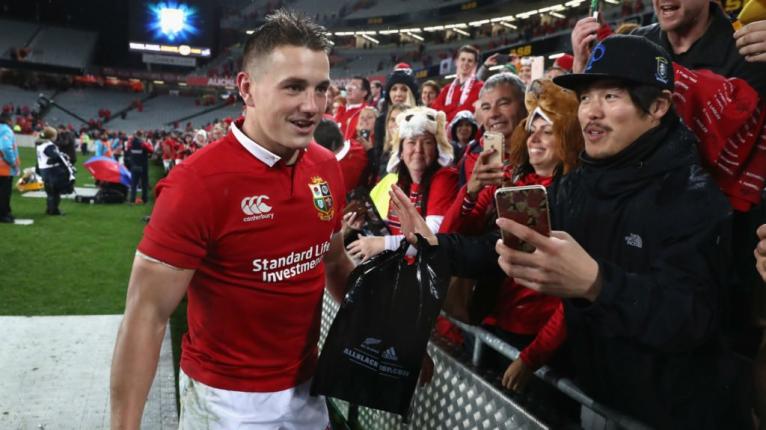
“It’s about making sure the speed of ruck and ball-playing is at pace. A big thing for us is having momentum and being able to fill the field.
“Sometimes we get caught up with [the idea] of having one side of the field overloaded, and that makes it easy to defend. We need to make sure that the whole field is used to attack from. You have to be dynamic with the ball and build momentum.”
After spending so many seasons playing within Warren Gatland’s restrictive, but successful power system with Wales, featuring a very powerful ‘banger’ at 12 in 6ft 4ins, 110kg Jamie Roberts and a goal-kicking, defensive maestro at full-back in Leigh Halfpenny, it was as if the pennies had dropped from Foxy’s eyes. The sky turned blue and cloudless, and the West Walian saw the road to Damascus quite clearly.
A couple of years later, and perhaps mindful of the lessons from that series, Sir Steve Hansen was playing with his own new toy in the All Blacks. The answer to the growth of relentless ‘rush’ defensive systems was twin playmakers working together in harness – perm any two from the trio of Damian McKenzie, Beauden Barrett and Richie Mo’unga.
Whether playing together on the same side of the field or splitting to offer a threat either side of the ruck, the defence would find it harder to ‘tee off’ on a specific target with two men available to make the play. Whether it was Richie and Beaudy at the 2023 World Cup, or Beaudy and D-Mac [or vice-versa] in the Razor era, the tinkering with that same troika of playmakers continues to this very day.
Now the concept is receiving a modern makeover from none other than the Springboks, traditionally the last of the usual suspects standing in line to be finger-printed for dual playmaking. Where the All Blacks are still struggling to the find their 10 for a new generation, and the support he receives from full-back or second five-eighth is still very much a work in progress, South Africa can now legitimately choose a pair of playmakers from the trifecta of Damian Willemse, Sacha Feinberg-Mngomezulu and Manie Libbok. Three is the magic number.
As I explained in the piece after that stupendous 43-10 victory in Wellington, the key to success has been the shift of Willemse from 12 to 15, making room for the power of either André Esterhuizen or Damian de Allende at inside centre to keep the defence honest.
In both Wellington and Durban, the balance between kick, run and pass has been word-perfect in the fluid attacking Esperanto Tony Brown is looking to teach.

Since Willemse moved to full-back in the 37th minute at the Cake Tin, the Springboks have scored 14 tries and 105 points in only 123 minutes of play. In the final 20 minutes of the last two matches, the score is 54-0 to the Bokke. In round four the balance shifted slightly towards the pass, in round five it tilted towards the run and the kick. As Feinberg-Mngomezulu observed after the game, “This was a vibe, I am very happy. We just wanted to play good rugby, put the work we have done in training into the game. Playing transition scenarios, and getting the right balance between kicking and running — I think we did that.”
If Wellington was great, in Durban it was even better. One of the benefits of the twin playmaking system is it drops the two most creative ball-handlers and visionary kickers into the backfield together. In this aspect of the game, the output of Feinberg-Mngomezulu and Willemse from the Springbok backfield was greater than anything achieved by Beaudy, D-Mac and Mo’unga for the All Blacks, and that is saying something.
For Argentina, to kick the ball away to that pair was to invite death by thousand cuts, and the first incision was made in the 37th minute.
If there is a single point of difference between Damian, Manie and Sacha and D-Mac, Richie and Beaudy it is lies in the vision and the sheer power of the kicking game from the back. In this example Willemse passes to Feinberg-Mngomezulu for the Stormers’ outside-half to find the long diagonal killer blow. With the two men from Cape working together, the length from the backfield was nothing short of prodigious.
“We just wanted to play good rugby, put the work we have done in training into the game,” Feinberg-Mngomezulu said. “Playing transition scenarios, and getting the right balance between kicking and running” – and that transition scenario for the Pumas was lethal indeed. The peak of backfield performance occurred just after half-time.
First Willemse does what the Wallaby backfield was signally unable to do in their two-match series versus the Pumas, and neutralize the threat of Rodrigo Isgró in the air down the right-hand side; moreover, he is able to create quick ball in the transition for first Pieter-Steph Du Toit and then Jasper Wiese in the following phase of play. Then the second arm of the playmaking axis swings into play, with Feinberg-Mngomezulu immediately stretching the field to the far side with a pinpoint-accurate crosskick to Cheslin Kolbe for the score.
There could be no more lucid illustration of Jon Davies’ prophetic words eight years ago. Two phases of play is all it takes the new Bokke to paint the perfect picture, attacking first down the left, then up middle and finally spreading the ball wide right in the process of ‘filling the field’ in one deadly attack.
The threat from run or kick from the backfield was a constant thorn in Albiceleste sides.
On the rare occasions that Sacha was absent, there was never any question Damian could not fill his shoes and impart the same impetus with ball in hand.
Willemse first passes from first receiver, then cleans out over the first ruck and is on hand again, to overcall for the ball from RG Snyman on the scoring phase – three actions all in the space of 20 seconds of attack. There is never any pause in play for an overstressed Argentina defence to regroup, and the pressure is suffocating.
That is what the dual playmaker system can do for you. For the Springboks, it is finally making the heartbeat of ‘Tony-ball’ tick over, and in robust health. As Pumas skipper Julián Montoya commented ruefully after the event, “South Africa are the best team in the world and they capitalised on every mistake we made.”
Ever since Willemse made the fateful move to full-back after an early injury to Aphelele Fassi at the Cake Tin, the Springboks have been unstoppable. With either Libbok or Feinberg-Mngomezulu at 10, Willemse at full-back and Canan Moodie at centre, it is the same arrangement which demolished the All Blacks 35-7 at Twickenham on 23 August 2023.
The hand of destiny has given Rassie a poke in the ribs, a little reminder of what is possible on a rugby field, and as ever, the Springbok supremo has taken the hint on board. There is the potential for Sacha, Damian and Manie to take the myrtle green and gold game to a whole new level. Dual playmakers, triple playmakers, ‘three is magic number’.


Comments
Join free and tell us what you really think!
Sign up for free