
If there’s one common thread that can be traced through Australian rugby since the dawn of professionalism, it’s been the continual line of genuinely world-class, on-ball openside flankers.
NEW: Follow Your favourites in the App 📱
You can now follow their favourite teams, tournaments and players in the RugbyPass App!
It might even extend well beyond the advent of professionalism in the 1990s, if we’re honest, but there’s no denying the lineage since the game turned pro.
It starts with David Wilson in the late 90s and quickly moves to George Smith in that period Australian fans knowingly refer to as the ‘Golden Years’, a period that hasn’t really been replicated since. Annoyingly.
Alongside Smith, there was current Rugby Australia CEO Phil Waugh, and David Pocock, now a Senator in the Australian parliament, followed soon after that. Michael Hooper wasn’t too far behind, and now it’s Fraser McReight. With the possible exception of Waugh to Pocock, most of those reigns have overlapped to some degree. And there’s been other notable contributors along the way, too: David Croft and Liam Gill, to mention two.
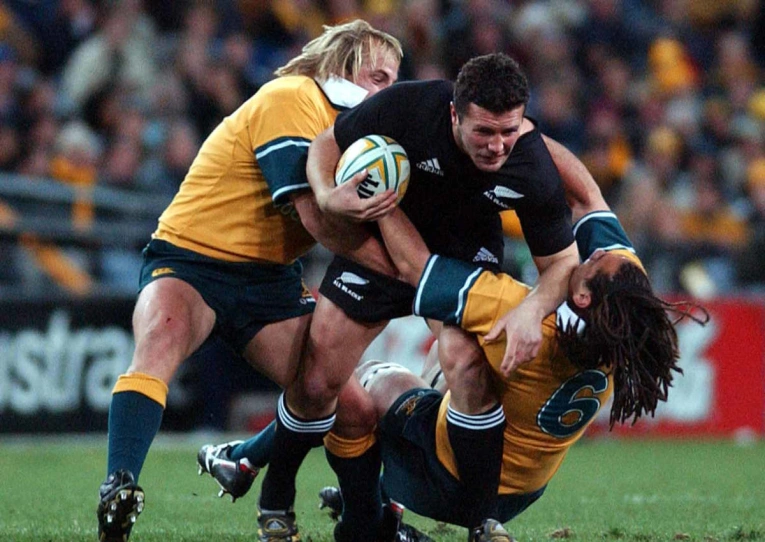
During those overlapping periods, discussion and consideration and selection converged at times, resulting in two of these great opensides starting Tests together.
Smith and Waugh. Pocock and Hooper. And the Wallabies might be entering another period of overlap.
McReight and Tizzano.
As he did against Italy in Perth last month, Carlo Tizzano has relished another opportunity to start a Test match. Against Japan in Townsville, he was phenomenal at the breakdown, winning three outright pilfer penalties, while also being among the Wallabies’ top ball-carriers and tacklers.
Tizzano has fast become the kind of on-ball threat that you’re better off either avoiding completely, or forcing him to make the tackle in the first place.
Though he’s a regular starter for the Western Force, he’s only started eight of his 16 Tests, and almost always when McReight is being load-managed – be that coming off the bench or rested completely.
But after such an eye-catching performance in Townsville, Tizzano’s stocks are only rising.
The three ruck turnovers won were outstanding both for the technical and physical accuracy involved, but also for the time in the game they occurred. Japan didn’t have a lot of opportunity to build attacking phases in Australian territory in the second half especially, and much of that was because of the timing of Tizzano latching onto available ball.
Even better might be the lessons he’s learned from past experiences. We only have to go back to Tizzano’s near thing in the second Lions Test in Melbourne to know how fine the margins are when it comes to these turnover penalties won. The pain from that one moment is still real; we can all feel it.
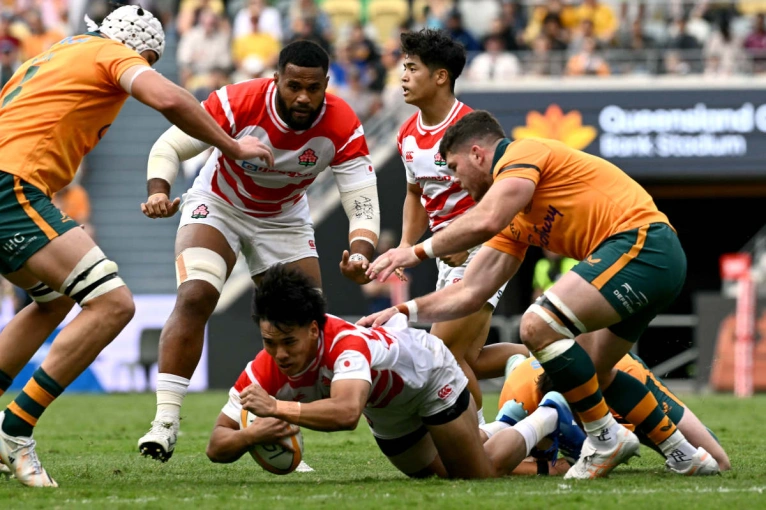
But watch Tizzano now and take note how many times he’s penalised in the same situation? I’d wager it’s way less than was the case last year. With another year’s experience and a really strong showing through Super Rugby Pacific this season to hone split-second adjustments to his timing, Tizzano has fast become the kind of on-ball threat that you’re better off either avoiding completely, or forcing him to make the tackle in the first place.
On Saturday in Townsville, there were those three turnovers won and not one penalty conceded. His timing was excellent and the decision-making around when to hold off and when to latch on was spot-on.
And when McReight did get onto the field with around 15 minutes to play, one of his first actions was to win a pilfer penalty of his own, almost as if to serve as a reminder that his powers are just as strong over the ball. That was a turnover won that screamed, ‘I’m still here’.
‘Is there a world where we see a Wallabies team without an out and out No.7? You pick tall timbers in a back row and don’t have a McReight or Tizzano?’
The interesting part of this is that it all comes at a time when teams are flirting with the idea of playing a bigger back row for physicality, which has lessoned the need for a true fetcher in the No.7 jersey. More and more players around the field these days – hookers, locks, centres, wingers included – have become adept at winning a ruck turnover, and it’s certainly no longer the exclusive domain of the openside flanker.
Through the Six Nations this year, we saw No.8s like Ben Earl and Caelan Doris starting Tests for England and Ireland respectively in the No.7 jersey. The All Blacks really haven’t had a true on-baller since Sam Cane finished up, with the likes of Ardie Savea, Ethan Blackadder and latterly Luke Jacobson playing on the open side. None of their breakdown work was compromised by any of these selections.
Indeed, only last week on Stan Sport, Morgan Turinui floated the idea of Australian coach Les Kiss trying a similar idea.
“Is there a world where we see a Wallabies team without an out and out No.7?” he wondered out loud on Between Two Posts. “You pick tall timbers in a back row and don’t have a McReight or Tizzano?”
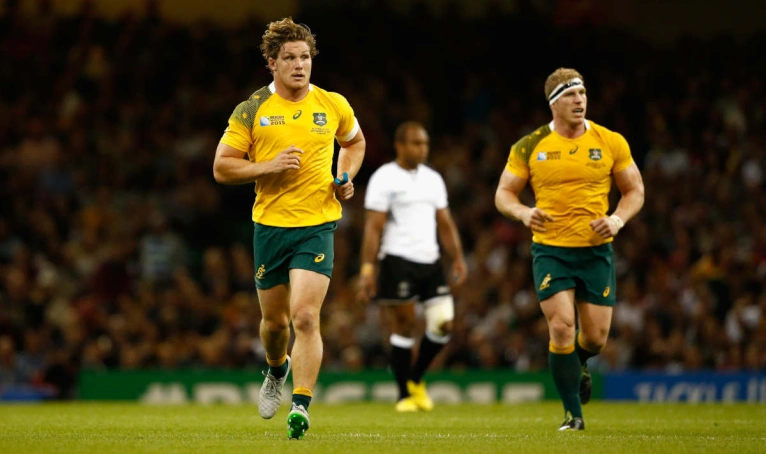
It wasn’t to advocate for any massive overhaul of the Wallabies game plan, just a flow-on from a broader discussion about things Kiss would or should be looking for as he embarks on his grand plan of having the Wallabies firing ahead of the Rugby World Cup on Australian soil next year.
Michael Hooper, part of the aforementioned long line of great Wallabies opensides, was, perhaps surprisingly, in strong agreement of the concept.
“Well, who got the steal early in the match (in Osaka)?” he pointed out. “McReight is one of the best jacklers in the game, but he didn’t come up with one for the match. Josh Canham did. He got one of the big turnovers. Tom Wright did.
“It’s the tackle that’s often so important to leading into the player getting over the ball, and we’re seeing second rowers be a lot better at that, at stealing. I see, certainly, a world against South Africa or France… where you would pick a massive back row.”
To wrap it up, Turinui threw up some names: “You could go [Will] Skelton and Canham (in the second row), and then [Jeremy] Williams, [Tom] Hooper and [Rob] Valetini, or something like that, just as a change-up.
“It’d be interesting. We’ve always just picked the out-and-out seven, but we’ve never really looked at it differently.”
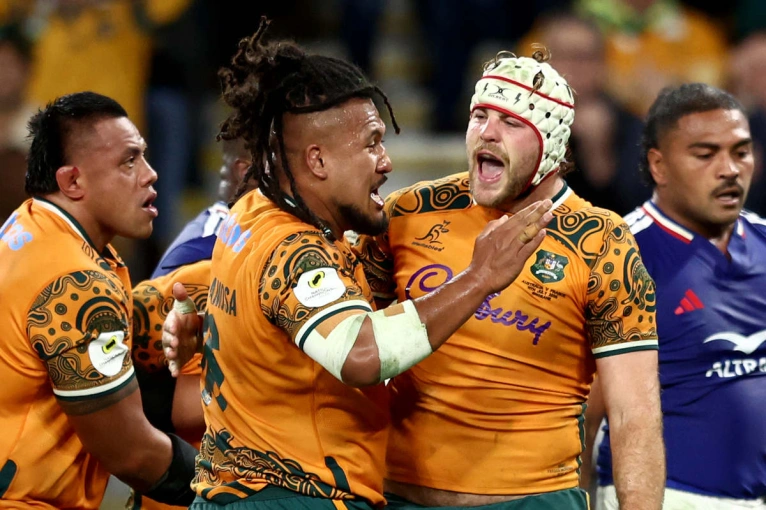
And that’s certainly true. The concept of the No.7 ball thief is about as ingrained in the mythical ‘Australian way’ of playing rugby as running the ball at all costs.
And maybe Tizzano and McReight were watching Between Two Posts, and thought, ‘hang on, we can’t let this stand!’ Their performances, within an otherwise excellent back-row performance, were certainly a timely reminder of the value of being able to turn defence into turnover opportunity.
It’s probably enough to kill the idea of not playing a fetcher dead before it’s even had a chance to become a broader discussion.
For now, the Wallabies have two truly outstanding openside fetchers at their disposal and the challenge is quickly becoming ‘how do we fit both of them in the team?’
It’s a hell of a problem for Les Kiss to navigate.
 Register your interest to receive priority updates on RWC27 ticket releases. Don't miss out, stay in the loop!


If Kiss keeps McRight as a regular player, he should be the captain. I can’t see Wilson surviving against the competition he is facing, brought about by some great 6’s pushing Bobby V into 8. Also Cale offering a greater skill set.
Would like to see a big mobile 8 to add to the competition.
I am a Reds Fan and people are going to hate this….But I am going to say it….Start Carlo and put Fraser on the bench…..and use him as a Kwagga-like player. This opens up our bench selections. IMO, Fraser spends so much time in our backline as it is so we may as well leave the door open for him to play in the centres. Then we have the option of having both of them on the field either in the forward pack or Fraser in the centres (12) so we don’t compromise our lineout in the forwards for games where the lineout battle is strong. This is how I would use them, particularly since almost all of our current backline covers 13, wings and 15.
Hooper, Tizzano, McReight, Valetini, Wilson, Cale, Samu before you start looking at Kemeny who won his club’s player of the year, or hybrids like Williams or Shaw. Backrow isn’t a problem position for us talent-wise - it’s just a big challenge to make sure we get the balance of speed, power and height right for each game.
I think one top-quality lineout operator is non-negotiable, so would move Bob to 8 and run Hooper and McReight/Tizzano against the Boks and ABs.
Might get away with both against Japan but you’ll get monstered agains the Boks or France with two small 7’s. Wilson’s got heart and obviously brings some leadership to the group but Hooper, Valetini and McReight look like the most balanced starting back row.
That is the back row I would be running, but honestly, I think Carlo is actually better for the team than Fraser…and I am a Reds fan. But can not deny the impact of Carlo’s in-closer game. Fraser is a freak of a player without doubt…but he is spending a lot of time out in the backs…I commented on it above; in fear of repeating myself, is Fraser the modern hybrid player? 7 and 12 cover?
I also see Hooper in the back row as creating more flexibility on the bench as a bonus.
Here is hoping the Wallabies don’t go down the road of twin 7’s again. That experiment has failed multiple times and it is a negative on a good pack.
McReight is the better of the two and a much better link player, I rate Tizzano highly and enjoy his combativeness, commitment and level of play. However, way too much will be lost if they try the “Dual name nickname” template again. Consign it to history.
I’d be pretty happy to consign the contrived nicknames to history either way! The editors haven’t done me any favours today.. 😏
I’m not so sure a pair of out and out 7’s is a good combination. The Hooper at 7 and Pocock at 8 worked for one test but was easily managed by the good teams and in my opinion a huge reason why the team dropped down the world rankings with more losses than wins. I think the solution for both McRight and Tizzano is easy. If you’re the best 7 and you’ll get a game, if you’re not, work on your game so you are.
And it was funny KwAus, Hooper was essentially playing the Ben Earl no.8 role, in that pairing, with Pocock still very much playing as the on-baller..
It failed with Smith and Waugh and again with Pocock and Hooper . The best sevens were moved to accommodate lesser players . Smith at 7 and David Croft at 6 may have worked . Croft was better than Wau . A Pocock at 7 Hodgeman at 6 may have worked .
There is nothing between McReight and Tizzano at 7 . Niether would be good at 6 or as good as Valentini .
du Toit is the best 7 in Rugby . Olivon as well ! Both big and mobile . Fetchers are overrated in Australia . They usually give away as many penalties as balls they win .
du Toit is of course plays blindside, South Africa’s opensiders wear no.6..
Agree, Boks and France have been playing without an open side fetcher for years .. seems to be just Australia and England that are hanging on to the jackle specialist at 7. Even the AB’s with not picking du’Plessis Kirifi after a stellar season but preferring Luke Jacobson’s ruck hitting and grunt work on defence.
The thing is breakdown work is no longer the preserve of the number 7 and to some degree almost anyone on the field will find themselves at some point in a position to have to play fetcher.
As such it doesn't really make sense to carry out and out specialists anymore simply as a matter of course and having both McReight and Tizzano creates a different dynamic because whilst they both play the position similarly in the way they attack the ball they offer slightly different advantages.
McReight is a better organiser for setting up mauls and drives off rucks but Tizzano is a better general ball carrier and link man and he tends to bend the line more and have more impact in the carry.
Defensively, they're very similar, both getting through a mountain of work and with usually pretty high accuracy and reliability. But curiously they don't get in each other's way as might be the concern with both trying to do the same thing.
Having multiple open sides on the field at the same time creates different challenges for the opposition because they suddenly find themselves in a position where setting rucks presents more of a risk to losing the ball unless they rapidly get numbers into the mix.
But having to do that constantly deprives your attack speed because at each ensuing phase you will end up with less and less numbers behind the ball due to those you've had to commit just to offset the additional regular contender at the breakdown. Eventually a mismatch will occur and you'll lose the ball or get penalized.
We've seen such tactics deployed successfully by Australia before and in more recent times by many teams including but not limited to the Home Nations, New Zealand and South Africa. So it's a proven tactic.
Generally speaking, it can only work when you have other players step up and fill in the usual grunt work that a more traditional no 8 fulfills so having an enforcer-style blind side and second rows that get into the mixer to do the cleaning and menace the opposing pack is what you need.
The Wallabies seem to have discovered this at just the right time with a number of players who can step in and play that hybrid 8 or hybrid 6 role with the current standouts being Williams, Cale and Hooper.
It's also been good seeing a more combative second row contingent in the likes of LSL and young Miles (although currently banned) and even Shaw getting in on it a bit too.
That's something that Swain definitely offers and obviously the side will get back in abundance once Skelton returns from injury.
I think what has really stood out from the last two matches and especially the match on Saturday is that the energy of the team has completely changed.
Everyone is looking to get involved and no one is standing around waiting for someone else to make something happen.
As a result, the specific lineup of personnel is less of a factor in the performance as players will simply fill whatever role is required of them in the moment.
So Kiss can comfortably throw two open sides on knowing that there will be no drop in performance because whatever redistribution of tasks needs to happen will simply occur as the players will make it happen.
When a side becomes predictable and staid, the opposition no longer has to wonder what is going to be thrown at them. They can just line up and wait for it to unfold and easily account for it.
That was unfortunately Joe's weakness as a coach with Australia because he was too conservative and couldn't incorporate enough variation into what he wanted his side to do.
Why it worked with Ireland is because the players never stopped employing their own natural tendencies nor did they give up their nous for the game plan.
So whilst their overall performances may have become rather monotonous they were still successful because they still had enough individual flair and creativity to handle difficult situations.
Kiss seems to value personal initiative in a more obvious and direct way and is not resistant to change. If something isn't working, he will simply try something else not just hold on for dear life in the hopes something different will happen while changing nothing.
And knowing that he has this kind of variation of being able to put both McReight and Tizzano on the field at the same time is exactly the sort of out of the box thinking that Australian rugby has been missing.
I’m not a fan of dual(ing) sevens. If Les wants to run the experiment in a tough match OK BUT, only in the last 20-30 mins, assuming our tight 5 have done the work up front and in the Lineout.
If Kiss wants to experiment, I would like to see Cale at 7, he has an awesome skill set and support speed, and could put serious pressure on opposition backline. He also loves to finish tries.
The question of the modern game… are you better off having a specialist 7 or a big ball carrier who adds to the lineout, given it is the most effective try-scoring component of the game and the best tool to secure/gain territory?
If you are going to run both players in the match day team….Fraser would have to be a Kwagga-like option covering 12 and 7.
Sorry brett, but you have some learnings from this one 😂 “..which has lessoned the need for a true fetcher in the No.7 jersey. More and more players around the field these days.” I don’t see the McZanno as a regular feature going forward, but I do see a more regular rotation and horses for courses approach between the two based on opposition. Interestingly, games the WBs play against arg are often quite unstructured, so this actually may be a time where tizzano is more likely to be in the fold.
Lessened perhaps. Lessoned is not a word.
Oh goodness… 🤦♂️ I don’t even think I can lay blame elsewhere for that, NH. Obviously, I’ll try…
Skelton, Canham, Williams, Hooper, Valetini and BPA. An impressive line up. Power, jumpers and poachers.
If Kiss wants to make his mark in history, then go for it. At present we are on course to stagnate outside the top 5.
I see a lot of potential. There’s better props than France’s; more potential and probably depth and quality in the centres, outside backs and backrow than Ireland; the makings of a more cohesive team identity than England has. There’s been some good talent-spotting, training and development under Joe Schmidt and now Les is turning them loose. Plenty to like.