
Let’s begin with a caveat. Assuming they win their final match in Cardiff on Saturday, South Africa is the number one success story from the Quilter Nations Series. The Springboks will have won all their games, and they will have banished both of the pretenders most likely to dethrone them, France and Ireland. With either 14 or 15 men on the field, it did not matter – the Springbok juggernaut rolled on relentlessly.
But beneath those titans in green and gold, the distant specks of mortal endeavour have been visible, busy with their own improvements. There were more storied levels of success which would have made for epic tales on another day. England achieved a clean sweep, beating three Rugby Championship heavyweights and exorcising the ghost of the All Blacks.
South Africa aside, the biggest good news story was neither Australia nor New Zealand, but Felipe Contepomi’s Argentina. Over 20 years ago, ex-Leicester and England outside-half Les Cusworth was a technical advisor to the Pumas, looking to move them forward from the dark age of VHS videotapes and into the enlightened day of DVD, comparing La Albiceleste to the England he knew as a player, before professionalism ever happened.

Cusworth had been involved with Argentina since 2001 when he began working as an adviser to then-coach and ex-Pumas centre Marcelo Loffreda. He lived in the suburb of Hurlingham, where the well-heeled properties might have been transplants from a village in picturesque Kent or Surrey or Sussex. “We started out with what now feels like a medieval form of analysis: we had two VHS tapes and a knife and fork,” commented the Welford Road will-o’-the-wisp wryly.
How times have changed. Last week Cusworth was delivering a report to the Rugby Football Union on the lessons that can be learned from the Pumas success under Contepomi. With the rump of players of national interest having emigrated back to Europe after the demise of the Super Rugby Jaguares in 2020, that is probably the highest compliment that can be paid.
The situation is still not too dissimilar to 2001. Cusworth again, preaching from his pulpit 24 years ago: “There are 400 Argentine players in Europe. The challenge is how many we can keep here. The UAR [the Argentine Rugby Union] is amateur by statute. There is a big fear going professional might unravel the club structure that has been built up over the years.”
The image of rugby as a game for the amateur elite, and the upper-class privilege embodied by colleges like Contepomi’s own alma mater Colegio Cardenal Newman, and clubs such as CASI [Club Atlético San Isidro], CUBA [Club Universitario Buenos Aires] or SIC [San Isidro Club] is slowly changing for the better.
The UAR recently announced the creation of a fourth professional franchise in the Super Rugby Americas competition, Los Capibaras. They represent the region of Litoral, and join the existing Dogos XV [based in Cordoba], Pampas [Buenos Aires] and Tarucas [Tucuman]. With clubs from Brazil [Cobras], Chile [Selknam], Uruguay [Penarol] and Paraguay [Yacare] also involved the SRA is beginning to firm as a South American version of the URC in Europe.
The quality? The top sides would give it a fair shake in the RFU’s newly-branded second-tier ‘Champ’ but fall short of Currie Cup or NPC standard, and the attendance for one game between Los Tarucas and Os Cobras reached a high-water mark of 8,500, with the Argentina-based sides regularly hitting 5-6,000. However modest the financial rewards compared to salaries in France or Japan, the game is growing and more professional pathways are opening up.
As UAR president Gabriel Travaglini pointed out at the announcement: “This development strengthens not only Argentina, but also rugby throughout the region, because it expands the talent pool, raises the bar, and enhances the spectacle. We are convinced that this addition will enrich the tournament and serve as a driving force to continue driving the growth of South American rugby.”
The increased presence of local professional pathways is extending the social reach of the game into new neighbourhoods. The two ‘growth detonators’ were Argentina’s success at the twin World Cups in 1999 and 2007. In 1999 the Pumas beat Ireland at the group stage and advanced to the quarter-finals; in 2007 they progressed even further, finishing the pool above Ireland and hosts France, and beating Scotland in the quarter-finals before losing to eventual winners South Africa in the last four.
As the Pumas valiantly resisted the final frenzied Irish assaults on their goal-line in 1999, the equivalent of Dixons and Currys in Buenos Aires switched TV channels to cover the conclusion of the game. Clusters of spectators formed spontaneously outside shop windows to support the national team. Wind the clock on eight years later, and the kick-off in the famous Boca Juniors v River Plate football derby was amended to avoid a clash with the Pumas’ quarter-final against Scotland. For once, La Bombonera remained silent. It did not tremble, or send out tectonic ripples across the capital city in celebration of the round-ball game. For one day at least, rugby was king.
As Jorge Busico, the founder of a school for journalism in Buenos Aires observed: “2007 was a great, big detonator. Many more people started to play rugby and more clubs were created. There was a really major expansion of rugby in Argentina. There is a whole [new] culture of rugby being played for money. Today’s players, unlike 15 or 20 years ago, want to earn money playing rugby. [Where the game] used to belong to an elite class, this is no longer the case… [although] it has never ceased to be a sport played by a certain class.”
The famous Bombonera stadium has murals of local dockworkers painted on its walls, as rugby, just like football is beginning to celebrate the lives of ordinary people. You can still see those dockyards on the Atlantic coast from the topmost tiers of the stadium itself, the tiers closest to heaven.
The appeal of the game to ordinary folk in Argentina, and beyond that South America , ill only be highlighted by the Pumas’ current run of success under Contepomi. Nowhere has their game improved more than its spectacular outcomes in the second half generally, and the last quarter in particular.
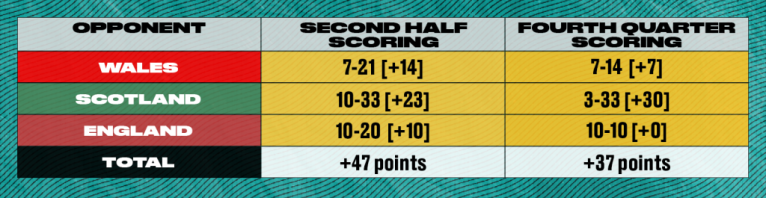
On their November tour, the Pumas won their second halves by an average score of 25-9, and their final quarters by an average of 19-7. They scored a massive 69% of their points total in the second period and 53% in the last 20 minutes. Giving the game definite shape and punchy direction off the bench is very much ‘on trend’ in international rugby and Argentina, along with South Africa and England, were the trend-setters not the trend-followers in November.
Two of the most promising introductions to the harsh world of international rugby have been at prop, with 23-year-old loose-head Boris Wenger and 20-year-old tight-head Tomás Rapetti arriving as the two front rowers voted ‘most likely to succeed’ since the days of Marcos Ayerza, Juan Figallo and Ramiro Herrera. Wenger was promptly gobbled up by Harlequins and will receive quality tuition from Adam ‘Bomb’ Jones at the Stoop. Rapetti was signed by Top 14 powerhouse Toulouse after the 2025 Junior World Cup, having represented the prestigious Asociación Alumni club in Buenos Aires and tracked the professional pathway through Los Pampas in SRA. Super Rugby Americas has become the new bridge linking Argentines to professional contracts overseas.
Nicky Smith is one of the top three scrummaging loose-heads in Europe but he must have been surprised at the sheer power generated by the 6ft 3ins, 125kg rookie in the last half hour in Cardiff.
— William Bishop (@RPvids1994) November 26, 2025
— William Bishop (@RPvids1994) November 26, 2025
Rapetti is likely to joined by at least one of his mates from the U20s in the full Pumas senior squad, with 150kg monster Gael Galván already contracted to Stade Rochelais in the Top 14. Rapetti ground through the gears to the very end and set the platform for the last Argentine try.
— William Bishop (@RPvids1994) November 26, 2025
That is what you call ‘bench impact’. Rapetti against Wales, and Santi Carreras versus Scotland, played only the last 35 minutes of each match but had a dramatic effect on the outcome. Scotland were winning 21-0 when the man named in RugbyPass’ team of the Rugby Championship arrived.
The uptick in Argentine backline confidence was palpable with the Bath playmaker on the field.
— William Bishop (@RPvids1994) November 26, 2025
— William Bishop (@RPvids1994) November 26, 2025
With the Pumas behind on the scoreboard, the man with 22 on his back ran and passed, igniting moves from within his own half to build tempo.
— William Bishop (@RPvids1994) November 26, 2025
When Argentina finally nosed ahead, he pinned Scotland back in their own 22 with the kicking game. The Pumas scored their last try after turning over the next lineout, with Carreras providing the scoring pass to Justo Piccardo. It was a fitting climax for a team which is setting trends rather than following them.
South Africa may be out on their own and playing the rugby of the gods at the present moment, but there is plenty of life and even a little of the ambrosial nectar filtering down the level below. England are thought-leaders in the current game, but so are Contepomi’s Argentina. Not even the newly-minted ‘Pom Squad’ was able to dominate them in the final quarter of the last game at Twickenham.
The UAR is steadily building a professional layer in South America via the Super Rugby Americas tournament, and the social demographic of the rugby-playing public in Argentina is slowly changing in response. One day, the Pumas may even be able to stage a game of rugby at the old chocolate box, and an oval ball will swirl and tremble over the dockyards. Now, wouldn’t that be something?


A troll headline. Ye gawds! The way people are carrying on about the ABs. One would swear they’ve dropped to…er…3rd! LOL! Hilarious. This is NOT a cratering team…(well, probably by their lofty standards… You know: anything less than #1 is a disaster.) People! Next, we’ll have them being compared to Wales. If they played the Poms again, I’d put my money on the Kiwis. And the Poms are a good team. Review this link & look at the standings in 2019. I promise you, you’ll be gobsmacked …https://sports.d1ofezjcys9fmh.amplifyapp.com/insight/official-world-rugby-rankings-comprehensive-guide-to-international-team-standings.html
Do Argy have no right to be compared to the ABs? I think the two teams are pretty close. Argy don’t have the scrum or the depth as yet as shown in the article, they will prob have both in the next few seasons. Hence the ‘overtaking’…
now that would be the feed of champions
Only if he us weighing the real black gold aka the paua
YEah Argentina and Australia have showed great spirit this year, playing some amazing back foot (LP can play it anytime) rugby.
Very interesting what the dynamic is going to be in Argentina, I queried this on the last article. Hope all the little nuances can work in their favour, a four team pro model seems like a good start, I hope everyones willing to get behind it, a bigger setup below it would be best but maybe they can do it their own way, using Acadamies etc rather than clubs and provinces.
Was a fan of Rapetti when I first saw him walk onto the field. I note that it must have been Smith who was the reason Wales scrum did such a good job in the weekend then.
Whats this though?
What was the report about and what did he say? What compliment? That he was asked for a report?
Nicky Smith didn’t play at the weekend, best to watch the game before you comment JW.