
After four Tests against a Springboks team that is becoming one of the all-time greats, the All Blacks have learned that their single biggest failing is they have lost the art of building pressure.
NEW: Follow Your favourites in the App 📱
You can now follow their favourite teams, tournaments and players in the RugbyPass App!
When they were the game’s leading team and chasing greatness between 2010 and 2019 the way South Africa now are, the All Blacks knew how to build and maintain pressure on their opposition by stacking repeat moments of calm, accurate and disciplined play.
Passes would go to hand, lineouts would be straight, scrums solid, cleanouts technically perfect, discipline immaculate, kicks would find touch and there would be no way for opposition teams to get out of the bear hug.
They would be squeezed into submission; broken by the way New Zealand would crank the handle, play by play, until it was inevitable something had to give.
It was weaponised excellence in that golden era – as it is now for the Springboks. But throughout Rugby’s Greatest Rivalry series, these 2026 All Blacks couldn’t, or at least only rarely, showed they had the patience, accuracy and discipline to produce big, consecutive moments to build the pressure on South Africa until they cracked.
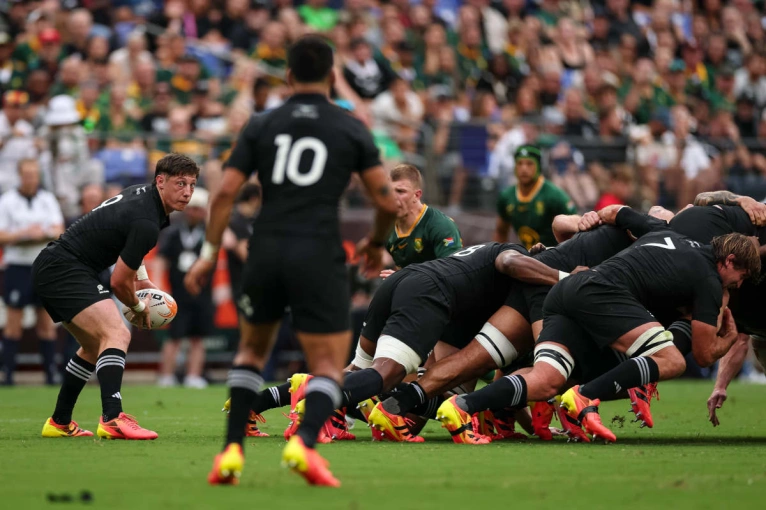
The total penalty count across the four Tests shows the All Blacks conceded 44 to the Springboks’ 36, but that number does not tell the full story of how ill-discipline hurt New Zealand.
Of those 44 penalties, too many were what coaches would call “soft” or “dumb” – needless acts that served no purpose. In the final Test in Baltimore, Tupou Vaa’i was penalised for holding Cameron Hanekom’s leg at a ruck and the backline was pinged in the first minute for being offside.
There were penalties in other Tests for cleaning out players past the ruck, for obstructing from kick-offs and talking back to the referee.
These acts of ill-discipline often came at critical times – when the All Blacks were building momentum and starting to put the Boks under pressure.
All three coaches have laboured the point to their players that discipline is critical, and yet behaviours are not changing. Is there then some deeper fault hindering the All Blacks?
It’s tempting to call them brain explosions, but really they were indicative of something deeper: an endemic fault in the New Zealand rugby system that does not deter poor discipline and maybe even encourages players to try their luck to see what they can get away with.
Ill-discipline, after all, was a feature during the Ian Foster era from 2020-2023, as it was during Scott Robertson’s two years in charge between 2024 and 2025, as it is now under Dave Rennie.
All three coaches have laboured the point to their players that discipline is critical, and yet behaviours are not changing. Is there then some deeper fault hindering the All Blacks?
“I wonder whether in Super Rugby it’s not always refereed strongly,” Rennie said, when asked whether there is an institutionalised problem around discipline.
“You come to internationals and you’ve got referees who are pretty tough in that area. But we’ve got to take accountability for that.
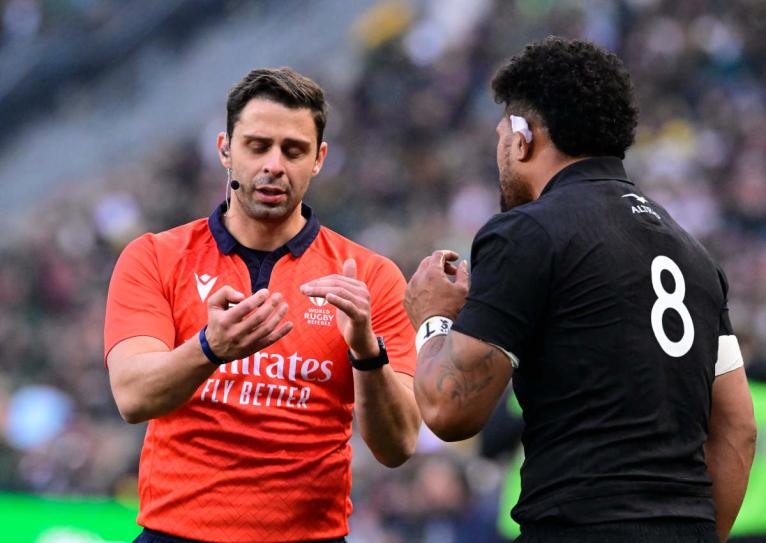
“At the start of a game, we’re offside at the first ruck. When you’ve got referees who, especially the English, are very technical, they’re going to try and set the game up and pick things like not rolling away and offside early. So, we’ve got to be smart around that.
“There’s no excuse. We’ve got to be better. We can’t give teams like South Africa soft entry through soft penalties.
“It’ll certainly be a focus for us and it has been. I think the penalty count was 10 tonight [Baltimore], which is not a big number. We’re not looking to be zero because we want to push the limits.”
The All Blacks only kicked one penalty at goal – and missed it – whereas South Africa kicked nine out of 10 – 27 points that they used to build pressure.
It wasn’t just ill-discipline, though, that derailed momentum for the All Blacks. In Baltimore, Richie Mo’unga missed a penalty for touch, there were lineout losses and scrum penalties – all of which meant New Zealand didn’t put South Africa under the same intensity of pressure.
They couldn’t build pressure to the point where they kept the scoreboard ticking over to the extent they probably could have, when other metrics such as line-breaks and defenders beaten are considered.
Also, the All Blacks only kicked one penalty at goal – and missed it – whereas South Africa kicked nine out of 10 – 27 points that they used to build pressure.
The one time in the series when the All Blacks stacked the big moments consecutively was in the final 25 minutes at Ellis Park, when they won an unexpected scrum penalty in their own 22 to relieve the pressure.
Then Quinn Tupaea executed a smart 50-22. A solid scrum enabled Ardie Savea to set up a try for Luke Jacobson and from there – having gone 26-16 up with 15 to go, they then played in the right areas of the field and let South Africa implode with two yellow cards that paved the way for two more tries.
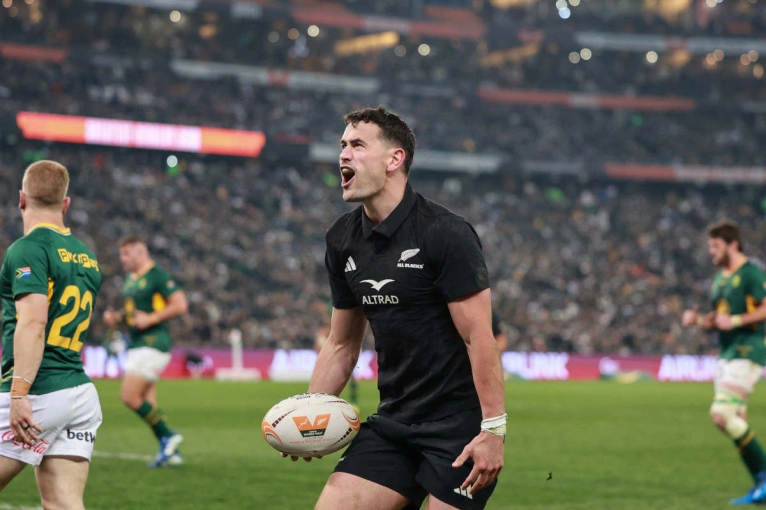
It was the perfect example of how to squeeze an opponent into submission – but for the remainder of the series, it was the Springboks who did that.
As Rennie summed up after the 43-28 defeat in Baltimore, a game that was genuinely in the balance with 10 minutes to go: “There’s a lot of good stuff. I think the boys showed a lot of courage defensively and a lot of scramble.
“I think on attack, when we’re patient and accurate, we scored 17 tries in the series. So, it tells you that when we get it right, we’re a handful. But we made too many errors tonight. They stripped a couple of balls out of our hands.
“But ultimately, that hurt us a bit because we just couldn’t apply pressure for long enough. It’s a little bit about a balance of our game. We’ve kicked reasonably well on this tour.
“We didn’t kick so well tonight. Just not contestable enough and we gave them too much space. They were pretty lethal.”
The big mystery of the last few years has been why New Zealand aren’t better at recovering the high ball, as this feels like it’s a skill-set that should be very much in their wheelhouse.
The hardcore analysts will say that this is all academic – that cleaning up the discipline, winning lineouts, kicking for touch and landing penalties wouldn’t make a critical difference when South Africa had such ascendancy at scrum, maul, the aerial battle and turnovers.
There’s no doubt the All Blacks have to improve in all four of those areas to be globally competitive at the highest level.
On the former two, the return of Tamaiti Williams will undoubtedly help as it will give the All Blacks another power scrummager and the depth at loosehead that they didn’t have in South Africa.
Not everyone will agree, but the return of Scott Barrett will be a major boost in both areas too as well as giving the All Blacks another ball carrier.
The big mystery of the last few years has been why New Zealand aren’t better at recovering the high ball, as this feels like it’s a skill-set that should be very much in their wheelhouse.
They hatched a plan to use the retreating wing to be the catcher and to try to group the bodies behind to mop up the scraps, but the Boks were either able to beat them in the air and win a clean catch or get between the retreating wing and awaiting full-back.
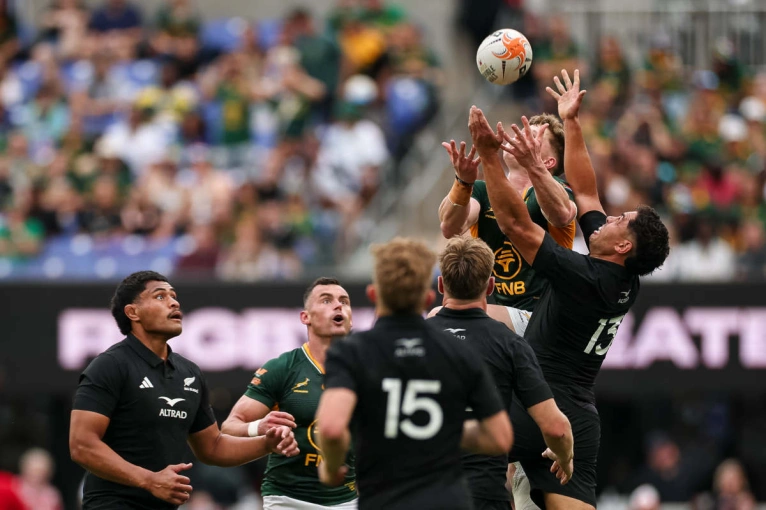
Arguably, coming out on the wrong side of the kick retrieval stats hurt the All Blacks more across the series than the scrummaging battle did. It enabled South Africa to hold the ball for long periods and advance up the field.
But still, while there is no doubt that the All Blacks were hurt by South Africa’s scrum, maul, kicking game and turnover work, they were hurt more by their own inability to build those pressure sequences.
“It is literally the difference between winning and losing,” said All Blacks No. 10 Mo’unga in Baltimore about the ability of the Springboks to stack the big moments.
“If you’re able to build momentum and build pressure and stack those moments, we’ve seen when it happens we get rewards, but [sometimes there’s] a soft penalty or we don’t get the bounce we want.”
As to the question of how to fix the problem, Mo’unga feels the answer will lie on both sides of the ball.
“I think there’ll be a real good conversation around ‘how can we build pressure?’,” he said. “I think we’ve seen what we can do with the ball, but it might be what can we do without the ball. What does our defence look like and how do we really suffocate them down in their own half?”
 Register your interest to receive priority updates on RWC27 ticket releases. Don't miss out, stay in the loop!


It’s funny how much Scott Barrett was hated last year. Now he is going to be their saviour. You just know that is going to end well. Building pressure starts with great forwards something the All Blacks don't have at the moment.
Rennie has a lot of isdues to address
Selection
Played Mounga and then didn't let him run the cutter, Jordy Barrett once again doing everything.
Pasker has a reasonable 3rd test never sited again
Vair at 6, not a loose forward, also not really an international lock.
Fthis outstanding invoice SR, so let’s pick Carter ahead of him.
No punch in midfield
Wobt win WC with Mackenzie, Vaii playing.
Tactics
Wary of SA scrums mauls and lineout, so we try to avoid it.
Basically pass it, some times for the sake of passing, what happens, sooner or later you drop it and go to Scrums.
Needed to confront the SA forwards in certain areas and get a line breaker in midfield
Catch the ball running backwards, who would have thought of this.
Mainstream media don't delve into his failings enough.
Except they weren’t.
The refs were just very poor throughout the series and more often than not they were wrong to penalize the All Blacks, and in cases I noted the Springbok too.
You can say this is because Super Rugby has the best referring or whatever, but that doesn’t change the fact that many of those penalties shouldn’t have been given.
Referees should really be decided by the host nations, not World Rugby.
Yes the ill discipline has certainly become an issue and need tiding up prity smartly. Certainly hasn't improved under Rennie.
Apparently Paul Cully has written an article saying that NZR is going to make another push for privatization of Super Rugby and getting outside money in to pay domestic wages.
This is a more important issue, it will not work.
NZR needs to think about completely revamping the make up of rugby in New Zealand by focusing on what matters to the people.
Right now it’s really a mess. It works (don’t know what NZR is spending their money on now that’s causing them to go in the Red, but it’s certainly not domestic player funding which has been static for decades now) but it could be so much better. We need one seamless game.
- Run the Club (Super Rugby and local competitions) and Provincial game (rural representative based teams) in parallel against each other but as slightly separate entities.
- Have both trying to achieve the same goal, the domestic title (say like old AFL v NFL Super Bowl), and continental participation (Super Rugby P). This means a new national club competition that Blues, Crusaders etc, take part in, along side ventures like Tasman (the perfect example given the Vikings where killed by NZR) and Moana, Ponnies etc.
- Have a top echelon of teams were say a dozen + teams have 10k+ crowds (achievable by a 150k+ pop areas) and say half a dozen that push 20k. This means reducing the spot light (currently over 20 odd teams) on the top level and fracturing bigger areas like Auckland into multiple teams (Blues and Auckland RFU etc).
- Develop pathways for youth by introducing new competitions like a College league.
That’s that’s your 5 or 6 current Super clubs, plus either a combination of either strong PU’s or more club investment.
This basically forces a split between professional players and amatuer players, but will still keep the tradition for everyone of being able to aspire to be an All Black or Black Fern, with enough investment being put into the amateur game/PU’s that by the peak ages of 28-30 these players are physically capable against professionals.
Personally I would give a huge spotlight to this group for the purposes of sustaining the importance of Rugby in New Zealand. If you leave the balance for pro sport to take over it will eventually kill the game.
- Run cyclical windows through the year when one competition takes over from the other, domestic club, pro club, rep rugby, Super, All Black etc all have their time in the spot light. And at other times use approaches similar to US sports and French rugby where Div 2 teams have their own timeslot/day.
- Run it regionally, and shared to promote growth over the whole country. Think like 3 pools from 12 of the top ranked teams. The balance of club vs union teams amongst these depends of factors like performance on field (earn more places through holding the title) and off field (rewards for crowd sizes and participation levels etc).
- Step it down and involve everyone. So a region might have 4 or 5 teams ranked in the top division but they all still play each other, including club v union inter matches in a joint table. each level down (so including the top level ofc) can also play similar level teams from the other regions.
You end up with more derbies and meaningful matches for you’re community, while also being able to delineate a clear competitive ladder for those teams able to compete at the highest level and external or neutral fans with no real skin in the game.
A top ladder might like like
Taniwha
Blues
Auckland RFU
Moana
Chiefs
The Bay
Hurricanes
Tasman
Crusaders
Canterbury
Highlanders
And a second div who’d want to fight to keep their best players from joining a club, but ones who stay are eligible for a Super Rugby Rep based team (they choose to be rewarded by being picked on performance rather than sign a contract based off their prospect value as a junior)
Harbor
Ponsonby
Some rich persons team
Counties
The other Bay
Taranaki
Manawatu
Petone
Wellington
Nelson
Lynwood
Otago
Maybe some clubs start to push out the unions in time, as they get more and more professional now that they have a higher tier to aspire to, but essentially it’s going to be clubs that have heavy financial backers that make their way up etc.
This will be all very familiar to NZ rugby fans as the local club comps rely heavily on an up and down nature, playing in one competition then another. Teams would easily transition between a domistic league table to then hold a regional or national match, all the while have clear and concise tables.
Everything is making them go into the red except the All Blacks. They probably will end up privatizing the Super Rugby teams because they have no option.
One easy fix is for Rennie to tell the team that any really stupid ill-discipline like: Holding players in the ruck, back chat to the referee, or fighting etc. Will result in the player getting dropped for a game - no exceptions, even if the captain etc.
But thts precisely what theyre told to do!
Good article, Gregor.
I did express some reservations when Rennie first came in, about his very public statements about brutality etc, and whether some refs would see this as provocative. Think it would help if the ABs dialled back the hype on that, and any reference to ‘napalm’ at the ruck, because the refs come looking for AB transgressions. Besides, the bitter truth is that the Boks were far more brutal and won the collisions that counted, backed up by the dominant tackles and meters-after-contact stats.
We need to be able to dent the gain-line if we are to put pressure on. Otherwise we’re going sideways and can be picked off. So I hope the AB selectors are looking at forwards who can do that. Aumua and Tauke’aho over Taylor, for instance. Holland shifting to tight-head lock and always starting. Segner over Blackadder (huge respect for Blackadder and his engine but he was rag-dolled several times in that one sequence before Jordan scored his try). And maybe, Barrett over Vai’i at 6.
We’ll know the true fallout from that tour when the squad for the Wallabies is named. Has Tosi, for instance, cooked his goose? Did they see enough of Ma’u to regard him as more worthy of investment? What did they see of Tavatavanawai that precluded him even being on the bench for the tests? Was that Beauden’s swan song - do they really need another back-line coach, or cover now Richie’s back? Is Reiko now the starting centre, given his Leinster experience should make him a great defensive fit with Jordie?
Lots of questions.
Makes a mockery of the idea Rennie was doing something dodgy at the breakdown doesn’t it. They got smashed.
Absolutely key is finding the balance of power runners who play within the middle parts of the field, and can control possession. The wider players. Savea and either Sititi or Lakai, fit that wider channel play, but our 6 needs to more of a 5.5 and play more centrally. Without effective ball running props, apart from Numia, that comes from hooker and the 2 locks or 6. Barrett and Holland back, and dare I say it Parker or Frizzel, gives us bulk and workrate at those spots. Aumua and Taukei’aho, not Taylor. Vai’i play closer in if 6.
It is naive and arrogant in the extreme to think we can play with width only, or too early, to beat SAF. Their d system GIVES us the space, and they cover superbly and then napalm our wide breakdown. Failing that ruck turnover, they blitz our next runners as we can only go one way back infield. Too much back door play and sideways running by us. High risk, high demand, hi early QF exit
{Dear god, can Rugby Pass make up their mind who actually wrote this…}
Joisus, finally a bit of perspective in the writing about the AB’s and recent history. Other day we also had Paul Cully, who is so wildly incompetent he still thinks Jamie Joseph is an AB grade coach, actually concede that the lack of a lot of basic skills in NZ players might have more to do with the NZ rugby system, not the AB head coach. Taken them a while, but when you have an agenda I suppose you have to work it through before you recognise that the problems might go a little deeper than your scapegoat...
First, the lesser issue is that Rennie is cocking up the whole discipline issue. With his teams its structural. His teams basic playing method are based on "flooding the breakdown", which actively risks conceding penalties. That is a club only strategy. You will get destroyed at test level doing that, as Rennie is finding out with the AB's, just as he did with the Wallabies.
International referees rule the game they way they do. Trying to talk them into refereeing the NZ way is as stupid as it is arrogant. Whinging about "a gravy train of penalties", a comment by his principal assistant, Neil "Out of his Depth' Barnes, is loser talk, and will only alienate the refs more, particularly the English ones.
And despite what the author claims, the AB's discipline improved significantly in 2025. It was how they beat SA at Eden Park, and quite convincingly, by being precise and disciplined. Now Rennie has taken the AB's backward, and in fact is actively encouraging less discipline with his basic tactical method, for all his hypocritical complaints about the consequences.
The biggest problem though is that Rennie is encouraging the worst possible traits in NZ rugby, not countering them. Chronic lack of discipline that is not punished by sloppy referees. Appalling catching skills and kick management. Impatience with and without the ball.
The Crusaders and Canterbury have won as much as they have during professionalism, and dominated the AB's when the AB's were at their peak, because they are far, far more patient, organised and skilful than NZ, Aussie and SA club teams.
The rest of NZ's teams all play in the same way; one step away from a brain explosion. Maybe, just maybe, if they got control of themselves they would spend less time whinging about the AB's losing and Crusaders/Canterbury winning. Not holding my breath.
Certainly haven’t noticed that. Teams been very standoffish at the BD for me.
Still sore about “Out of Depth” Razor losing his job I see…..
The interesting subtext here is the idea that if NZ fixes their mistakes they would win. As an AB supporter I like that sub text. But the reality is that the Boks are a well oiled machine, with settled core of key players and a coherent game plan that enables them to move smoothly throught the gears and dominate most if not all teams at the moment. Until the ABs can build a settled core of top players (especially forwards) and build a coherent game plan around them, the dike will keep spouting “mistakes”.
Did he really say that (didn’t read it through)?
Discipline would obviously help the cause but lets not act like Gregor Paul has any idea that he knows what he’s talking about.
Actually he probably does think it’s as simple as playing Mounga and playing a perfect game of football but you are totally right.
The All Blacks have always held that belief and I think it is key to do so. If The All Blacks are able to play our game then we should, we can and we will win. However, this mindset has cost us in the past. Mainly around being too stubborn to take the 3 points or do drop goals. We got the mix right in 2015 when Carter could do it all but it took a long time to get the team to do this even in close matches. Hell we still barely took the 3 points on offer in SA. Test rugby is test rugby and you should always look at building scoreboard pressure.
When Rennie coached the Wallabies, the ongoing messaging around brutality, character, edge etc resulted in us having a discipline issue as well. I used to put most of the blame on the brumbies cynical playing style at the time and the heavy influence of the ponies in the wallabies setup. Perhaps Rennies philosophy as head coach was more of an influence than I first thought. Now the ABs have a similar issue it seems.
From memory mused those were a lot more specific breakdown infractions. Perhaps he has moved on to pressuring other areas though?
Bingo !
Except here we wish we were seeing this brutality. Currently the boys are only giving away dumb penalties, nothing that also hurt their opposition.
Except, as the article says, it's been a problem for years. Regardless of the coach.
Doc Craven walked into a rugby theory class one morning and asked how long each of us thought we had the ball in our hands during play in a rugby game - after much deliberation it turned out that about 3 minutes was the top end of having the ball in your hands.
Richie hit the nail on the head right at the end of the piece above.
“I think we’ve seen what we can do with the ball, but it might be what can we do without the ball.”
What you do off the ball in a rugby game far outweighs what you do with the ball. You can be as good with the ball as you like for five minutes of the game if you are getting outplayed off the ball for the other seventy five minutes draw your own conclusions.
Yeah, that lack of effort from the All Blacks in this series is synonyms with Ardie Savea’s style of rugby and recent low’s.
He was fantastic when playing for Moana in Super rugby and along with our Hurricanes examples the boys did a great job of trying to do without off the ball effort (like covering the tries Carter let it). They wanted to go wide and then forward, not so much stop the opposition from doing the same.
One of the two areas is going to have to get better that’s for sure.
Nail + head
Similar principle applies to on vs off the pitch actions and the narratives coming from the AB coaches recently have been a stream of poor excuses that are entirely unbecoming.