
Stereotypically Italian things are generally accompanied by a date. The period a Roman emperor ruled, for example, or the vintage of a fine Chianti Classico. The dates provide the context, and the context provides the relevance. When it comes to the rise of Italy as a rugby nation, this context is too often lost – and Italian rugby viewed as one homogenous lump.
It doesn’t matter how well Italy perform in the current Six Nations, some people still harbour the same dated perception – which is really weird. An Italian win is still treated like it’s a one-off performance, or a single positive blip, which ignores how consistent their game has become at all levels. It’s reminiscent of the problem Argentina had when they joined the Rugby Championship. Even to this day casual supporters think the Pumas are the easy option when facing the southern hemisphere teams – which is bonkers.
In their early years in the Six Nations, isolated wins for Italy were the prime goal. Sometimes those wins would be punctuated by two or even three-year gaps. That is not the case now and it hasn’t been since the early 2020s. Italy are now toppling their rivals every season – sometimes more than once per season. It’s like watching Cesar Millan, such is their ability to get the big dogs to roll over.
Italy’s performance against Scotland was a great example. Many people thought Scotland would win in Rome – but why? At the time of writing, Scotland are just one place above Italy in World Rugby’s rankings. Before the game kicked off, they were one place above Scotland. Which also makes some Scottish fans’ reaction to the loss even more unusual. When you consider Scotland lost to Italy, then comfortably beat England, it seems like more of a comment on the increased quality in Italian rugby – rather than the demise of Scotland or England.
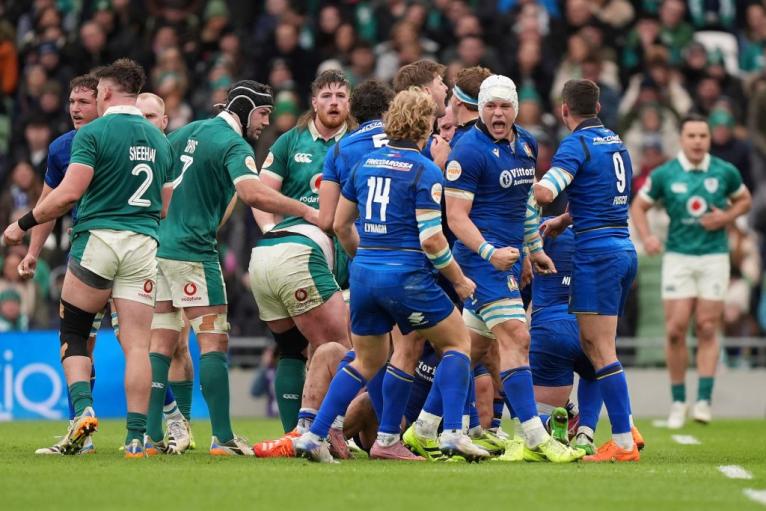
Then there was the hyper competitive performance against Ireland, in Ireland. Italy could easily have won that match – and not through flukey intercepts or controversial red cards. Italy were Ireland’s equals in Dublin, literally, they nearly matched them stat for stat. But the key metric, was not ‘metres carried’ or ‘metres kicked’, but ‘how many metres can a front row forward’s backside be lifted into the air’ – Irish props dominated that category.
Italy either have a weird genetic programme underway, or it’s one of the greatest coincidences in the history of rugby they have identical players in Michele Lamaro and Manuel Zuliani.
In the past, Italy have had solid packs, or some good backs, but never at the same time. That is not the case now. And nor it is the case that Italy can now only perform at home. There was a time when Italian away games were treated as a possible banana skin for those teams dwelling at the lower end of the table – traditionally Wales or Scotland. But Italy have now started exporting those banana skins direct to Ireland, England, France, Wales and Scotland – there’s one on its way to Cardiff, via courier, as we speak.
In the front row Italy now have players who can compete with some of the best in the world. Simone Ferrari, the tight head, is in line to become one of the players of the tournament. Giacomo Nicotera is currently the most accurate lineout thrower in the competition and Danilo Fischetti has become the loosehead we all thought he would.
In the second row they have the hugely impressive Andrea Zambonin – a player who along with France’s Mickaël Guillard, is going to dominate Six Nations lock play for the next decade. Then there’s Niccolò Cannone, who at just 27 has become one of the greatest Italian enforcers since Augustus established the the Praetorian Guard. Together with his brother, Lorenzo Cannone (who plays back-row), they are the top tacklers in after two rounds.

In the back-row, Italy either have a weird genetic programme underway, or it’s one of the greatest coincidences in the history of rugby they have identical players in Michele Lamaro and Manuel Zuliani. Both have necks which require trundle wheels to accurately measure and offer a ‘ground threat’ few teams in the world can replicate. Some think it unwise to have two players of that type in the starting team – but it is working. Having two means one is always on their feet. The result is the opposition must constantly overpopulate rucks – something which coaches are not keen on doing for long periods of time.
In Paolo Garbisi, Italy have the perfect 10, who also looks like he could do a job at seven. Garbisi may only be 25, but he has matured hugely. Where he once used to try and do it all himself, he is now equally adept facilitating – it’s arguably the greatest lesson a playmaker can learn at the highest level..
Then there are the first-choice Italian centres Nacho Brex and Tommaso Menoncello – two gentlemen who sound a bit like a food, and a drink, and are just as tasty. They are one of the best centre pairings in the game, with both offering ‘gainline’ as their first skill – then everything else as a beautiful extra. Something that is becoming rare in a game where many inside centres are becoming pass/ kick first and gainline second.
This Italian team has nothing to do with those from the early 2000s – and we should stop referring to them as such.
In the back three, Italy have a balanced combo of attacking and defensively capable players. The most underrated probably being Monty Ioane, who presents a credible threat every time he touches the ball. There are some wings in the game who enter contact with a slightly worried expression on their faces – Ioane is not one of those guys.
Marshalled by the brilliant Gonzalo Quesada, this Italian team has nothing to do with those from the early 2000s – and we should stop referring to them as such. Those early squads were of course Italian pioneers, with a few high-quality players who could create the occasional win. This bunch are different. They are a composite of high-quality players across the squad – and capable of beating plenty.
This is Italian rugby in 2026, not 2006.

Plot your team's route to the Six Nations title with our Six Nations score predictor game!


Comments
Join free and tell us what you really think!
Sign up for free