
Wind the clock back, all the way to 2005. It turned out to be a Grand Slam season for Wales after an endless drought, 27 years of waiting and yearning; but at the midpoint of the tournament, nothing had looked less likely.
HSBC SVNS returns to Cape Town this December!
Don't miss your chance to see the world’s best rugby teams take centre stage 5-6 December in Cape Town.
Halfway through the third-round game against France in Paris, Wales trailed 15-6, and it could have been a lot, lot worse. On the back of what France coach Bernard Laporte later called ‘10 minutes of madness’ just after half-time, flanker Martyn Williams scored two rapid-fire tries and Wales unexpectedly fought back to score 18 of the next 21 points and run out winners in a cliffhanger, 24-18.
The surprises had started earlier in the week, when it was revealed the sponsors name on the famous red shirts had to be changed. Cardiff-based brewery Brains had been adopted as the national rugby team’s main shirt sponsor in 2004. At the time Brains bitter was one of the most popular beers in the country, but the Loi Évin restricted the advertising of alcoholic drinks across the Channel.
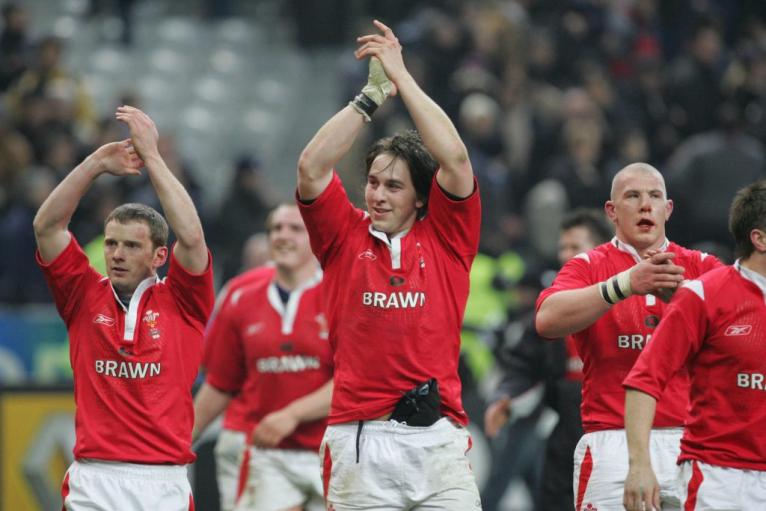
The law meant Wales were unable to wear the brewery name on the shirt front in Paris. By the wave of a wand and a subtle sleight-of-marketing-hand, someone came up with the solution, via a cunning bit of punnage: ‘why not change Brains to Brawn?’
Mike Ruddock’s charges needed ample reserves of both the last 10 minutes of the game, defending for their lives on their goal line for what seemed like an eternity, as home supporters shook the stadium in Saint Denis. France called for scrum after scrum, with set-piece giant William Servat at the epicentre of every pushover attempt. God knows how, but Rob McBryde and the Welsh scrum survived the storm, and emerged into the clear air, and blue sky of a ‘W’.
Servat was one of the three strongest scrummaging hookers in the world since the new millennium began. The current scrum coach of the Ireland national team, John Fogarty, once told me felt his arm go limp just before he blacked out completely in the middle of a scrum against Servat, playing for Leinster against Stade Toulousain, such was the pressure brought by the man not-so-playfully nicknamed La Buche [‘the Log’].
The other two were Springboks – Bismarck du Plessis in the 2010s and current Bokke scrum Atlas, Malcolm Marx. Nobody who watched the South African scrum destruction of the British and Irish Lions in the first Test of the 2009 series will ever forget it. Du Plessis’ prowess was such he had forced skipper John Smit into the unfamiliar position of tight-head, but the carnage Du Plessis and Tendai ‘Beast’ Mtawarira wrought on the other side of the tourists’ scrum was nonetheless something to behold. The Springboks of that era had the brawn, and they also had the ultimate brains behind it in the shape of scrum-half Fourie du Preez.
On the evidence of their past two Nations Championship matches against France and Ireland, the world champions have lost the balance between brawn and brains. The scrum power based around Marx remains, but there is little or no intelligence behind the key option-taking and play-making positions in the backs. There is no Du Preez, or Willie le Roux to give South African play shape with ball in hand. It may be temporary; it may be long-lasting. But right now, that is indisputably a fact of life.
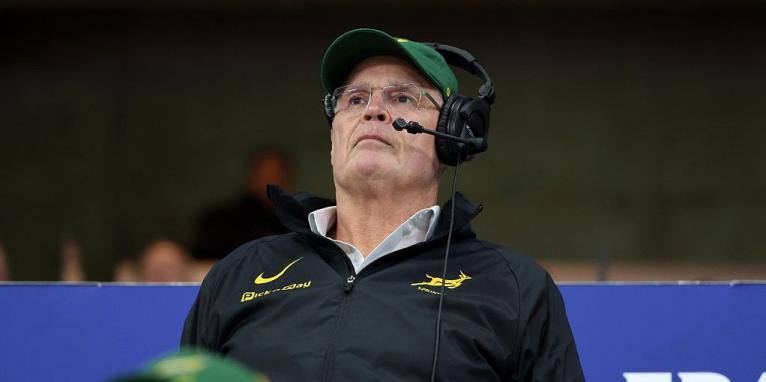
And that is why Rassie Erasmus’ latest missives against officiating is nothing more than a smokescreen, designed to camouflage the team re-engineering needed in the background. Erasmus is the first coach in history to understand it is quite possible to double up as a top head coach and a prime social media influencer, but the irony of his complaints is that for the most part, Erasmus got the game he wanted from referee Andrea Piardi in Paris.
South Africa won the lion’s share of the penalties, 14-11 in a high-penalty count game, with the scrums providing eight of those sanctions. Those are the kind of stats which won the Springboks the RGR series. In Dublin under the auspices of Englishman Christophe Ridley, the Boks also won the penalty count overall 10-8 and the scrum penalties by three to one, and South Africa won two other turnovers by free-kick on the opposition put-in, while losing none of their own. If you are winning the penalty count overall by 24 to 19 and the scrum penalties/turnovers by 13 to one, there really is no reason to be blaming the officiating for your own failings.
The potential issue for South Africa at next year’s World Cup is their opponents are finding solutions to their scrummaging issues quicker than the Springboks are able to rediscover the lost balance between brawn and brains. This time last year, Ireland conceded nine penalties and two yellow cards at scrum time, at the weekend the deficit was trimmed to two penalties and no yellows at all.
First to Paris. France found work-arounds in their game-management which outweighed the Springboks’ scrum dominance. Unlike the English Prem referees in the fourth round, Piardi only asked for ‘shoulders out’ by both of the loose-head props at the very first set-piece, without repeating the instruction at every scrum. When scrums did rotate left as a result, he simply rewarded the feeding team, which was invariably South Africa. The tipping point arrived between the 63rd and 69th minutes.
https://t.co/UqQlYccYcS
— William Bishop (@RPvids1994) November 19, 2026
https://t.co/M1pRRuCCAb
— William Bishop (@RPvids1994) November 19, 2026
At the first reset, Springbok tight-head Wilco Louw is angling in and down into the centre of the tunnel. At the second time of asking, the scrum lasts for a full eight seconds and Les Bleus finish the more dominant of the two, dumping the South African front row on its collective backside.
Some neutrals would assuage that the Springboks got lucky, because the scrum was a close copy of the critical turning point in the opening Test of the Greatest Rivalry series, when a penalty had been awarded to the defending side in very similar circumstances.
https://t.co/SASXW3up2T
— William Bishop (@RPvids1994) August 23, 2026
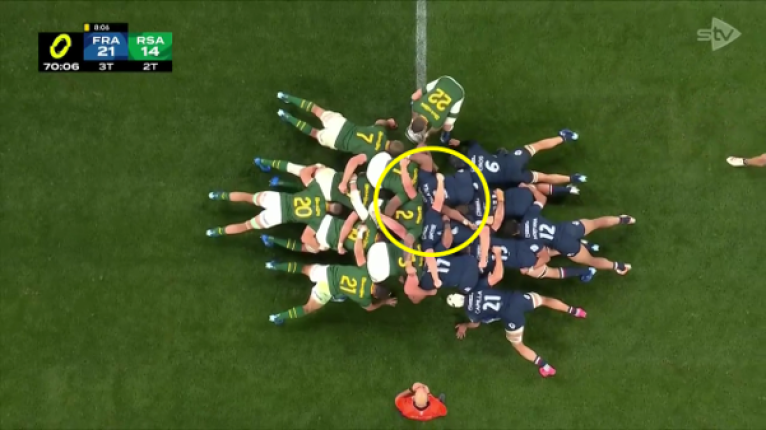
The domino effect of Springbok penalties put French tight-head Régis Montagne on yellow-card notice, and he duly received his marching orders at the very next scrum. That in turn meant Sipili Falatea had to return ‘cold’ after a full 50-minute shift at the coal-face, and it cascaded into South Africa’s one truly dominant scrum of the match.
https://t.co/O5LEifL6FE
— William Bishop (@RPvids1994) November 19, 2026
Falatea and his hooker Maxime Lamothe try to wedge in on Malcolm Marx, but the Bulls new rake is way too powerful and drills the gap between them as the UBB tight-head rolls in at 90 degrees. Fair enough.
Where France looked to pincer on Marx to limit his effectiveness, Ireland’s plan in Dublin was to present Tadhg Furlong slightly ahead of his two club-mates in the front row, and crab to the right to stop Ox Nche walking around their tight-head.
https://t.co/LLwsQFcYPL
— William Bishop (@RPvids1994) November 22, 2026
In contrast to the same game in November 2025, the men in green were never either demoralised or dismantled at the set-piece, and they enjoyed their own moments of success against the opposition feed.
https://t.co/X4m4aStwQD
— William Bishop (@RPvids1994) November 22, 2026
https://t.co/wJBFdJy86h
— William Bishop (@RPvids1994) November 22, 2026
Although Andrew Porter was penalised for walking around in the second instance, he clearly wins the hit against Wilco Louw and could count himself unlucky with the outcome. If Ireland are feeding the ball, they probably win the penalty under the current refereeing ‘rules of engagement’.
The one occasion where Porter lost the moment at ‘set’ resulted in a wheeling pushover try for South Africa.
https://t.co/TKW5EjLrTy
— William Bishop (@RPvids1994) November 22, 2026
But when the ball moved outside the set-piece, there was little comparison between the alertness and ingenuity of the two sides.
https://t.co/VIm7An2T3s
— William Bishop (@RPvids1994) November 22, 2026
After reclaiming the ball from a contestable kick, South Africa can think of nothing better than to hack it through aimlessly, in stark contrast to the slick handling and sharp awareness on the ensuing kick return by Ireland. There is brawn in abundance, but no brains behind it.
The last time the Springboks endured consecutive losses to Ireland and France was in November 2022. It provoked another refereeing outburst by Erasmus one year before a World Cup, and World Rugby’s head of elite referees Joel Jutge lamented the Springbok coach’s use of social media to voice his complaints.
Four years later the pattern has been repeated, but this time around the Springboks have lost to the same opponents while looking devoid of attacking spark. If the Boks lose the Nations Championship final against France – their third defeat on the bounce – Jutge’s question then – “What will be done to make [Rassie Erasmus] stop? I don’t know” – may have been answered, without words, but by the actions of his own team.

NEW IN THE APP: Official World Rugby Rankings hub! Compare team rankings side-by-side, with data going back 20 years.
Download the RugbyPass app on the App Store (iOS) and Google Play (Android) now!


Comments
Join free and tell us what you really think!
Sign up for free