
It hasn’t taken long, Already the pressure is mounting on Dave Rennie, the head coach of the New Zealand All Blacks. Just days after the unexpected loss to Wales in Cardiff, the host of the Aotearoa Rugby Pod, Ross Karl, proclaimed in conversation with ex-England scrum-half Ben Youngs, “Yeah, look, the patience has run out. They just lost to Wales. There is no patience left. That hasn’t happened in 73 years.”
HSBC SVNS returns to Cape Town this December!
Don't miss your chance to see the world’s best rugby teams take centre stage 5-6 December in Cape Town.
That was before the 37-12 loss to England at the weekend and before New Zealand fell to an historic low, fifth place in the world rankings. In the wake of that chastening defeat at the old cabbage patch, the chief executive of NZR Steve Lancaster came out to bat for his head coach.
Indeed, Lancaster quickly shifted attention to the length of the All Blacks’ season.
“The last two weeks’ performance is really disappointing and we need to understand how that’s come to pass, but [there is] no question over Dave being the right person to lead the team,” he said.
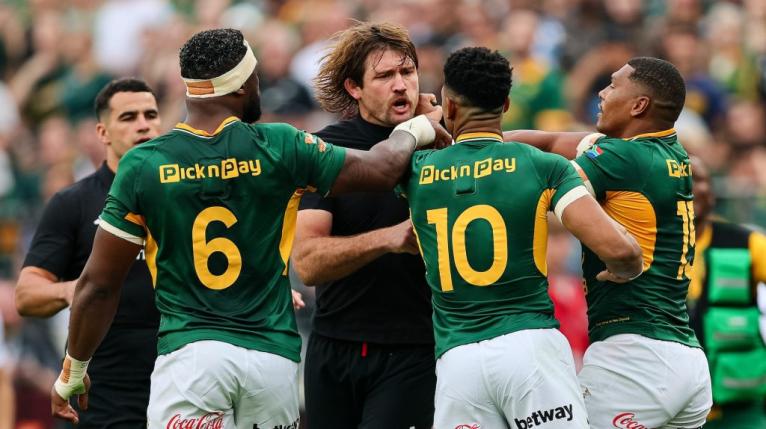
“We probably [never] fully appreciated just how gruelling that Rugby’s Greatest Rivalry series was. Those four Tests were unbelievable in their intensity, the quality of the rugby, but South Africa have lost their last two matches, three of their last four and we’ve lost our last two. We will have to look deeper to understand whether that has been a factor or not.”
The chief executive was promptly backed up by consultant selector Sir Graham Henry.
“It’s the end of the season and we’re buggered,” Henry said. “They’ve just got no gas in the tank, which is unfortunate, but that’s the way it is. Just too much rugby, you know. They’re just running out of petrol, which is really disappointing, but that’s the reality.”
Next weekend’s Nations Championship second place play-off against the same opponents will be the 13th international fixture the All Blacks have fulfilled in 2026, and that is pretty much par for the contemporary course. The situation was the same, if not worse for most of the representatives from the home unions who were called upon to turn out for their own nations and the British and Irish Lions in 2025. Skipper Maro Itoje played 13 games of international rugby in 2025, the most any All Black has played in 2026 thus far is 11.
To apply even more perspective, Australia played 15 games in the Lions year in 2025. During their World Cup-winning year in 2003, Clive Woodward’s England played no fewer than 17 games of international rugby. And while the RGR series may have a similar long-term impact of mental and physical degradation as a Lions tour, that is typically not felt until the following season.
If Rennie’s charges go on to lose their final game of the season next weekend, the ex-Glasgow man will have registered seven wins out 13 in 2026 at a 54% win rate. Scott ‘Razor’ Robertson was shown the door for posting a win rate of 74%, second only to double World Cup winner Rassie Erasmus. It has been a tumultuous 12 months for New Zealand rugby indeed, and there is little sign of the waters settling.
Some departments of the team have trodden water, or gone backwards from the beginning of the year. The lineout coached by Neil Barnes is ranked 11th out of 12 in the tournament with an 84% retention rate. It was an area of weakness against England, with the All Blacks losing four of their 12 throws, and it was an area of inferiority in RGR. As Rennie said afterwards, “obviously not being able to secure some of that lineout ball affected our ability to get our game going and get a bit of continuity. So, it added to the errors and turnovers.”
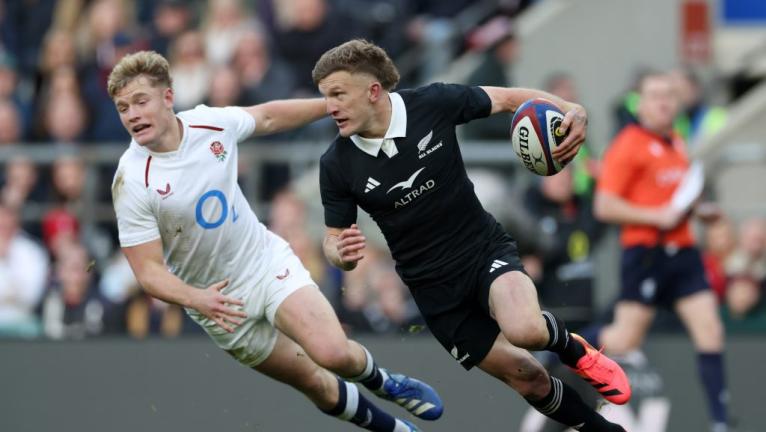
The defence coached by Tana Umaga is similar in structure to Australia’s and I have aired my thoughts on it. Like the Wallabies, the All Blacks have only forced half a dozen turnovers in the tackle in the Nations Championship, the lowest in the competition. The ratio of missed tackles which go for full line breaks is high [one in every 3.7 tackles] compared to South Africa [one break in 6.2 tackles] and England [one every 7.5]. New Zealand have conceded 22 tries – fifth in the table and below their closest World Cup rivals South Africa [14], France and England [18] and Ireland [19].
Perhaps the single biggest concern for Rennie after events at Twickenham was the absence of his typical imprint on the character of the game, regardless of its eventual outcome. While the All Blacks eventually lost the RGR series 3-1, they always left that imprint, but they left barely any traces in the water at all in South-West London. They came and went as quickly as a carnival over a summer weekend.
The All Blacks lost the battle for control of the ball comprehensively, making twice as many tackles as their opponents while building half as many rucks – 67 to England’s 135 – in the course of the match. That might be okay for South Africa, but it does not suit New Zealand under Rennie. Not one little bit.
“We had 30%-odd possession, 30%-odd territory, and turned over two-to-one to them,” Rennie said in the aftermath. “[We] just gave them too many opportunities down our end to hurt us and couldn’t get any continuity going in our game.
“Most of our footy we played at our end of the field. I think half-time, we’d made 130 tackles to their 39. Maybe that told in the end, but you look at the stats, we got well beaten in just about every number.
“Last week, I felt we let the country down, and it was a way worse performance tonight. The guys are hurting. There were so many motivating factors [in our favour] tonight. A good performance potentially puts you in the final next week with Beauden [Barrett] and Anton [Lienert-Brown]. There are a lot of reasons to front… but we didn’t. We need to work out why.”
While Rennie’s star is currently waning, England head coach Steve Borthwick’s is beginning to wax again, and one of the mainsprings of his side’s resurgence has been the return of Exeter’s Henry Slade to national colours in the number 13 jersey. Despite commanding form in recent club outings at Sandy Park, questions had been raised about Slade hanging on to one of the 25 Enhanced Elite Player Squad [EPS] contracts available for the current season. An EPS contract gives the recipient a guaranteed annual payment instead of match-by-match fees, and it affords more workload management options to the England coaches.
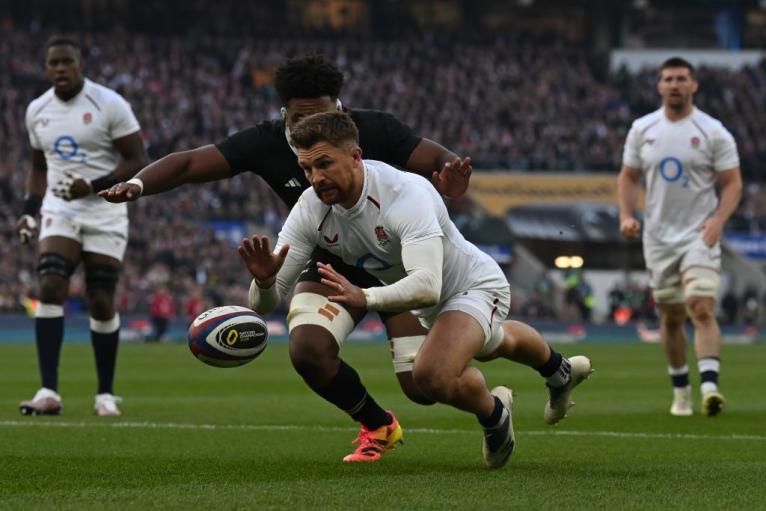
The truth is Slade should never have been considered as anything other than a first choice for his country, whatever the fluctuations in form. And his 13-Test partnership with Bath’s Ollie Lawrence in the centres remains the blue riband option for the World Cup in in 2027. England have only started two matches with that pairing outside Northampton’s Fin Smith, and they won both games at the 2025 Six Nations against first France, then Scotland.
If that seems hard on Gloucester’s Seb Atkinson, who has shown clear signs of improvement and provided a slick foil for Smith and Slade against the All Blacks, that is life in the big city. Lawrence has been hamstrung by injuries and mistakenly bumped from 12 to 13 for his club, but inside centre is where he belongs at this level of the game. For Lawrence and Slade it is the case that ‘form is temporary, but class is permanent’.
The combination of Fin Smith at 10, Slade at 13 and George Furbank at 15 grants attack coach Lee Blackett the three playmakers he needs to keep Borthwick honest in selection and ‘on trend’ with the Prem, and it gives English supporters the Northampton Saints-style attack they truly crave.
There were some exceptionally promising signs the trio could be just the medicine the doctor ordered for England’s recent ailments on attack, right from the start of the game.
https://t.co/SN5pZAHbCm
— William Bishop (@RPvids1994) November 23, 2026
A huge amount of sheer running power by the full-back and three-quarters is required to enable the swing attacks of the contemporary era function properly, and in this sequence Slade and Atkinson start on the right side of the ruck, with the Gloucester man [in the black hat] splitting wide right and Slade sweeping over to the left to make a close-set threesome with Smith and George Furbank. Once that trifecta is together, you know something good is about to happen.
Running power and repeat efforts were also theme of England’s next big attack, with both centres cleaning out over Will Joseph on the right at the start, then swinging back to the left to engineer a clean break on the opposite side of the field two phases later.
https://t.co/uEc94i8COi
— William Bishop (@RPvids1994) November 23, 2026
The criticism of Slade when he first came into the England set-up was a shakiness with keeping ball in heavy contact situations, but here and in the following example he finds a way to retain and present the ball expertly when lacking support after making the initial bust.
https://t.co/CiJ2oWSdvN
— William Bishop (@RPvids1994) November 23, 2026
With his background in the England age group teams as a 10, there has never been any doubt about the Exeter man’s ability to give and take a pass of sumptuous quality, especially off his left hand.
https://t.co/ckr1qUhj21
— William Bishop (@RPvids1994) November 23, 2026
That flicked pass to Joseph on the right is a thing of beauty, with Slade staying absolutely square to the defender and removing his ability to shift out on to the rookie Gloucester wingman.
All the old questions which appeared to have been banished by the brutally-swift exile of ‘Razor’ Robertson in January have returned with a vengeance after two consecutive losses in November. If Rennie loses again in the second-place Nations Championship final this weekend the naysayers will be further emboldened. To lose to England twice in two years may be considered unfortunate, but to lose three out of three would be more than just careless.

NEW IN THE APP: Official World Rugby Rankings hub! Compare team rankings side-by-side, with data going back 20 years.
Download the RugbyPass app on the App Store (iOS) and Google Play (Android) now!


The press proclaimed the All Blacks aura dead. Some in NZ have defended that. But what was that Aura. That Aura was that the All Blacks were feared, that they were the best in the world. Ruthless, efficient, punishing and never died easily. You could be 3 scores up with 20 to play and you never thought for a second the game was over. You knew they were coming regardless of what was happening, that everything would have to be earned with blood and guts and that you were in for an all consuming fight. If you didnt have it in you, you got smashed. If you had the fight in you, you might still get smashed, you were probably gonna lose a tight one and maybe just maybe you would claw out a win. That was real aura. There was no sign of that Aura in London last week. Nobody could see a way back for that team after England scored first in the second half. This felt different, it felt final, it felt like the All Blacks had no answers or solutions. It felt familiar, like it did in Twickenham 2023, Ireland in 22, the Boks in 25, and England last year. Its happened too many times now to say the Aura that inspired so much fear is still alive. That Aura is certainly dead, replaced now by a new Aura that the All Blacks are a good team but beatable and sometimes prone to collapse. No longer to be feared but to be respected and when they are under pressure, to be hunted and finished off.
England unfurled their attacking intent from the start. Earl was incredible, hitting the line with speed and power he was stepping like a winger too. He looked like Damian De Allende combined with Duane Vermeulen at times. They also attacked from deep often finding a quick player running at pace on the advantage line giving the NZ defence so little time to react. This all led to line breaks and points. it could have been more.
NZ offered very little in return. Their defence just busted open at will by pace or guile. Their deficiencies on defence have become glaring. Missed tackles, no physicality, poor decision making and lethargy. To add to their woes on the attacking side their swing attack became predictable. They were shovelling the ball out wide without purpose. Their offloading game went missing. They kept knocking it on as well. They struggled defensively, could not hold the ball, were drubbed at the lineout and kicked way too long. You play 3 locks yet you dont contest and your lineout goes to hell, someone explain that? Their game management was pathetic, box kicks were flying so long that there was no contest and they lost every territorial exchange.
Robertson oversaw a debacle at Twickenham last year but this was equal in measure if not worse. Where to from here? Its anyones guess
Hey Nick, it was not the most discussed topic on the week-end, however, what did you think of McCloskey and Henshaw as a midfield partenership ? It will ofc depend of Ringrose’s return but, even on that case I truly think Ireland would get the best of Henshaw be using as an 13 rather than an 12.
Other than that, South African players really look tired at the end of their Ireland’s game, didn’t they ? I have read a comment highlighting it elsewhere but, watching it live, it stroke me how much their energy in their last two games looked similar to what it was during the France’s 2023 quarter final and then the England’s semifinal. Except they were then able to figure out how to win those close games.
I think they may be able to fix the part that realtes to their forward by bringing back Snyman, Smith, Estheruizen (and Fourie or Mbonambi ?) but I have more concerns about their backs… I really believe that, except in a 5-3, Libbok his either a starter or out of the 23 and that Feinberg-Mngomezulu is their second best fullback but still not ready to play a full game at flyhalf. Then, knowing Rassie has used Steyn in 2019 and Willie in 2023 to bring experience to close their games, what could be done ? Start Feinberg-Mngomezulu, bench Pollard and switch Feinberg to fullback when the latter comes on the pitch ? Use a 5-3 to bring both Pollard and Feinberg ?
In that case, their problem with wings’ cover in the case of an injury would still remain… I thought Rassie’s post-game analysis of his choice to replace KLA by Estheruizen was very clever back to when they lost their first RGR’s game against AB and I would personally favour one of their 9 switching to the wing rather than Willemse covering it. However, it wasn’t the choice they made vs France, what would have you done in that case ?
Finally, 6-2 really looks like a must go when you have sufficient versatility among your backs and numerous forwards who can make an impact. Do you believe the AB’s decision to go with a 4.5-3.5 against England and eventually use it as a 4-4 is something which has do to with them sticking to their ideas in a way similar to what you highlighted concerning their tactics against Wales or do you think they just believe it to be the most efficient use of the pool of players they have. I must say that if it has something to do with a potenial refusal of being seen as “followers” rather than “innovators”, it would be really disappointing from their coaching group…
Again and as ever, thanks for these articles !
😳
First time, I hear the name of Lawrence since 3 weeks I think.
That’s a very interesting prediction for the WC and I am not sure a very popular one at this moment.
Should it happen, we should see that centre partnership operating at the 6 Nations first I think.