
After four Tests against a Springboks team that is becoming one of the all-time greats, the All Blacks have learned that their single biggest failing is they have lost the art of building pressure.
NEW: Follow Your favourites in the App 📱
You can now follow their favourite teams, tournaments and players in the RugbyPass App!
When they were the game’s leading team and chasing greatness between 2010 and 2019 the way South Africa now are, the All Blacks knew how to build and maintain pressure on their opposition by stacking repeat moments of calm, accurate and disciplined play.
Passes would go to hand, lineouts would be straight, scrums solid, cleanouts technically perfect, discipline immaculate, kicks would find touch and there would be no way for opposition teams to get out of the bear hug.
They would be squeezed into submission; broken by the way New Zealand would crank the handle, play by play, until it was inevitable something had to give.
It was weaponised excellence in that golden era – as it is now for the Springboks. But throughout Rugby’s Greatest Rivalry series, these 2026 All Blacks couldn’t, or at least only rarely, showed they had the patience, accuracy and discipline to produce big, consecutive moments to build the pressure on South Africa until they cracked.
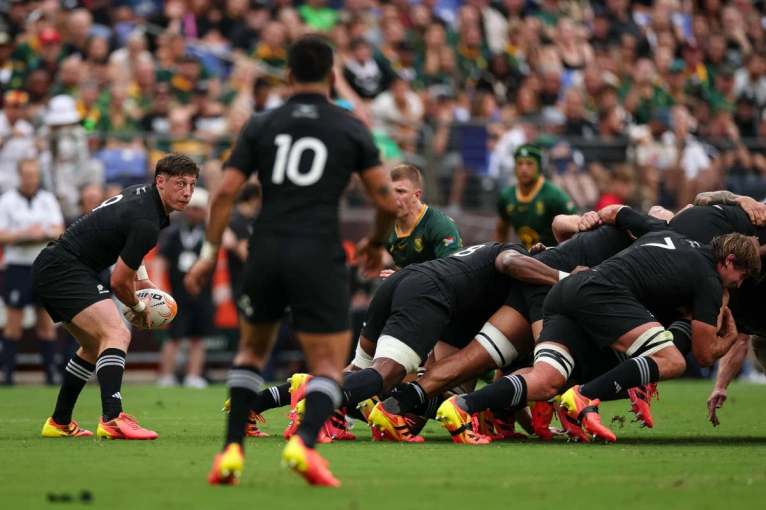
The total penalty count across the four Tests shows the All Blacks conceded 44 to the Springboks’ 36, but that number does not tell the full story of how ill-discipline hurt New Zealand.
Of those 44 penalties, too many were what coaches would call “soft” or “dumb” – needless acts that served no purpose. In the final Test in Baltimore, Tupou Vaa’i was penalised for holding Cameron Hanekom’s leg at a ruck and the backline was pinged in the first minute for being offside.
There were penalties in other Tests for cleaning out players past the ruck, for obstructing from kick-offs and talking back to the referee.
These acts of ill-discipline often came at critical times – when the All Blacks were building momentum and starting to put the Boks under pressure.
All three coaches have laboured the point to their players that discipline is critical, and yet behaviours are not changing. Is there then some deeper fault hindering the All Blacks?
It’s tempting to call them brain explosions, but really they were indicative of something deeper: an endemic fault in the New Zealand rugby system that does not deter poor discipline and maybe even encourages players to try their luck to see what they can get away with.
Ill-discipline, after all, was a feature during the Ian Foster era from 2020-2023, as it was during Scott Robertson’s two years in charge between 2024 and 2025, as it is now under Dave Rennie.
All three coaches have laboured the point to their players that discipline is critical, and yet behaviours are not changing. Is there then some deeper fault hindering the All Blacks?
“I wonder whether in Super Rugby it’s not always refereed strongly,” Rennie said, when asked whether there is an institutionalised problem around discipline.
“You come to internationals and you’ve got referees who are pretty tough in that area. But we’ve got to take accountability for that.
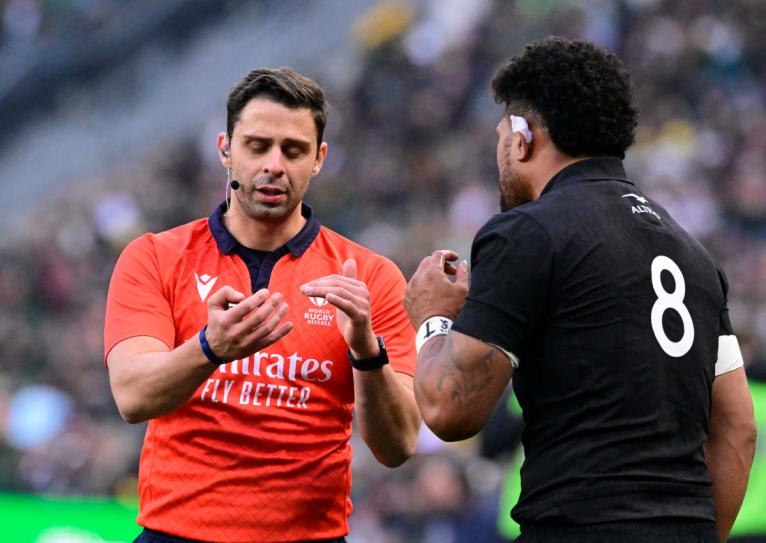
“At the start of a game, we’re offside at the first ruck. When you’ve got referees who, especially the English, are very technical, they’re going to try and set the game up and pick things like not rolling away and offside early. So, we’ve got to be smart around that.
“There’s no excuse. We’ve got to be better. We can’t give teams like South Africa soft entry through soft penalties.
“It’ll certainly be a focus for us and it has been. I think the penalty count was 10 tonight [Baltimore], which is not a big number. We’re not looking to be zero because we want to push the limits.”
The All Blacks only kicked one penalty at goal – and missed it – whereas South Africa kicked nine out of 10 – 27 points that they used to build pressure.
It wasn’t just ill-discipline, though, that derailed momentum for the All Blacks. In Baltimore, Richie Mo’unga missed a penalty for touch, there were lineout losses and scrum penalties – all of which meant New Zealand didn’t put South Africa under the same intensity of pressure.
They couldn’t build pressure to the point where they kept the scoreboard ticking over to the extent they probably could have, when other metrics such as line-breaks and defenders beaten are considered.
Also, the All Blacks only kicked one penalty at goal – and missed it – whereas South Africa kicked nine out of 10 – 27 points that they used to build pressure.
The one time in the series when the All Blacks stacked the big moments consecutively was in the final 25 minutes at Ellis Park, when they won an unexpected scrum penalty in their own 22 to relieve the pressure.
Then Quinn Tupaea executed a smart 50-22. A solid scrum enabled Ardie Savea to set up a try for Luke Jacobson and from there – having gone 26-16 up with 15 to go, they then played in the right areas of the field and let South Africa implode with two yellow cards that paved the way for two more tries.
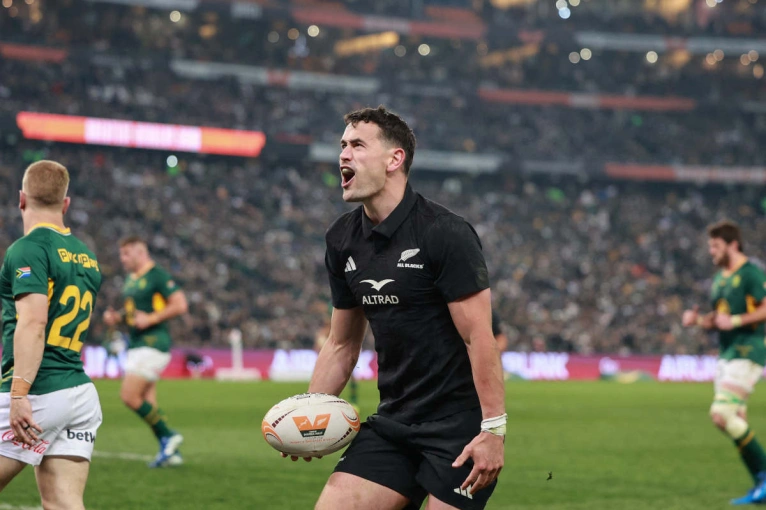
It was the perfect example of how to squeeze an opponent into submission – but for the remainder of the series, it was the Springboks who did that.
As Rennie summed up after the 43-28 defeat in Baltimore, a game that was genuinely in the balance with 10 minutes to go: “There’s a lot of good stuff. I think the boys showed a lot of courage defensively and a lot of scramble.
“I think on attack, when we’re patient and accurate, we scored 17 tries in the series. So, it tells you that when we get it right, we’re a handful. But we made too many errors tonight. They stripped a couple of balls out of our hands.
“But ultimately, that hurt us a bit because we just couldn’t apply pressure for long enough. It’s a little bit about a balance of our game. We’ve kicked reasonably well on this tour.
“We didn’t kick so well tonight. Just not contestable enough and we gave them too much space. They were pretty lethal.”
The big mystery of the last few years has been why New Zealand aren’t better at recovering the high ball, as this feels like it’s a skill-set that should be very much in their wheelhouse.
The hardcore analysts will say that this is all academic – that cleaning up the discipline, winning lineouts, kicking for touch and landing penalties wouldn’t make a critical difference when South Africa had such ascendancy at scrum, maul, the aerial battle and turnovers.
There’s no doubt the All Blacks have to improve in all four of those areas to be globally competitive at the highest level.
On the former two, the return of Tamaiti Williams will undoubtedly help as it will give the All Blacks another power scrummager and the depth at loosehead that they didn’t have in South Africa.
Not everyone will agree, but the return of Scott Barrett will be a major boost in both areas too as well as giving the All Blacks another ball carrier.
The big mystery of the last few years has been why New Zealand aren’t better at recovering the high ball, as this feels like it’s a skill-set that should be very much in their wheelhouse.
They hatched a plan to use the retreating wing to be the catcher and to try to group the bodies behind to mop up the scraps, but the Boks were either able to beat them in the air and win a clean catch or get between the retreating wing and awaiting full-back.
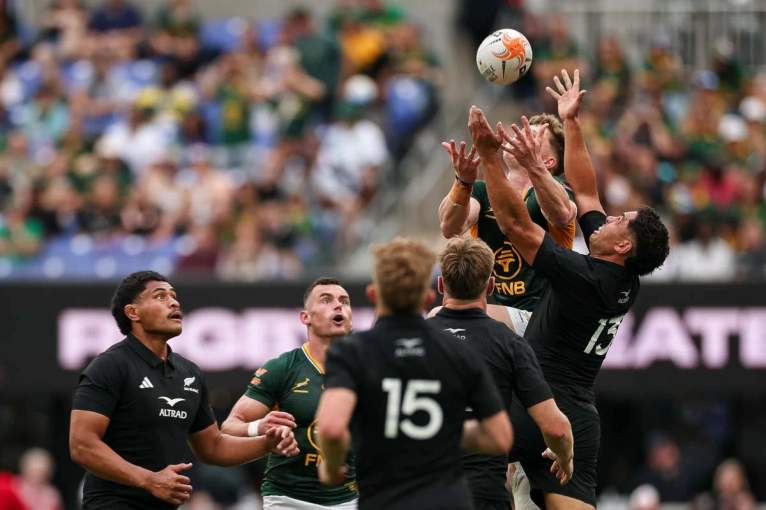
Arguably, coming out on the wrong side of the kick retrieval stats hurt the All Blacks more across the series than the scrummaging battle did. It enabled South Africa to hold the ball for long periods and advance up the field.
But still, while there is no doubt that the All Blacks were hurt by South Africa’s scrum, maul, kicking game and turnover work, they were hurt more by their own inability to build those pressure sequences.
“It is literally the difference between winning and losing,” said All Blacks No. 10 Mo’unga in Baltimore about the ability of the Springboks to stack the big moments.
“If you’re able to build momentum and build pressure and stack those moments, we’ve seen when it happens we get rewards, but [sometimes there’s] a soft penalty or we don’t get the bounce we want.”
As to the question of how to fix the problem, Mo’unga feels the answer will lie on both sides of the ball.
“I think there’ll be a real good conversation around ‘how can we build pressure?’,” he said. “I think we’ve seen what we can do with the ball, but it might be what can we do without the ball. What does our defence look like and how do we really suffocate them down in their own half?”
 Register your interest to receive priority updates on RWC27 ticket releases. Don't miss out, stay in the loop!


Doc Craven walked into a rugby theory class one morning and asked how long each of us thought we had the ball in our hands during play in a rugby game - after much deliberation it turned out that about 3 minutes was the top end of having the ball in your hands.
Richie hit the nail on the head right at the end of the piece above.
“I think we’ve seen what we can do with the ball, but it might be what can we do without the ball.”
What you do off the ball in a rugby game far outweighs what you do with the ball. You can be as good with the ball as you like for five minutes of the game if you are getting outplayed off the ball for the other seventy five minutes draw your own conclusions.