
Stat of the week: Between minute 32 and 70, the All Blacks spent just eight minutes with a full complement of players – yet they beat Scotland by eight points and never trailed.
A riveting weekend of Quilter Nations Series action left us with one big question: why don’t cards always matter?
South Africa won their red card period 19-3, and spent 10 of those minutes playing against a 14-man France. Wales conceded 10 points against Argentina when they were short-handed for 20 minutes, but conceded – on average – 14 points per 20 minutes across the other hour of the game.

Elsewhere, Joseph-Aukuso Suaalii’s yellow card led to a 14-point swing in five minutes for Australia as Italy seized the initiative.
What does this tell us about how teams react when they go a man down?
The average ball-in-play time per match is around the 35-minute mark. That means there is around four minutes and 20 seconds of ball-in-play time per 10-minute period. That is assuming that the sin-bin periods are like any other 10-minute period in the game, but of course they are not.
Cards definitely do matter. It is physically and mentally more demanding to play with a man down than to play with the same numbers.
The sin-binned side have an incentive to waste as much time as possible; walking to lineouts, kicking to goal rather than kicking to touch, resetting lineouts etc. The team with one extra player want to do the opposite and keep ball-in-play time as high as possible during this period. Whichever side has more possession in that period can dictate, to a certain degree, the shape of the game.
Cards also change the game plan for each side. Nowhere was that more clear than in Paris. South Africa lost Lood de Jager to a red just prior to half-time in a match France were a point ahead in. When they came out in the second half, France changed their game plan and began playing from one side of the pitch to the other to exhaust the remaining Springboks. That didn’t work and their only reward was three points to Thomas Ramos just before the hour mark. By the time the French were reduced to 14 after a deliberate knock-on from Louis Bielle-Biarrey after 62 minutes, the French were exhausted and South Africa won the remainder of the game 19-0.

The journey through the sin bins was similar for New Zealand. They spent more or less the same amount of time down to 14 players (30 minutes) but did it in three distinct chunks. The first one – to Leroy Carter – they came out 7-0 up. The last one, for Wallace Sititi, was a 0-0 tie. It was only the second yellow card, awarded to Ardie Savea for attempting to pull down the maul which brought Scotland’s first try, where they lost the subsequent 10 minutes 7-0.
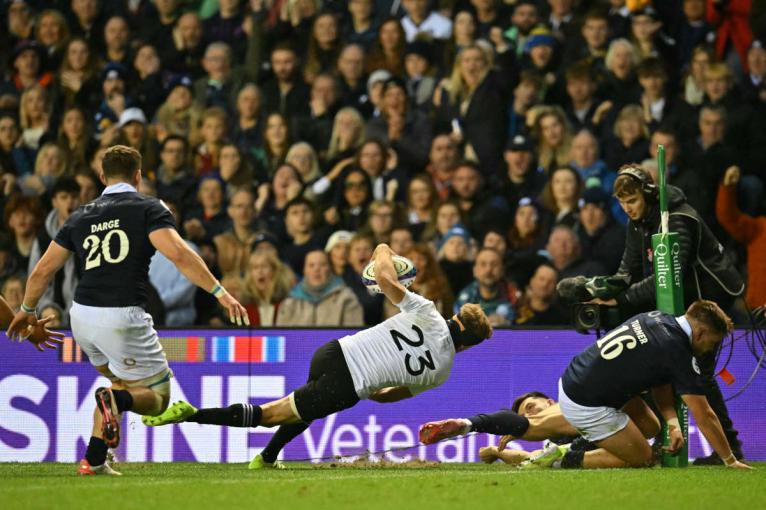
These cards changed the shape of the game. Scotland massively won the territory battle, with 81% of their possession coming in the All Blacks’ half, compared to only 55% of New Zealand’s in Scotland’s half. That gave the hosts a 22-entry advantage of 11 to six. But the All Blacks absorbed that pressure, forced Scottish mistakes, and with 10 minutes to go, they were back up to 15. What followed was a Kiwi masterpiece as Damian McKenzie put a seal on the game with a stunning finish against a tired, and no doubt disheartened, Scottish side.
All that leads us to the question of whether cards are that much of a punishment. They definitely do matter. It is physically and mentally more demanding to play with a man down than to play with the same numbers.
It is also likely that the impacts of sin-bin periods are felt at times other than when teams are down a man. An early sin-bin for example might lead to problems later when players suddenly find they have more metres in the legs than they expected or trained for. But, as New Zealand and South Africa found on the weekend, it can also cause opponents to over-play and lets the short-handed team feed off the scraps.
Wales turning a corner?
As a Welshman, it pains me to write this after Wales have conceded 52 points against Argentina in the first home match since conceding 68 against England. Things are clearly not good for Wales at the moment and Sunday’s match was filled with outrageous defensive mishaps which were baffling to watch. I have seen some comments suggesting these issues are easily fixed, though I am much less convinced by that.
However, we are in the mood for some optimism. Against Argentina, Wales made the same number of line breaks (seven) as they did in the previous two matches against Japan combined. They also surpassed Argentina’s points-per-entry into the 22 (4.6 against 3.7).

The attack being built under Matt Sherratt and Danny Wilson’s tutelage is rightly being praised. This is just the third time this year Wales have scored three or more tries and just the second time against tier-one opposition.
This is a good platform to build from, but caution is needed as well. Seven line-breaks is a step up, but Argentina made 14 and if Wales can’t improve their defence then they’ll need to out-score opponents. Their kicking game also looked to be a weakness and at times an attacking weapon for the South Americans. The likes of New Zealand and South Africa will have no issues with holding out their attack and letting them go to the air, knowing the chaos caused will favour them, not Wales.
Reasons to be cheerful? Some, but not a lot.
Will England’s end game trump the All Blacks’?
Over the last five matches, England have trailed for just 37 of the 400 minutes. They have won the last 20 minutes by a combined total of 54-12, including winning the last two final quarters 22-0. Against Australia they deployed a weaker starting pack and brought on their best set of available forwards to put the game to bed.
Meanwhile, New Zealand have won their last two final quarters 27-0, and their last four final quarters by a combined 45-12.
But England will be looking keenly at the All Blacks’ record 43-10 loss to the Springboks in Wellington two months ago. There they lost the second half 36-0 and the final quarter 26-0. One thing is for sure, in this weekend’s prime match-up, nothing is decided before the final 20 minutes.


I don’t want to beat a drum, but the true smarts here is player evolution: the hybrid. The Boks were never really in a 14-man position. Esterhuizen played centre, or flank, depending on the state of play. (Of course, to do this, it is vital that one can at least hold one’s own in the setpiece…) The rapid development of rugby thought & process under Rassie brings a whole new level of fascination & wonder to ‘Heaven’s Game’. Now Borthie is saying: take this! And we see England with their 5 feral flankers! (Ironically, the human equivalent of the African Hunting Dog - tireless & unceasing.) Love it!
What this tells you is that even when you are a man up you still have to stick to your gameplan and not get carried away. Its only then will you make the most of it
Great article, informative and statistical analysis, thanks!